A Requisition for Sanity
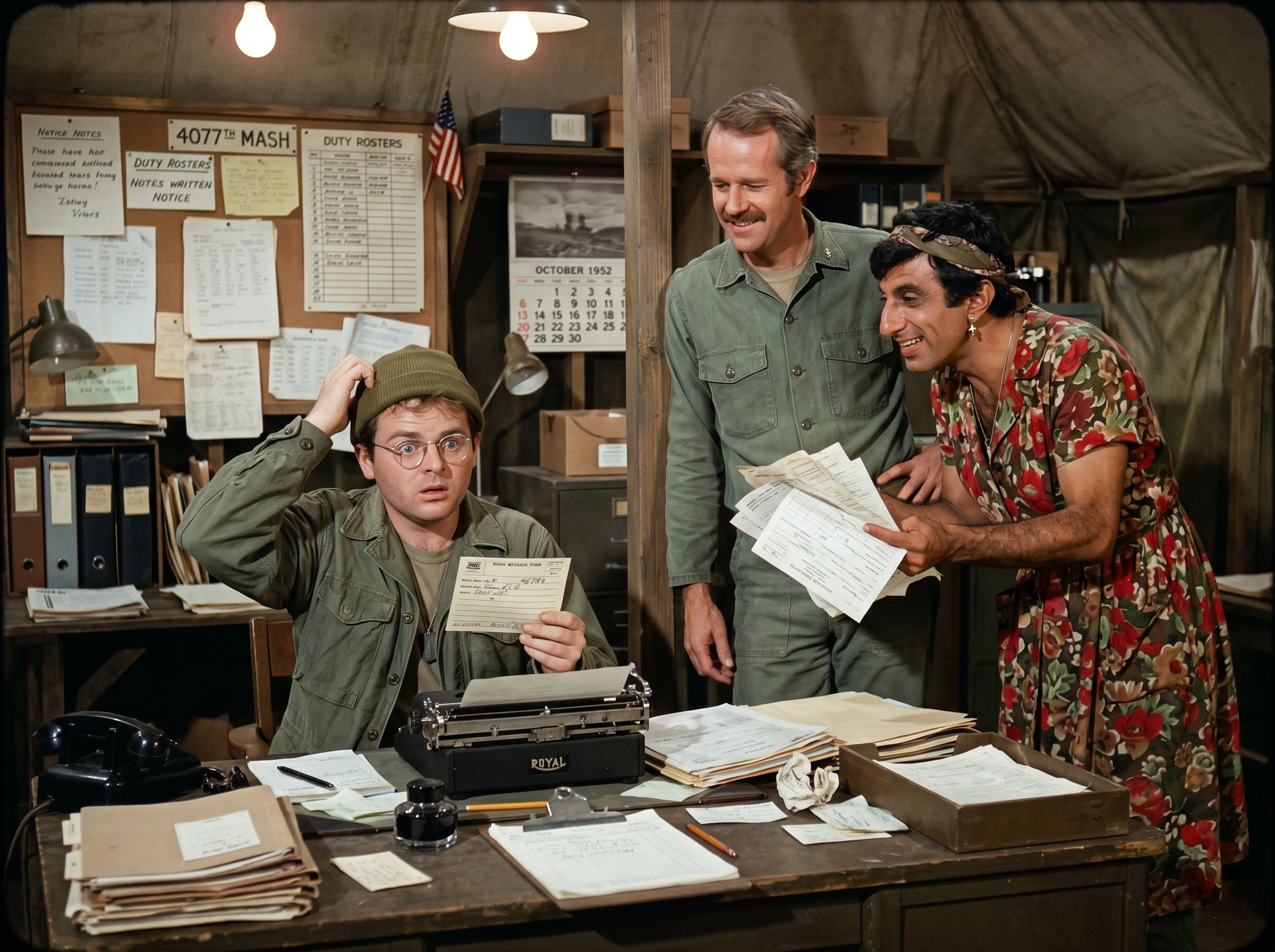
The afternoon sun baked the canvas roofs of the 4077th Mobile Army Surgical Hospital, casting long, tired shadows across the dusty compound. Inside the clerk’s office, the air was thick, heavy with the smell of mimeograph ink, stale coffee, and the endless, exhausting grind of military bureaucracy.
It was a quiet Tuesday, which in this particular corner of the Korean War, usually meant something terrible was about to happen.
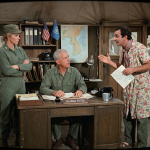
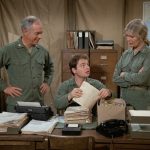
Corporal Walter “Radar” O’Reilly sat frozen behind his cluttered wooden desk. The modest clerk station was an organized disaster of olive drab filing cabinets, beige folders, and a bulletin board pinned with a hundred overlapping memos. Radar stared at a freshly torn strip of teletype paper as if it were a live hand grenade.
His round, youthful face was a portrait of wide-eyed, nervous confusion.
“I don’t understand,” Radar muttered to himself, nervously adjusting his wire-rimmed glasses. “This doesn’t make any sense at all. It’s from I Corps, but it’s stamped by the Department of Agricultural Procurement.”
Captain B.J. Hunnicutt, seeking a few minutes of refuge from the suffocating boredom of the Swamp, was leaning comfortably against the edge of Radar’s desk. His arms were crossed loosely over his chest, his posture the picture of relaxed, exhausted amusement.
“Don’t try to understand it, Radar,” B.J. said softly, a dry, affectionate smile pulling at the corner of his mouth. “Army logic is like a wet sponge. The harder you squeeze it, the less water you get, and eventually, you’re just left with something that smells vaguely like a swamp.”
Before Radar could attempt to untangle the Captain’s gentle, tired metaphor, the office door swung open.
Corporal Maxwell Klinger practically glided into the room. He leaned over the desk enthusiastically, clutching a thick stack of slightly crumpled requisition forms to his chest. His posture was expressive and highly theatrical, his dark eyes shining with a sly, desperate hope.
“Did somebody say ‘Department of Agricultural Procurement’?” Klinger asked, his voice dripping with sudden anticipation. “Because if they are looking for someone to procure agriculture in Toledo, Ohio, I am your man. I once grew a tomato on a fire escape that was so beautiful, my uncle tried to marry it.”
Radar looked from the paper to Klinger, then up to B.J., his panic rising visibly.
“Klinger, it’s not about tomatoes,” Radar squeaked, his voice cracking. “It’s a direct order. They want to transfer a ‘Corporal M. Klinger’ immediately to a specialized supply depot.”
Klinger gasped, clutching the forms tighter against his worn utility shirt. “I’m going home? To the land of hot dogs, neon signs, and decent indoor plumbing?”
B.J. uncrossed his arms, his amused expression fading into mild, protective curiosity. “Let me see that, Walter,” B.J. said, reaching his hand out for the teletype message.
Radar pulled the paper back slightly, his knuckles turning white as he gripped the edges.
“That’s the problem, Captain,” Radar said, swallowing hard, his eyes darting frantically around the room. “They don’t want to send him to Toledo. They want to send him to an experimental military farm in the Aleutian Islands. And if I don’t reply with a confirmation code in ten minutes, command is sending a jeep to pick him up.”
The words “Aleutian Islands” hung in the small, dusty office like a heavy, frozen weight.
Klinger froze in place. The theatrical joy instantly vanished from his face, replaced by a look of sheer, unadulterated horror.
“The Aleutians?” Klinger whispered, the requisition forms trembling in his hands. “But… there’s no baseball in the Aleutians. There’s no Tony Packo’s. There’s just ice, wind, and walruses. I’m a creature of the city, Captain! I don’t even like snow cones!”
B.J. gently plucked the teletype message from Radar’s rigid, nervous fingers. He scanned the typewritten lines carefully, his brow furrowing as he translated the dense, nonsensical military jargon.
“He’s right, Klinger,” B.J. said, his voice quiet and steady. “Command apparently thinks you’re an expert in cold-weather root vegetables. Someone down at I Corps must have mixed up your personnel file with a guy named Klinger from Minnesota.”
Radar was practically vibrating in his wooden chair, his eyes fixed on the clock ticking relentlessly on the wall.
“Captain, what do we do?” the young clerk asked, his voice thick with genuine worry. “If I don’t send a rejection code, they’ll dispatch the transport. He’ll be freezing his nose off by Thursday!”
Klinger slumped heavily against the filing cabinet. The fight seemed to completely drain out of him, leaving only the bone-deep exhaustion of a man who had been disappointed by the world one too many times.
For all his wild schemes, for all his desperate, elaborate attempts to escape the madness of the 4077th, he had never imagined a fate worse than the one he was already living. At least here, he was warm. At least here, in this ridiculous, blood-soaked camp, he had people who actually knew his name, knew his quirks, and cared if he woke up the next morning.
“Just do it, Radar,” Klinger said softly, his voice devoid of its usual bombast. He stared blankly at the dirt floor. “Send me to the glaciers. Maybe the polar bears will appreciate a decent cup of coffee.”
B.J. looked at the devastated Corporal, his heart aching just a fraction beneath his calm, pragmatic exterior.
This was the quiet cruelty of the war. It didn’t just take lives in the operating room; it played agonizing, careless games with a man’s hope on pieces of cheap paper. It treated human beings like misplaced inventory.
“Hold on a second, Klinger,” B.J. said gently, stepping closer to the desk. “Nobody is sending you to herd walruses.”
B.J. turned back to Radar, who was already hovering his hands anxiously over the keys of his beloved Underwood typewriter.
“Radar, let me ask you something,” B.J. said, tapping a finger against the teletype paper. “What happens if an order comes in for a soldier who technically doesn’t exist?”
Radar blinked, his forehead wrinkling as he searched his encyclopedic knowledge of military regulations. “Well, sir, we file a Form 112-B for ‘Personnel Misidentification.’ It bounces back to General Headquarters in Tokyo and gets lost in the basement filing cabinets for about six to eight months.”
B.J. smiled. It was that warm, grounded, reassuring smile that made him the quiet anchor of the entire camp.
“And does our Maxwell Klinger have a middle initial ‘M’ on his official enlistment papers?” B.J. asked.
Klinger looked up from the floor, a tiny, fragile spark returning to his dark eyes. “No, sir. No middle name. My mother said we couldn’t afford the extra letters on the birth certificate.”
Radar’s face lit up with a sudden, brilliant realization. All the anxiety melted away, replaced by the sharp, capable efficiency of the best company clerk in Korea.
“So,” Radar said, his fingers flying to the heavy typewriter keys, “I just send a message back saying that Corporal M. Klinger does not reside at this unit. And by the time the brass figures out it’s just plain Corporal Klinger, the experimental farm will be fully staffed by some poor guy from Duluth!”
“Exactly,” B.J. said, leaning comfortably back against the desk and crossing his arms once more.
The frantic, rhythmic clacking of the typewriter filled the small office. To the three men in the room, it was a beautiful, musical sound. It was the sound of paperwork being weaponized for good.
Within moments, Radar ripped the paper from the machine and fed it into the teletype. They all stood in comfortable silence, watching the machine chatter away, sending their little administrative lie out into the vast, unfeeling machine of the United States Army.
Klinger let out a long, shuddering breath of relief. He looked down at the crumpled requisition forms in his hands, then tossed them casually onto Radar’s overflowing desk.
“You know, Captain,” Klinger said, a faint, genuine smile touching his lips. “I think I prefer the mud and the blood right here anyway. At least I know which way the wind blows.”
B.J. reached out and gave Klinger’s shoulder a firm, companionable squeeze.
“We prefer you in the mud too, Klinger,” B.J. said softly. “The place just wouldn’t be the same without you.”
Radar looked up from his desk, adjusting his glasses once more. The panic of the afternoon was completely gone, replaced by the quiet, exhausting relief that came after dodging another invisible bullet.
Outside the thin walls of the office, the roar of a distant chopper broke the temporary quiet. The war was still out there, waiting for them. The stretchers would come again. The endless fatigue would return.
But for today, in this small, dusty office, they had won a tiny, vital victory. They had saved one of their own, not with scalpels or sutures or medicine, but with a typewriter and a missing middle initial.
Klinger adjusted his cap, his theatrical posture returning in full force. He gave B.J. and Radar a sharp, deeply respectful salute. Then, he turned and marched out the wooden door, stepping back into the endless, weary routine of the 4077th with his head held high.
B.J. picked up his coffee mug from the desk, taking a slow, contemplative sip. He looked down at Radar, who was already reaching for the next stack of dreary, olive-drab paperwork.
“Good work, Walter,” B.J. murmured gently.
Radar smiled shyly, keeping his eyes firmly fixed on his desk. “Just doing my job, sir.”
They couldn’t stop the war, but in the quiet corners of the camp, they could always save each other.