The Red Tape and the Comic Book Box
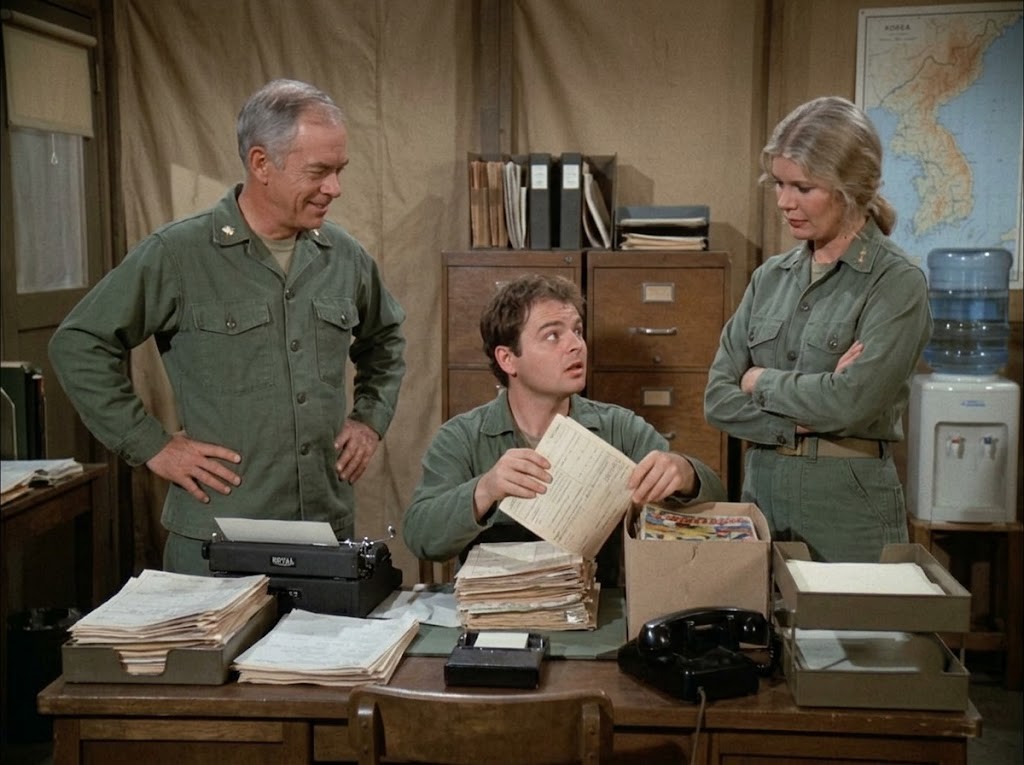
Some days, the war in Korea didn’t feel like a matter of life and death. It felt like an endless avalanche of carbon paper, triplicates, and forms that made absolutely no sense to a sane human mind.
In the middle of that paper blizzard sat Corporal Radar O’Reilly, the unlikely anchor of the 4077th.
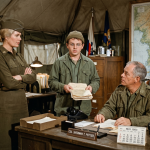
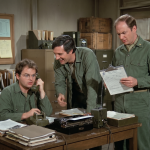
It was late afternoon, and the swampy heat of the Korean summer was settling into the canvas walls of the administrative tent. Radar sat behind his cluttered wooden desk, surrounded by towers of files, his faithful Royal typewriter, and a heavy black telephone that always seemed to ring at the worst possible moment.
But right now, Radar wasn’t looking at supply requisitions or medical discharges. He was staring down at a crumpled piece of paper in his hands, his eyes wide with a mixture of panic and deep, agonizing guilt.
Standing over him like two sentinels of military authority were Colonel Sherman Potter and Major Margaret Houlihan.
Colonel Potter stood to Radar’s right, his hands planted firmly on his hips. A faint, knowing smirk tugged at the corner of the old cavalryman’s mouth, though his eyes remained sharp and inquisitive.
To Radar’s left stood Margaret, her arms tightly crossed over her olive-drab fatigue shirt. Her expression was a formidable mix of stern professionalism and quiet, exhausted curiosity.
Between them on the desk sat a cardboard box overflowing with old, colorful comic books—a rare treasure in the middle of a combat zone, and a notorious distraction for the company clerk.
“Alright, Radar, let’s have it,” Colonel Potter said, his voice dropping into that low, fatherly rumble he used when he was trying to get to the bottom of a camp mystery. “You’ve been sweating through your shirt for three hours, and it isn’t just the humidity.”
Radar swallowed hard, his neck stiffening as he looked up from the document. He shifted uncomfortably in his wooden chair, his gaze darting between the Colonel’s steady smirk and Margaret’s unyielding stare.
“Well, sir… it’s a bit of a logistical knot,” Radar stammered, his voice cracking slightly as he gripped the edges of the form. “You see, it’s Form 104-B. The one regarding personal property allotments and… and morale distribution.”
Margaret leaned forward slightly, her brow furrowing. “Corporal, that box has been sitting on your desk since the morning supply truck arrived, and you’ve treated it like a unexploded mortar shell. What exactly is in that paperwork?”
Radar looked down at the paper again, his thumb nervously smoothing out a crease in the corner. He knew he couldn’t hide it anymore, but the truth was bound to set off a chain reaction that the fragile peace of the afternoon couldn’t survive.
“It’s about the comic books, Major,” Radar whispered, looking up with wide, pleading eyes that could soften a stone. “And it’s about Captain Pierce and Captain Hunnicutt.”
Colonel Potter’s smirk vanished, replaced by the weary look of a man who had spent too many years dealing with the antics of brilliant but exhausting surgeons. He sighed, taking a step closer to the desk. “What did Pierce and B.J. do now, Radar? Did they requisition a tank to haul those funny books into camp?”
“Worse, sir,” Radar squeaked, holding the paper out as if it were a signed confession. “They didn’t requisition them at all. They traded something for them. Something very important to the entire camp.”
—
Margaret’s arms uncrossed instantly, her posture tightening into absolute military rigidness. “What did they trade, Corporal? If those two have bartered away medical supplies for cheap illustrations, I will personally see them court-martialed!”
“No, ma’am! Not medical supplies!” Radar said quickly, waving his hands to defuse the brewing storm. “Nothing like that. They wouldn’t ever touch the penicillin or the plasma. They know better than that.”
Colonel Potter leaned over the desk, tapping a finger on the stack of files. “Then spit it out, son. Before Major Houlihan blows a gasket and I have to fill out a report on spontaneous combustion.”
Radar took a deep breath, looking at the cardboard box full of brightly colored covers. “They traded the camp’s entire monthly allocation of premium ice cream syrup, sir. The chocolate stuff. The stuff we were supposed to get for the fourth of July celebration.”
The office went completely silent for a three-second count. The only sound was the distant hum of a generator outside and the gentle clinking of the water cooler in the corner of the tent.
Margaret blinked, her fiery anger momentarily derailed by the sheer absurdity of the revelation. “Chocolate syrup? They traded the camp’s dessert for a box of Captain Marvel and Superman?”
“It was a three-way trade, Major,” Radar explained, his voice gaining a bit of confidence as he fell back on his true talent—understanding the black-market logistics of the U.S. Army. “They traded the chocolate syrup to a supply sergeant in the 8063rd, who traded a case of steak knives to a Navy lieutenant, who finally shipped this box of vintage comics up from a warehouse in Incheon.”
Colonel Potter shook his head, a mixture of exasperation and reluctant admiration washing over his weathered face. “Grounded in genius, executed by idiots. Why on earth would Hawkeye and B.J. go through that much trouble for a box of children’s stories?”
Radar didn’t answer right away. Instead, he reached into the cardboard box and pulled out one of the comics. The cover was worn, the edges frayed from years of being read and reread by kids back in the States.
“They didn’t get them for themselves, Colonel,” Radar said softly, his voice losing its nervous edge. He turned the comic book over, revealing a small, hand-written note taped to the back cover.
Margaret stepped closer, her stern expression softening as she read the messy, unmistakable handwriting of Hawkeye Pierce.
*For the kids at the San Don Orphanage. A little color for a grey world. Keep reading, kids. – Hawk & B.J.*
The silence returned to the tent, but the tension had completely evaporated. The heat seemed a little less oppressive, the stacks of red tape a little less daunting.
Margaret looked away, her eyes suddenly tracking the map of Korea on the wall, her lips pressed into a tight line to conceal the sudden wave of emotion. “Those absolute fools,” she murmured, though her voice lacked any real bite. “They could have just asked for a collection.”
“You know how they are, Margaret,” Colonel Potter said quietly, his fatherly warmth returning in full force. “They’d rather commit a minor felony for a good cause than do something the easy way. Keeps their blades sharp.”
Potter looked down at Radar, who was still holding the comic book like a shield. The old man reached out and tapped the paper Radar had been agonizing over.
“What’s this form say, Radar? Officially?” Potter asked.
Radar looked down, a small, grateful smile forming on his face. “Officially, sir, it’s an administrative discrepancy. The supply truck driver marked the chocolate syrup as ‘spoiled in transit due to improper refrigeration.’ He… well, Hawkeye gave him a pair of wool socks to write that down.”
Colonel Potter picked up his pen from the desk, scribbled his signature across the bottom of the form without reading another word, and tossed it into the completed tray.
“Case closed,” Potter declared, adjusting his cap. “The chocolate syrup was bad. A tragedy, really. We’ll just have to survive on vanilla.”
Margaret crossed her arms again, but this time, a gentle, genuine smile lit up her face. “I suppose I can inspect the orphanage tomorrow, Colonel. To ensure these… ‘discrepancies’ are properly distributed to the children.”
“Good idea, Major,” Potter nodded. “Take the Corporal with you. He looks like he needs to get out of this office before he turns into a piece of carbon paper himself.”
Radar beamed, his chest swelling with that quiet pride that came from being part of the strange, beautiful, dysfunctional family of the 4077th. He packed the comic book carefully back into the box, ready for tomorrow’s journey.
Outside, the laughter of Hawkeye and B.J. echoed from the direction of the Swamp, drifting through the camp like a reminder that even in the darkest corners of the world, humanity always found a way to survive.
—
Behind the endless red tape of the 4077th, it was always the heart, not the regulations, that kept the wheels turning.