A Taste of Home in the Mess Tent
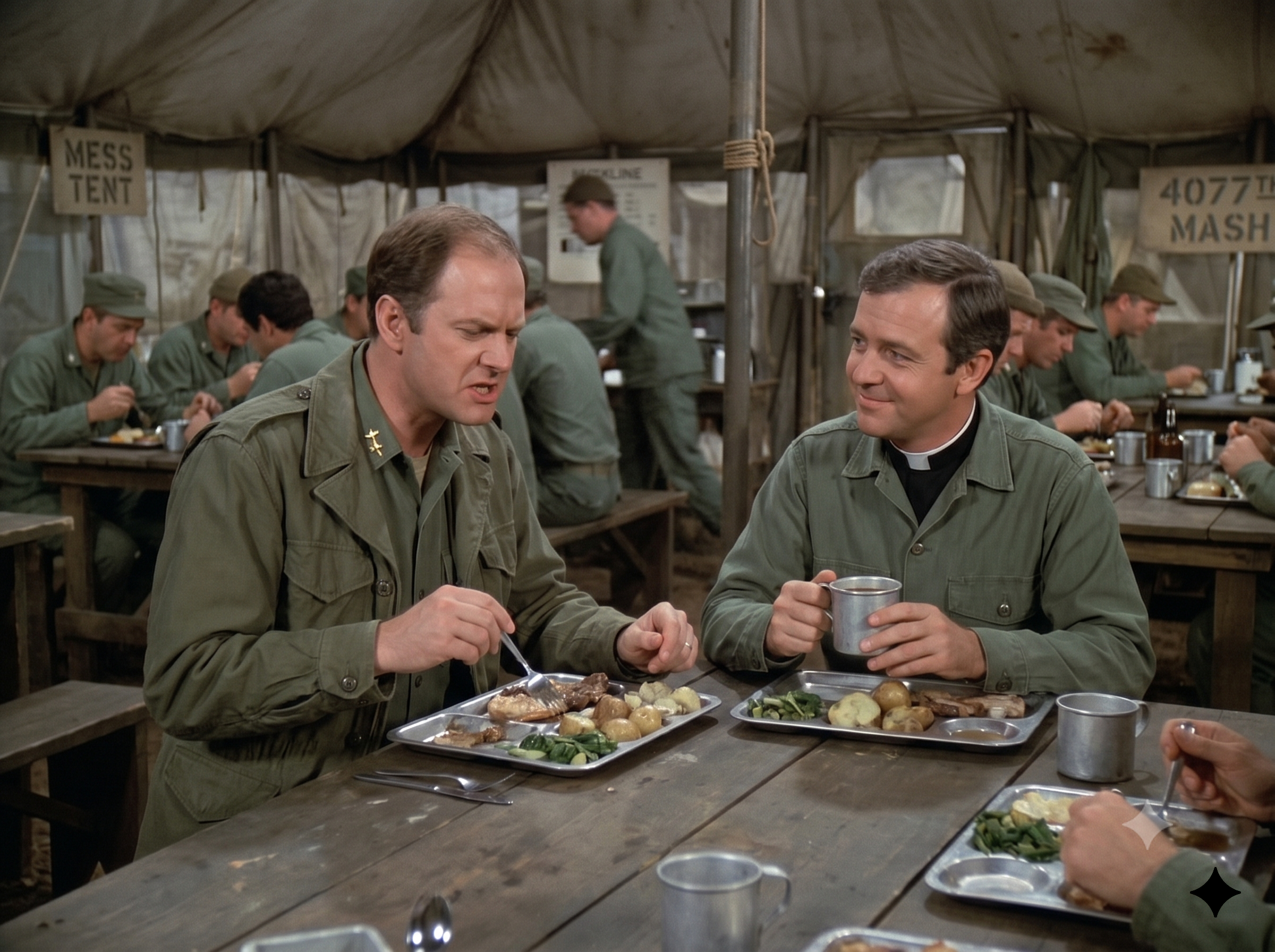
The mess tent of the 4077th Mobile Army Surgical Hospital was a place where culinary miracles were aggressively forbidden. It was a canvas-walled purgatory where sheer exhaustion met inevitable indigestion three times a day.
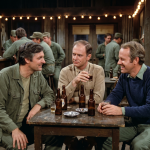
On a dreary, overcast afternoon, the air inside was thick with the smell of damp wool and boiled coffee. The dull roar of tired voices filled the space. Dozens of men and women in faded olive drab huddled over long wooden tables, eating without tasting, desperate for calories before the choppers returned.
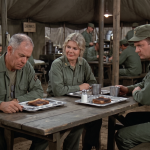
Major Charles Emerson Winchester III sat stiffly on a wooden bench, looking as though he had been asked to dine in an open sewer.
His posture was impeccably upright. It was a stark, almost defiant contrast to the slumped, defeated shoulders of the medics eating behind him. He stared down at his aluminum tray with an expression of profound, restrained horror.
Sitting directly across from him was Father Francis Mulcahy.
The chaplain held a battered tin mug of lukewarm coffee between his hands, seeking whatever meager warmth the metal could provide. A soft, mildly confused, yet undeniably fond smile played across his face as he watched the brilliant surgeon wage a silent, desperate war against his lunch.
Charles held his fork suspended in mid-air. He prodded a suspicious, gelatinous yellow-brown mound on his tray. It jiggled ominously.
“Father,” Charles began, his voice a tight, low purr of absolute disdain. “I am a man of science. I have studied the human body, the biological flora of the earth, and the chemical composition of the universe.”
He poked the mound again. It seemed to stubbornly push back against the tines of his fork.
“And yet,” Charles continued, his eyes narrowing in disgust, “I cannot, for the life of me, identify whatever this tragic, coagulated insult to gastronomy is supposed to be.”
Father Mulcahy leaned forward slightly, peering at the tray. “I believe Corporal Judson called it ‘Creamed Surprise,’ Major.”
“The only surprise, Father, will be if I survive the afternoon without requiring emergency gastric intervention,” Charles muttered.
His grip tightened on the thin metal fork. The knuckles of his hand turned white.
They had just come off a brutal, relentless eighteen-hour shift in the OR. The casualties had poured in without mercy. Charles’s hands, usually steady and impossibly precise, carried a slight, invisible tremor of sheer, bone-deep fatigue.
Suddenly, the terrible food was no longer just a bad meal. To Charles, it was a personal attack.
It was the mud, the blood, the noise, and the sheer indignity of this war concentrated into a single, beige lump on a metal tray. The polite restraint of his Boston upbringing was beginning to fracture under the crushing weight of Korea.
Charles’s face began to flush a deep red. His jaw set hard.
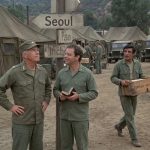
He raised his fork higher, his eyes flashing with a sudden, terrifying fury. The surrounding chatter seemed to fade as he drew in a sharp breath, his posture rigid, preparing to unleash a devastating, thunderous tirade that would undoubtedly echo all the way to Seoul.
“You know, Charles,” Father Mulcahy said quietly.
The gentle voice sliced through the building tension with the calm precision of a scalpel. Charles froze, his impending tirade caught squarely in his throat.
He looked up, expecting to see a reprimand. Instead, he found the chaplain looking at him with eyes full of quiet, unwavering understanding. There was no judgment in Mulcahy’s soft smile, only a deep, weary empathy.
“I read an article once in a medical journal,” Father Mulcahy continued, his tone conversational and light. “It suggested that the human body requires a certain amount of adversity to build true resilience.”
Charles lowered his fork a fraction of an inch. “Father, I am attempting to eat lunch, not participate in a forced evolutionary stress test.”
Mulcahy chuckled, a warm, genuine sound that briefly cut through the heavy gloom of the tent.
“I grant you, the mess tent takes the concept of adversity a bit far,” Mulcahy said softly. “But I find it helps to think of it not as food, but as a test of spirit.”
The anger that had been boiling inside Charles began to simmer down. It was quickly replaced by the heavy, crushing weight of his own exhaustion. He let the fork clatter loudly onto the metal tray.
He slumped forward, just an inch, losing the rigid posture of the Boston Brahmin. For a brief, unguarded second, he looked entirely defeated.
“It is just… so deeply uncivilized,” Charles whispered, his voice cracking slightly.
He wasn’t talking about the food anymore. They both knew it.
He was talking about the young boy from Iowa who had slipped away on his table three hours ago. He was talking about the smell of ether that never seemed to wash out of his skin. He was talking about the endless, agonizing miles between this muddy camp and the music halls of Massachusetts.
Father Mulcahy understood perfectly. He had spent his morning holding the hands of the wounded, offering prayers to boys who were too young to be so far from home.
He carried his own heavy burdens, safely hidden beneath his white collar and his gentle smile.
Mulcahy carefully set his tin mug down on the wooden table. He reached into the deep pocket of his worn, olive drab fatigue shirt.
“I completely agree, Major,” Mulcahy said softly. “The conditions here are often an affront to everything we hold dear.”
From his pocket, the chaplain produced a small, slightly crumpled packet. It was wrapped neatly in plain wax paper. He slid it across the rough wood of the table until it rested right next to Charles’s metal tray.
Charles looked at the small packet, then up at the priest. “What is this?”
“A care package arrived yesterday from my sister,” Mulcahy said, his eyes twinkling with a hint of quiet joy. “She enclosed a small tin of genuine, imported English Earl Grey tea leaves. I have managed to secure a canteen of hot water that doesn’t entirely taste like iodine.”
Charles stared at the wax paper. To a man like him, in a place like this, it was a treasure beyond measure.
It was a sliver of civilization. It was a lifeline.
“I cannot accept this, Father,” Charles said softly, his voice thick with uncharacteristic emotion. “It is far too precious. You should save it for yourself.”
“Nonsense,” Mulcahy replied brightly, leaning back in his chair. “Tea is a communal sacrament, Charles. It is meant to be shared. Especially after the kind of morning we have had.”
A profound silence settled between the two men. It isolated them in their own private bubble amidst the clanking trays and tired voices of the surrounding mess tent.
The aristocratic surgeon and the humble priest. Two men from entirely different worlds, united by the shared trauma of a mobile hospital and the quiet, desperate need for a moment of grace.
Charles slowly reached out and picked up the small packet. He held it carefully, as if it were spun from fragile glass.
He took a deep breath. The scent of boiled canvas was still there, but in his mind, he could already smell the bergamot.
“Thank you, Francis,” Charles said. It was barely a whisper, but it carried the weight of a thousand words of gratitude.
Mulcahy simply nodded, picking up his tin cup of terrible coffee once more.
“You’re very welcome, Charles,” Mulcahy smiled. “Now, I suggest you attempt to eat at least a little of the Creamed Surprise. You need your strength. The helicopters will be back before sundown.”
Charles looked back down at his tray. The food was still hideous. It was still an absolute insult to his refined palate.
But the anger was gone.
With a resigned sigh, Charles picked up his fork. He squared his shoulders, instantly reclaiming his dignified posture.
“Very well,” Charles declared, his dry wit returning. “But I wish it to go on formal record that I am eating this under extreme protest. And if I perish from internal revolt, I expect you to deliver a highly complimentary eulogy.”
“I shall be sure to mention your bravery in the face of insurmountable culinary odds,” Mulcahy replied.
Charles scooped up a small amount of the yellow mound. He closed his eyes, took a deep breath, and placed it in his mouth.
He chewed. His face immediately contorted into a brief expression of intense, profound regret.
Across the table, Father Mulcahy took a sip of his bitter coffee, his presence a quiet, steadying anchor in the storm.
Outside, the wind howled across the Korean mountains. The war was waiting. The wounded would return soon.
But in this small, quiet moment, across a battered wooden table, humanity had won out over the madness. They were exhausted, they were far from home, and the food was awful.
But they were not alone.
In a place where tomorrow is never promised, sometimes salvation comes in the form of a bad meal shared with a good friend.