The Quiet Spaces Between the War
The hardest part of the war was never the noise. The noise made sense. The roar of the choppers, the shouting in the compound, the clatter of metal instruments hitting steel trays in the OR—all of it was a language the 4077th had learned to speak fluently. It was the quiet that always threatened to break them.
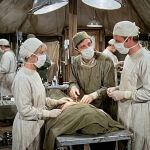
When the blood stopped flowing and the helicopters finally went back to wherever they came from, the silence of the Post-Op ward settled over the camp like a heavy, damp woolen blanket. It was in this quiet that the adrenaline finally faded, leaving behind nothing but an exhausted, hollow ache.
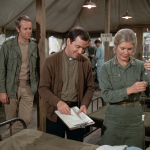
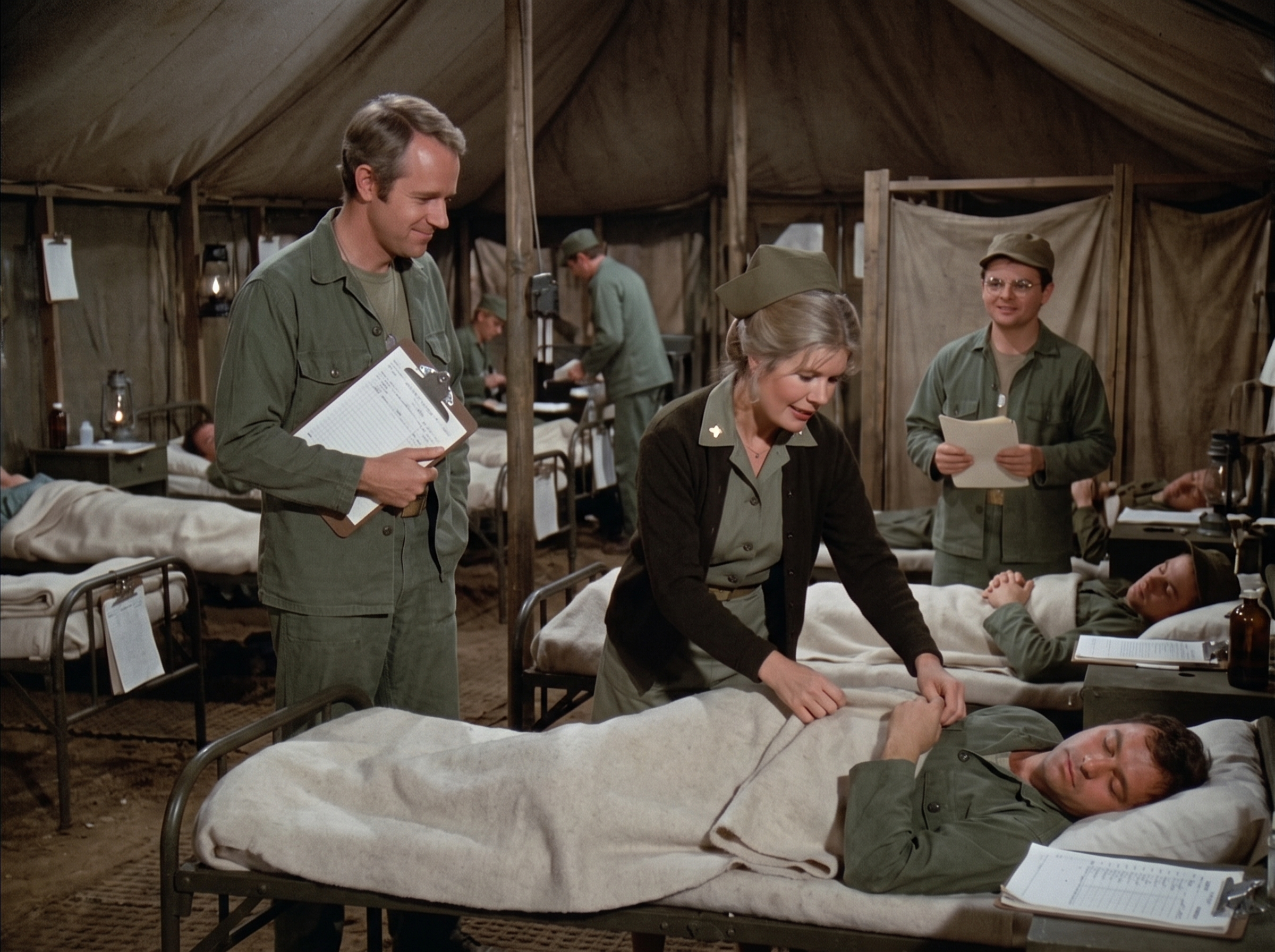
Captain B.J. Hunnicutt stood near the center aisle of the canvas tent, a medical clipboard resting loosely in his left hand. His green fatigue shirt felt like it was made of lead. He had been on his feet for twenty-two hours straight. His eyes burned with the specific, gritty fatigue that came from staring into open wounds under harsh, unblinking surgical lights.
He had come into Post-Op to update the charts, a mundane task that usually required more concentration than he had left to give. But right now, the pen was still. He wasn’t writing. He was just watching.
A few feet away, Major Margaret Houlihan was moving between the cots. She wore her dark green cardigan buttoned neatly over her uniform, a familiar armor against the persistent, creeping chill of the Korean afternoon.
To the rest of the army, and often to the camp at large, she was “Regular Army.” She was the strict, unyielding Head Nurse who demanded perfectly squared corners, polished brass, and absolute discipline. She could dress down a colonel without blinking and could strike fear into the heart of any enlisted man who dared to slack off on her watch.
But not here. Not in Post-Op.
B.J. watched as Margaret stopped beside the cot of a young private. The boy couldn’t have been more than nineteen, his face pale and slack against the flat white pillow.
Margaret didn’t just check his pulse. She didn’t just mark a chart and move on. She leaned over him, her movements slow, deliberate, and deeply human.
She reached out and took the rough edge of the grey military blanket, pulling it up gently to cover the boy’s shoulders. Her hands, which only hours ago were snapping instruments into doctors’ palms with military precision, were now performing an act of pure, maternal grace.
B.J. smiled. It was a small, quiet smile, barely lifting the corners of his mustache. It was the kind of smile born of deep, unspoken respect. He knew the secret Margaret tried so hard to hide beneath her brass and bravado: she cared. She cared so much that it probably hurt her to breathe sometimes.
From the corner of the tent, near a canvas partition separating the supply crates, another pair of eyes was watching.
Corporal Walter “Radar” O’Reilly had slipped into the tent to deliver a stack of fresh supply requisitions. He stood frozen in the shadows, his olive-drab cap pulled down slightly over his forehead, clutching the paperwork to his chest.
Radar wasn’t a doctor. He wasn’t a nurse. But he saw everything. He saw the way the doctors’ hands shook when they thought no one was looking. He saw the way Father Mulcahy prayed silently in the mess hall. And right now, he saw Major Houlihan being gentle.
Through the thick, round lenses of his glasses, Radar’s eyes were wide with a kind of innocent, reverent pride. To him, the people in this camp were heroes. Not the kind in comic books, but real ones. Tired, cranky, flawed heroes who somehow managed to put broken people back together.
Suddenly, the quiet of the ward was broken.
The young soldier in the cot violently jerked his head to the side. A sharp, terrified gasp tore from his throat. His eyes snapped open, unseeing and wild with the lingering horror of the front line. He thrashed weakly against the mattress, his good arm flailing in the air as if trying to push away an invisible enemy.
Margaret didn’t flinch. She didn’t call for a corpsman to restrain him. The mask of the strict Major shattered completely, leaving behind only the raw, exposed heart of a healer as the boy blindly grabbed her wrist, his grip desperate and trembling.
“Hey, hey there,” Margaret whispered. Her voice was entirely devoid of its usual sharp edge. It was soft, melodic, and incredibly steady.
She didn’t try to pull her arm away from the terrified soldier’s grip. Instead, she brought her other hand up and laid it gently over his knuckles. She leaned down closer, bringing her face into his line of sight, forcing him to focus on her rather than the ghosts haunting his waking mind.
“You’re safe,” she murmured, her tone carrying the rhythm of a lullaby. “You’re at the 4077th. The fighting is over for you, soldier. You’re safe.”
The boy’s chest heaved. He blinked rapidly, the harsh fluorescent lighting of his nightmares giving way to the muted pale greens and warm shadows of the recovery tent. He looked up at Margaret.
For a long second, he didn’t see an officer. He just saw a woman looking at him with profound, unconditional kindness.
“Am I…” the boy croaked, his voice cracking dryly. “Am I going home?”
Margaret’s face softened even further. A quiet sadness flickered in her eyes, mixed with a fierce, protective relief. She smoothed a damp lock of hair away from his forehead.
“Yes,” she promised him softly. “You’re going home. We’re going to make sure of it. Now, you need to rest. Let the medicine do its work.”
The fight drained out of the young private all at once. His heavy eyelids fluttered shut. His grip on Margaret’s wrist loosened, his hand falling back against the crisp white sheets. His breathing slowed, evening out into the deep, restorative rhythm of true sleep.
Margaret stayed bent over him for a long moment. She carefully tucked his arm back under the wool blanket, smoothing the fabric down with an incredibly tender touch. She lingered there, just watching his chest rise and fall, making absolutely sure the terror had passed.
When she finally stood up, she took a deep, shaky breath. She raised her chin, her shoulders squaring instinctively as she prepared to rebuild the invisible wall she kept between herself and the rest of the world.
She turned around and immediately locked eyes with B.J.
Margaret froze. A flash of defensiveness crossed her features. She expected a joke. She expected a wisecrack about her getting soft, or a sarcastic comment about the “Iron Maiden” showing a heart. She stiffened, her hand moving to adjust the collar of her cardigan in a nervous, defensive gesture.
But B.J. didn’t say a word about it. He didn’t make a joke.
He just stood there in his wrinkled fatigues, leaning slightly on his clipboard. The gentle, knowing smile never left his face. His eyes, usually dancing with mischief, were warm and completely sincere. He looked at her not as a fellow officer, but as a friend who understood exactly what it cost to care that much.
He tapped his pen against his clipboard, giving her a slow, respectful nod.
“Vitals look good from over here, Major,” B.J. said quietly. His voice was a low, comforting rumble in the quiet tent. “Looks like he’s in excellent hands.”
Margaret’s defensive posture melted away. She stared at him, realizing in that unspoken exchange that her secret was safe. B.J. wasn’t mocking her; he was honoring her.
Before she could respond, a small voice echoed from the shadows near the canvas partition.
“Yes, ma’am,” Radar said earnestly.
Margaret startled slightly, turning her head to see the young corporal stepping out into the dim light. Radar was clutching his paperwork tightly against his uniform, his face glowing with a wide, completely unironic smile.
“You’re real good to ’em, Major Houlihan,” Radar added, his voice hushed out of respect for the sleeping men. “They’re lucky to have you.”
Margaret looked back and forth between the exhausted, smiling surgeon and the earnest, wide-eyed clerk. The heavy, damp canvas walls of the Post-Op tent suddenly didn’t feel so oppressive. The pervasive smell of antiseptic and old blood seemed to fade, replaced by the quiet, radiant warmth of this strange, patched-together family.
She didn’t need to bark an order. She didn’t need to pull rank. She didn’t need to be anything other than exactly who she was in that moment.
A small, genuine smile broke across Margaret’s face. It was a beautiful, unguarded expression that reached all the way to her eyes. The deep fatigue etched into her features seemed to lift, washed away by the simple, profound comfort of being seen and appreciated by the people she served alongside.
“Thank you, Captain,” Margaret whispered softly, her voice thick with unshed emotion. She glanced warmly at the young corporal. “Thank you, Radar.”
She took one last look at the sleeping private, then straightened her cardigan, picking up her own medical chart. The war was still raging just a few miles away. The helicopters would inevitably return, bringing more noise, more chaos, and more heartbreak.
But for right now, in this quiet, pale green room, the world was exactly as it should be.
B.J. went back to writing his notes. Radar quietly placed his requisitions on the front desk. And Margaret moved to the next cot, ready to do it all over again.
In the end, it wasn’t the medicine that kept the 4077th alive; it was the quiet moments of grace they gave to each other.