The Magic of the Maumee River
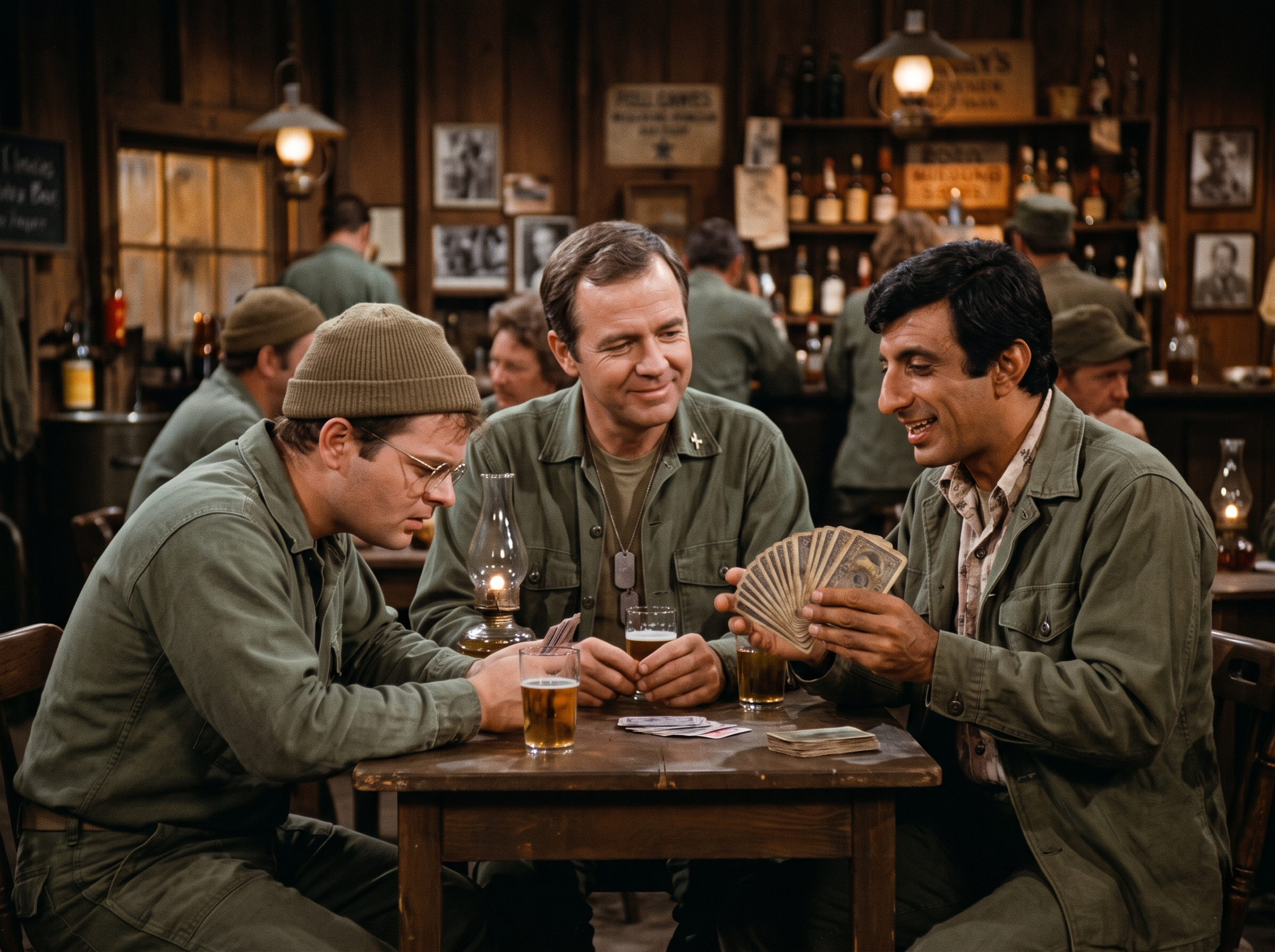
The smell of Rosie’s Bar was a complicated cocktail of stale beer, damp wood, and the faint, lingering scent of cheap cigars. But to the men and women of the 4077th, it was the sweet perfume of temporary freedom.
They had just stumbled out of a grueling forty-eight-hour marathon in the operating room. The kind of shift that left your hands shaking, your eyes burning, and your soul feeling like it had been run through a wringer.
Now, hiding in a dim corner booth beneath the warm, amber glow of a practical oil lamp, three weary souls sought refuge in the simple distraction of a frayed deck of playing cards.
Corporal Maxwell Klinger was holding court. For once, he wasn’t wearing a flowered dress or a feathered hat. He was dressed in standard, rumpled olive drab, looking every bit the exhausted enlisted man. But the theatrical spark in his eyes remained entirely undimmed.
With a flourish that belonged more on a vaudeville stage than in a Korean dive bar, Klinger fanned out the worn, dog-eared cards. His face was lit up with absolute, charismatic confidence as he launched into his patter, declaring himself “The Great Klingerini, Mystic of the Midwest.”
Sitting across from him, Father John Mulcahy nursed a half-empty glass of beer. He watched Klinger’s busy hands with a look of mild, polite confusion.
The chaplain wore a soft, sincere smile, thoroughly enjoying the complete lack of life-or-death stakes at the table. He didn’t quite understand the mechanics of the card trick being performed, nor did he particularly care. It was just good to hear voices raised in playful deception rather than cries of pain.
Beside the Father, Corporal Walter “Radar” O’Reilly was entirely captivated.
Wearing his signature knit olive drab cap pulled down tight against the evening chill, Radar was leaning so far forward his nose was practically grazing the wooden table. He was squinting intensely through his round spectacles, scrutinizing every single movement of Klinger’s fingers.
Radar was completely, innocently baffled. He was looking for trapdoors, hidden wires, or extra sleeves, entirely unaware that the magic was just Toledo street hustle.
“Now, gentlemen,” Klinger announced in a hushed, dramatic whisper, snapping the fan of cards shut. “I have not touched this deck since the good Father shuffled it. Radar, my clairvoyant friend, I want you to close your eyes. I want you to think of a card. Don’t say it out loud.”
Radar squeezed his eyes shut so hard his face scrunched up. “Okay. I’m thinking.”
“Keep it locked in your mind,” Klinger coaxed, weaving his hands over the deck. “Think of home. Think of the peaceful fields of Iowa. Let the spirits of the Maumee River guide the pasteboards.”
Klinger cut the deck with a sharp snap, pulling a single card from the middle. He slammed it face down on the table between the three of them.
“The spirits have spoken,” Klinger declared triumphantly. “Turn it over, kid.”
Radar opened his eyes, taking a deep breath. He reached out with a trembling hand, treating the cardboard square as if it were a fragile bird. He flipped it over.
It was the Seven of Clubs.
Radar stared at the card. The intense, boyish wonder slowly drained from his face, replaced by a profound, heavy disappointment. His shoulders slumped, the weight of the last forty-eight hours suddenly crashing back down onto him.
“That… that ain’t it, Klinger,” Radar whispered, his voice cracking slightly. He looked down at his lap. “I was thinking of the Queen of Hearts. Like my mom.”
The vibrant, playful energy in the booth evaporated instantly. The harsh reality of the war, the distance from home, and the heavy sorrow of the camp came rushing back into the small space, suffocating the magic.
The silence at the table was sudden and thick.
Father Mulcahy’s polite smile faded. He saw the genuine heartbreak in Radar’s eyes. To a homesick, exhausted young man, this wasn’t just a failed card trick. In Radar’s tired mind, it felt like a bad omen. It felt like the universe confirming that home was a million miles away and completely out of reach.
Mulcahy slowly lowered his beer to the table. He leaned forward, preparing to offer a gentle word of pastoral comfort, to remind the boy that God’s love was closer than Iowa, even if it didn’t feel like it.
But before the chaplain could speak, Klinger moved.
The fast-talking, wisecracking hustler from Toledo vanished. Klinger looked at the crushed expression on Radar’s face, and his own dark eyes softened with deep, unspoken empathy. Klinger knew exactly what it meant to be desperate for a sign from home.
“Hold on a second, kid,” Klinger said. His voice was no longer theatrical. It was quiet, steady, and remarkably gentle.
He didn’t pick up the cards. He just pointed a finger at the Seven of Clubs lying on the scarred wood.
“I didn’t say the spirits were going to pick your card, Radar,” Klinger said smoothly, leaning in closer. “I said they were going to guide the pasteboards to give you a message. You think the spirits of the Maumee River don’t know what they’re doing?”
Radar blinked, sniffing slightly, and looked up through his smudged glasses. “They don’t?”
“Never,” Klinger insisted, tapping the table for emphasis. “The Queen of Hearts is a fine card. It’s a beautiful card. But it’s just a picture of royalty. It doesn’t do any real work.”
Mulcahy watched Klinger, fascinated. He realized the corporal wasn’t trying to save his pride as a magician; he was desperately trying to save a friend’s broken morale. The chaplain remained silent, letting Klinger work a different kind of miracle.
“Now, you look at this Seven of Clubs,” Klinger continued, his voice weaving a warm, hypnotic spell. “The Club. It looks like a clover, right?”
Radar squinted at the card again. “Yeah. I guess it does.”
“Exactly. A clover. Something that grows in the dirt. Something real. Like a farm in Ottumwa,” Klinger said softly. “And the number seven? Any gambler in Toledo will tell you, seven is the luckiest number in the world. It’s the number of survival. It’s the number of the guy who beats the odds and walks away from the table a winner.”
Radar was holding his breath, his eyes wide, hanging onto every single word.
“The spirits didn’t give you the Queen of Hearts because you don’t need reminding about your mother,” Klinger said, a small, genuine smile touching the corners of his mouth. “You already know she loves you. The spirits gave you the Seven of Clubs to tell you that your luck is holding. That you’re going to make it through this miserable, muddy place, and you’re going to get back to that clover in Iowa.”
A profound stillness settled over the small wooden table. The background noise of Rosie’s Bar seemed to fade entirely away.
Radar stared at the Seven of Clubs for a long time. Then, very slowly, a bright, deeply relieved smile spread across his face. The heavy burden on his shoulders seemed to lift just a little bit. He reached out and carefully tucked the card into his breast pocket, right over his heart.
“Gee,” Radar whispered, his voice full of pure, restored wonder. “Thanks, Klinger. That’s a really great trick.”
“Don’t mention it, kid,” Klinger winked, leaning back in his chair and picking up the rest of the deck. “The Great Klingerini never leaves a customer unsatisfied.”
Father Mulcahy picked up his glass of beer. He looked at Klinger over the rim, his eyes shining with a deep, quiet respect. He raised the glass in a silent toast to the corporal from Toledo.
Klinger caught the chaplain’s eye and offered a modest, almost imperceptible nod in return.
They sat together in the dim, amber light of the bar, three tired friends finding warmth in the dark. The war raged on somewhere beyond the thin wooden walls, but for a few precious minutes, the magic had worked perfectly.
Sometimes the greatest miracles in a war zone aren’t found in the operating room, but in the quiet, desperate kindness of a friend holding a frayed deck of cards.