Breakfast at the Edge of the World
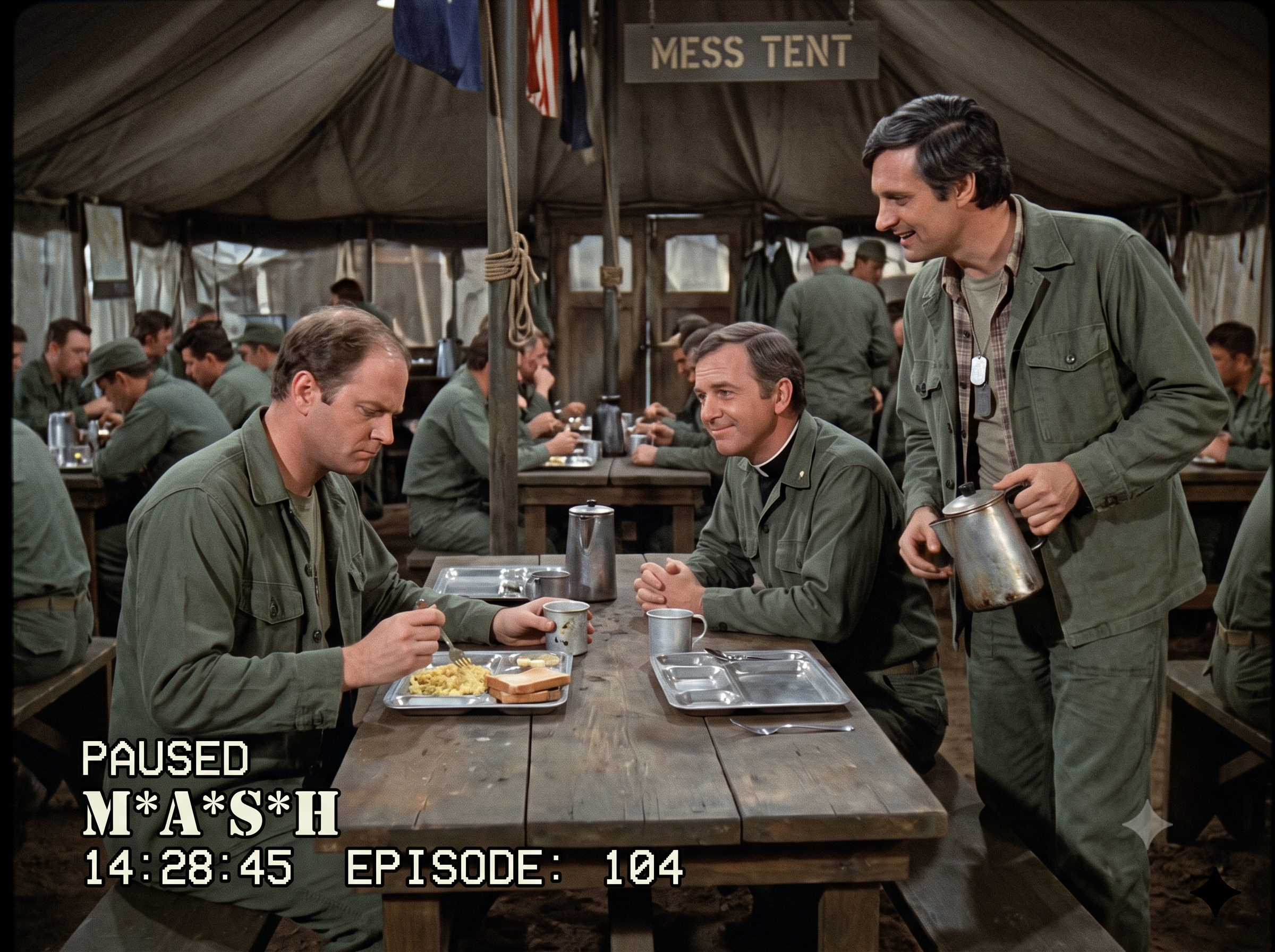
Morning in the 4077th smelled like damp canvas, diesel fuel, and the tragic promise of powdered eggs.
It was 0600 hours, and the mess tent was already half-full of people who were either too tired to sleep or too hungry to care.
Major Charles Emerson Winchester III sat at the center of a scarred wooden table, frozen in a state of profound, aristocratic grief.
He was staring down at his dull metal tray. On it sat two pieces of lukewarm toast and a neon-yellow mound that Igor had cheerfully identified as scrambled eggs.
Charles did not see breakfast. He saw the complete collapse of Western civilization.
His fork was poised in his right hand, hovering just an inch above the tray. He was trembling slightly with restrained irritation. His face was a mask of wounded pride and utter culinary devastation.
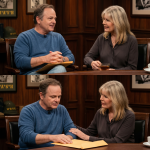
Sitting directly across from him, Father Mulcahy watched this silent tragedy unfold.
The chaplain leaned in gently, his hands folded neatly on the tabletop. A soft, compassionate smile played at the corners of his mouth. Mulcahy had seen men face mortar fire with less absolute dread than Charles currently held for his breakfast.
“It’s a test of faith, Major,” Mulcahy said quietly, his voice a calm harbor in the noisy, clattering tent. “I find it helps if you try to imagine them as a very aggressive form of pudding.”
Charles closed his eyes, taking a slow, measured breath through his nose.
“Father,” Charles murmured, his voice tight with exhausted civility. “I am a man of science. And science tells me that whatever died to produce this… substance… was not a fowl. It was an industrial accident.”
Before Mulcahy could offer a blessing over the industrial accident, a shadow fell across the table.
Hawkeye Pierce stood at the head of the table, looking like a man who had survived a shipwreck and decided to open a comedy club on the beach. He was clutching a battered metal coffee pot in his left hand, his green fatigue jacket hanging loose and wrinkled over his shoulders.
Hawkeye flashed a sudden, spontaneous grin. It was the kind of dry, witty smile he used to keep the darkness at bay after eighteen hours of meatball surgery.
“Morning, gents,” Hawkeye chimed, shaking the coffee pot slightly. “Who’s ready for a fresh cup of hot, liquid regret? Straight from the crankcase of a 1948 Jeep.”
Charles slowly opened his eyes and shifted his glare from the eggs to Hawkeye.
“Pierce,” Charles said, his voice dropping an octave. “If you pour that toxic sludge anywhere near my person, I will personally see to it that your medical license is revoked and replaced with a certificate in fry-cookery.”
Hawkeye didn’t miss a beat. He leaned in, the smile widening. “Careful, Charles. That sounded suspiciously like a compliment to the chef. Igor might hear you and ask you to the prom.”
Charles’s grip on his fork tightened. The knuckles on his large hand turned white.
He had just spent the better part of a day and night piecing together shattered boys. He was running on fumes, and this indignity was suddenly one too many.
He took a deep breath, his broad chest expanding. He was preparing to unleash a Winchester tirade of epic proportions, a symphony of multisyllabic insults that would strip Hawkeye to his very soul.
He raised the fork like a conductor’s baton, his mouth opening to deliver the fatal blow.
But the words never came.
Instead, Charles’s hand began to shake. Not with rage, but with a sudden, violent tremor of pure exhaustion. The fork clattered sharply against the metal tray, the sound ringing out like a gunshot in the morning air.
Hawkeye’s smile vanished instantly.
The witty retort died on his lips. He recognized that tremor immediately. He’d had it in his own hands more times than he could count.
It was the physical toll of adrenaline leaving a body that had absolutely nothing left to run on.
The background noise of the mess tent seemed to fade, leaving a heavy, ringing silence around their small section of the wooden table.
Charles stared at the fallen fork as if it had betrayed him. The aristocratic mask slipped, just for a fraction of a second, revealing the bone-deep weariness of a man who was thousands of miles from the world he understood, covered in the invisible grime of a war he despised.
He reached out slowly with his left hand and gripped his right wrist, trying to steady the shaking. He looked away, his jaw tight, his eyes fixed on a distant, water-stained patch of the canvas wall.
“Blast it,” Charles whispered. It was a small, fiercely defeated sound.
Father Mulcahy moved first.
He didn’t offer a platitude. He didn’t quote scripture. He simply reached across the table, his small, gentle hand resting briefly over Charles’s trembling knuckles.
The touch was incredibly light, but it carried the weight of absolute understanding.
“It was a long night, Charles,” Mulcahy said softly. “The longest we’ve had this week. No one expects you to be made of iron.”
Hawkeye didn’t say a word. He didn’t make a joke about the Boston shakes.
Instead, he stepped closer to the table. He moved with the quiet, careful efficiency of a doctor assessing a wounded patient. He reached out and smoothly pulled Charles’s empty metal coffee mug toward him.
Hawkeye tilted the heavy metal pot and poured a steaming, dark stream of army coffee into the mug. The bitter, burnt smell rose between them, mingling with the scent of canvas and the cold morning draft.
He pushed the warm mug back across the table until it rested right in front of Charles’s hands.
“Drink it, Charles,” Hawkeye said.
His voice was completely stripped of its usual sarcastic edge. It was low, steady, and unexpectedly gentle.
“It tastes like a burnt tire,” Hawkeye added quietly, “but it’s hot. And you need the heat.”
Charles stared at the mug. The thin wisps of steam curled up, warming his tired face.
He took a slow, shuddering breath, the tight lines around his eyes softening just a fraction. He knew exactly what Pierce was doing.
Pierce was giving him an out. He wasn’t making a spectacle of the great Charles Emerson Winchester III losing his composure over a plate of powdered eggs. He was just a tired doctor, handing a cup of coffee to another tired doctor.
Slowly, deliberately, Charles released his grip on his wrist. His hand was steadier now.
He wrapped both of his large hands around the warm metal mug, letting the heat seep into his cold, stiff joints. He lifted the mug to his lips and took a slow, agonizing sip.
He swallowed, his face contorting slightly at the intensely acrid taste. He lowered the mug and set it back on the table with a soft clink.
“You are entirely mistaken, Pierce,” Charles said. His voice was quiet, but it was slowly recovering its familiar, clipped cadence.
Hawkeye raised an eyebrow, the ghost of a smile returning to his face. “Oh?”
“Yes,” Charles said, looking up, his posture straightening just an inch. “It does not taste like a burnt tire. It tastes like a burnt tire that has been dragged through a swamp, left to ferment in the sun, and then lightly seasoned with despair.”
Hawkeye chuckled, a genuine, tired sound that reached his eyes. “Igor’s secret recipe. Passed down through generations of deeply angry cooks.”
Across the table, Father Mulcahy’s soft smile returned, brighter this time. He withdrew his hand, folding it back with his other.
“I believe it builds character,” Mulcahy offered pleasantly, picking up his own mug.
“Father,” Charles replied, taking another sip of the terrible coffee, “if I acquire any more character in this godforsaken place, I shall have to be declared a public nuisance.”
The quiet tension at the table dissolved, replaced by the familiar, comfortable rhythm of their shared purgatory.
Hawkeye poured a cup for Mulcahy, then one for himself. He didn’t sit down, but simply stood at the end of the table, holding his mug with both hands, letting the steam rise into the cold air.
They were a very long way from home. They were exhausted, they were cold, and they were staring down the barrel of another long day in a war that made no sense at all.
But as Charles picked up his fork once more, eyeing the neon-yellow eggs with a renewed, albeit slightly calmer, sense of aristocratic disdain, the mess tent didn’t feel quite so bleak.
They were trapped in the madness, but they were trapped together.
And somehow, over terrible coffee and worse food, that unspoken bond was just enough to keep the darkness away for one more morning.
The food was always hard to swallow, but the company made it possible to survive the meal.