A Matter of “Phivate” Property
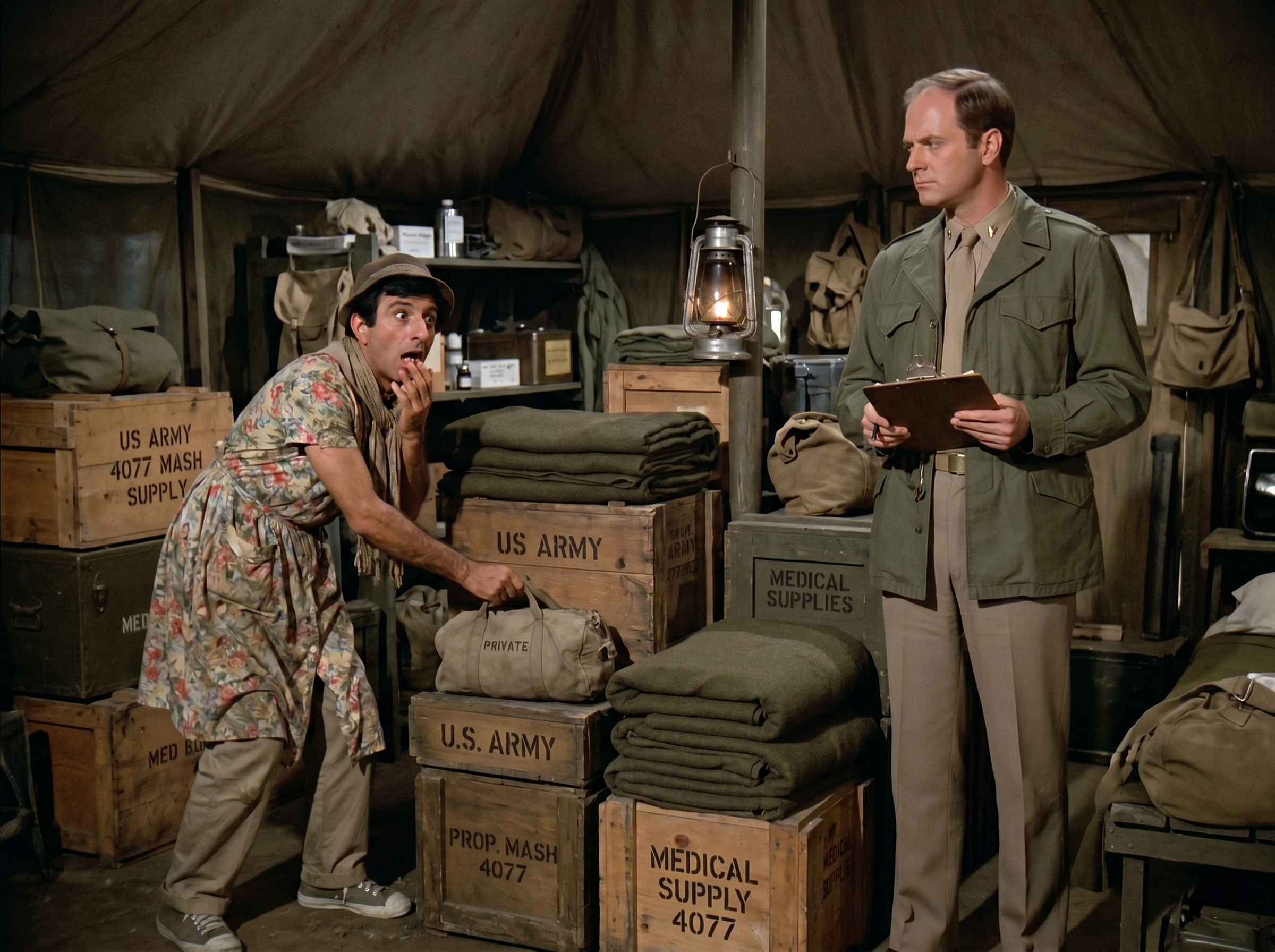
The supply tent of the 4077th was usually a sanctuary of dust, canvas, and quiet desperation. It smelled permanently of mothballs, damp wool, and whatever terrible meal the mess tent was boiling into submission that day.
But in the middle of a war, it was also the only place a person could find three square feet of glorious, uninterrupted silence.
Corporal Maxwell Klinger was moving with the stealth of a highly trained combat operative, which was a difficult illusion to maintain while wearing a faded floral sundress. He crept through the narrow aisles of stacked olive-drab blankets and wooden crates, his canvas sneakers making no sound on the packed dirt floor. He wore a sensible beige bucket hat and a loose scarf, looking less like a soldier and more like an eccentric aunt sneaking into a matinee.
He clutched a small canvas duffel bag to his chest like a newborn baby.
Klinger checked over his shoulder. The coast was clear. The camp was quiet, caught in that rare, golden hour of the late afternoon when the OR was silent and the choppers were miles away.
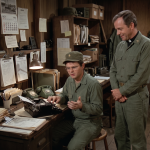
He found his chosen spot. It was a dark, recessed corner behind a heavy wooden crate stenciled with “US ARMY 4077 MASH SUPPLY.” A single warm camp lantern cast a soft, dim glow over the stacked canvas bags and dull metal shelving.
Klinger knelt, holding his breath. He looked down at the small bag in his hands. He had spent twenty minutes behind the latrines with a can of black paint and a makeshift stencil, rushing to mark his territory before anyone came looking for him. In his frantic haste, his spelling had suffered a minor casualty. The bag proudly and boldly read: PHIVATE.
He didn’t care. It was his.
He reached out, ready to slide the bag into the dark gap behind the crate, completely out of sight. He was almost safe. He was almost home free.
“I sincerely hope, Corporal, that you are not preparing to lay an egg.”
The voice cut through the quiet tent like a silver butter knife. It was crisp, arrogant, and dripping with pure Boston Brahmin disdain.
Klinger froze. His heart stopped.
With a sharp gasp, his hand flew to his mouth in a sudden, theatrical panic. His eyes went wide as saucers. He spun around, his floral dress swishing against the wooden crates, caught entirely off guard.
Standing exactly three feet behind him was Major Charles Emerson Winchester III.
Charles stood impeccably upright, an island of tailored dignity amidst the dust. He wore his green fatigue jacket buttoned flawlessly, a tan tie secured at his throat. He held a wooden clipboard against his chest like a shield of absolute authority.
Charles looked down at Klinger. His right eyebrow was arched so high it practically threatened to leave his forehead. His expression was a masterpiece of dry superiority and refined irritation. He looked exactly like a man who had just found a very large, very ugly moth in his wardrobe.
“Major!” Klinger gasped out, his fingers still pressed dramatically to his lips. “I… I didn’t hear you come in! I was just… doing a spot check! Inspecting the perimeter for… fabric weevils!”
Charles did not blink. His cold, patrician gaze slowly moved from Klinger’s panicked face, down the floral print of his dress, and finally rested on the small canvas bag Klinger was desperately trying to block with his knee.
“Fabric weevils,” Charles repeated, his voice dangerously flat. “How fascinating. And tell me, Klinger, what exactly is the standard operating procedure for securing…” Charles leaned forward slightly, squinting at the black stenciled letters. “…’Phivate’ property?”
Klinger swallowed hard. The theatrical comedy drained from his face, replaced by a sudden, very real tension.
Charles took a slow step forward, his polished shoes crunching softly on the dirt. He reached his free hand out toward the bag. “Let us see what sort of contraband you are hoarding for your next ridiculous scheme.”
“Major, please,” Klinger said, his voice dropping its high-pitched act. He put a hand over the canvas bag. “Don’t open it. It’s not what you think.”
Charles stopped. He looked at Klinger’s hand, then up to his eyes. “We shall see about that, Corporal.”
“Major, I’m begging you,” Klinger said, holding onto the bag. “There’s no scam here. I’m not running a black market. I’m not fencing army blankets to the locals. Just let me put this away.”
Charles let out a long, aristocratic sigh. He shifted his clipboard to his left hand and planted his right hand firmly on his hip. He looked at Klinger with the exhausted patience of a tutor dealing with a spectacularly dense child.
“Corporal,” Charles said softly, but with absolute authority. “You are dressed like a deranged florist, squatting in the shadows of a military supply tent, fiercely guarding a poorly spelled bag. You will hand it over this instant, or I will have Colonel Potter demote you so far down the ranks you will be saluting the camp stray dogs.”
Klinger’s shoulders slumped. The fight went out of him. He slowly pulled his hand away from the bag, looking down at his canvas sneakers.
Charles reached down and picked up the bag by its thick rope tie. He carried it over to the light of the warm camp lantern, setting his clipboard down on a nearby crate of medical supplies.
“Now,” Charles muttered to himself, “let us see what ‘Phivate’ treasures the pride of Toledo has managed to pilfer today. Black market penicillin? Stolen brass? Perhaps a scandalous new line of French hosiery?”
Charles untied the thick knot. He pulled the heavy canvas open.
He looked inside.
He stopped. The dry, arrogant sneer slowly vanished from his face.
Charles blinked, genuinely confused. He reached into the bag and pulled out a battered, colorful tin box. The label was written in Arabic. Beside it was a small, thick block of hard, aged cheese wrapped in wax paper. Underneath that was a heavy glass jar filled with green olives swimming in dark oil, and a tightly folded bundle of flatbread that looked slightly crushed from transit.
Tucked right at the bottom, beneath the food, was a letter. The envelope was heavily creased, covered in beautiful, flowing script, and smelled faintly of cheap rosewater and old paper.
Charles stared at the items in the flickering lantern light. There was no contraband. There was no scheme.
“It’s from my mother,” Klinger said quietly from the shadows.
Charles looked up. Klinger was still sitting by the crate, his hands folded in his lap. He looked incredibly small, and incredibly tired.
“It came in on the afternoon chopper,” Klinger explained, his voice low and hollow. “Took three and a half months to get here. Half the bread is probably stale, and the tin is dented to hell.”
Charles looked back down at the tin of Lebanese sweets. “Klinger… why are you hiding this in the supply tent? Surely you could keep this in your footlocker.”
Klinger let out a short, dry laugh. “Major, you know this camp. If I take a box of real food into the enlisted men’s tent, it’s gone in sixty seconds. They’re locusts. Good guys, sure. But they’re starving locusts. Radar would eat the cheese, Zale would drink the olive oil, and Iggy would probably try to smoke the flatbread.”
Klinger stood up, wrapping his scarf a little tighter around his neck. He looked at the bag on the crate.
“I just wanted to eat it slow,” Klinger said, his voice cracking just a fraction. “I wanted to come in here tonight, when everyone was asleep. I wanted to sit in the dark, close my eyes, and eat one olive. Just one. I wanted to pretend I was sitting on my front porch back in Toledo, listening to the neighborhood wake up. Just for ten minutes, Major. A guy needs something that belongs just to him in this place. Something private.”
He gave Charles a weak, self-deprecating smile. “Or, you know. ‘Phivate’. I was in a hurry with the paint.”
Charles stood perfectly still in the dim, dusty tent. He looked at the dented tin. He looked at the creased letter from a mother thousands of miles away.
Charles understood.
More than anyone else in the 4077th, Charles Emerson Winchester III understood the desperate, clawing hunger for a quiet, dignified moment of home. He remembered the grand dining room in Boston, the heavy silverware, the absolute peace of a private meal. The war stripped away every ounce of privacy a man had. It forced you to sleep, eat, bleed, and bathe surrounded by strangers.
Charles looked at Klinger. Beneath the ridiculous floral dress and the cheap hat, he saw a man just as homesick, and just as exhausted, as he was.
Charles cleared his throat softly. He carefully placed the tin, the cheese, and the jar of olives back into the canvas bag. He made sure the letter was safely tucked at the bottom.
He pulled the heavy rope tight, tying it into a secure knot.
Charles picked up the bag and walked over to Klinger. He held it out.
Klinger looked at it, stunned. He slowly reached out and took the bag, holding it tight against his chest.
“A remarkably atrocious attempt at spelling, Corporal,” Charles said, his voice returning to its normal, clipped rhythm, though the icy edge was completely gone.
Klinger blinked. “You’re… you’re not going to confiscate it?”
Charles picked up his wooden clipboard and brushed a speck of invisible dust from his crisp green sleeve.
“Confiscate what?” Charles asked, looking Klinger dead in the eye with a perfectly straight face. “As I informed you, Corporal, I am currently tasked with inventorying military medical supplies. Having thoroughly inspected this area, I see absolutely nothing that falls under my purview. I am a surgeon, not a grocer. I have far too much on my mind to concern myself with the clandestine dietary habits of a cross-dressing Toledoan.”
A slow, genuine smile spread across Klinger’s face. The heavy weight of the war seemed to lift off his shoulders, just for a second.
“Thank you, Major,” Klinger said softly.
Charles turned on his heel, heading for the tent flap. He stopped just before stepping out into the fading daylight. He didn’t turn around.
“Klinger,” Charles said quietly over his shoulder.
“Yes, sir?”
“If that cheese is an aged Kasseri, as I suspect it is…” Charles paused. “I highly recommend you pair it with a very dry biscuit. It helps cut the richness. And… do try to savor it.”
“I will, Major. I promise.”
Charles pushed the tent flap aside and stepped out into the loud, dusty reality of the 4077th.
Left alone in the quiet, dim light of the lantern, Klinger smiled. He knelt down, tucked his “Phivate” piece of home safely behind the heavy wooden crates, and finally breathed out.
Even in a place that takes everything from you, a true friend knows exactly when to look the other way.