The Bureaucracy of Angels
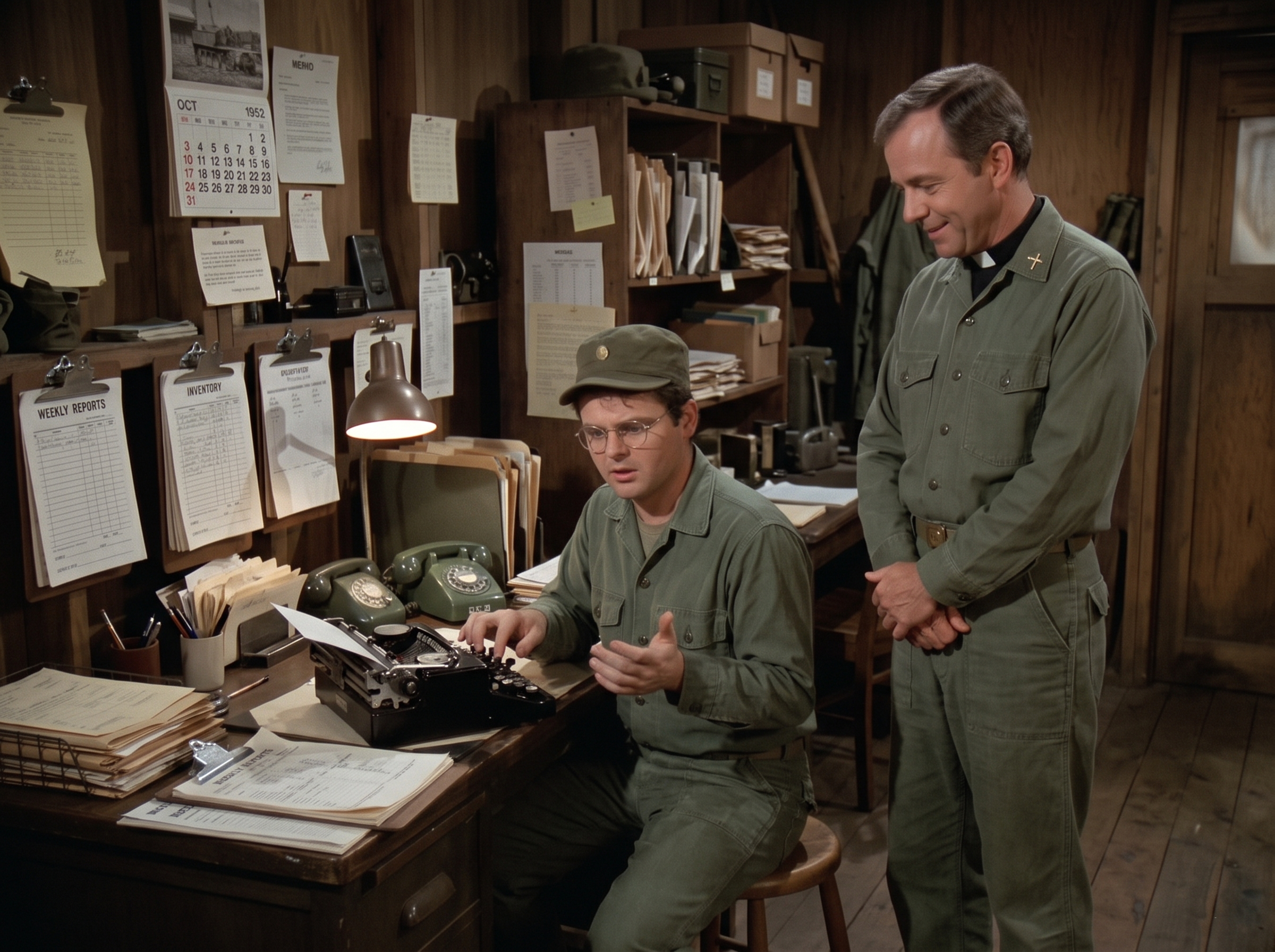
The 4077th only ever had two volumes: deafening, blood-soaked chaos, or an exhausting, ringing silence.
Today, it was the latter.
The afternoon sun was fighting a losing battle against the October chill, casting long, pale shadows across the compound. Inside the clerk’s office, the only sound was the hesitant, agonizingly slow clack-clack-clack of a typewriter.
Corporal Walter “Radar” O’Reilly sat hunched over his desk, his face pulled into a knot of pure misery.
The small gooseneck lamp on his desk cast a warm, yellow circle over the keys, highlighting the smudges of carbon paper on his fingertips. Above him, the calendar proudly announced it was October 1952, a fact that brought no comfort to a boy who felt like he’d been away from Ottumwa, Iowa, for a century.
To his left, a clipboard heavily burdened with “WEEKLY REPORTS” hung on the wooden rack. Next to it, another clipboard ominously titled “INVENTORY” waited to ruin his life.
Radar struck another key. The metal arm flew forward and slapped the paper. He stared at the letter *T*, then let out a heavy sigh, raising both hands in the air in a gesture of absolute, helpless frustration.
“It won’t work,” Radar muttered to the empty room, his hands suspended over the keys. “They’re gonna know. The brass is gonna take one look at this, and we’re all going to Leavenworth.”
He was trying to balance the books. Specifically, he was trying to explain how a brand-new, military-issue Jeep engine had mysteriously vanished from the motor pool, while a desperately needed shipment of pediatric antibiotics had just as mysteriously arrived from a local village clinic.
Captain Pierce and Captain Hunnicutt had done the trading, of course.
They always did. They were brilliant surgeons and absolute lunatics, and Radar loved them like brothers. But they left the paperwork to him, and Radar was fundamentally, genetically incapable of lying to the United States Army.
He raised his hands higher, trying to explain the situation to the silent, olive-drab rotary phones sitting on his desk. “I mean, how do you just misplace an engine? It’s an engine! It’s not a pair of socks!”
“I find it’s best not to ask the Almighty for logistical explanations, Corporal. He tends to delegate the paperwork.”
Radar jumped, nearly knocking his glasses off his nose.
Father John Mulcahy stood in the doorway, his hands casually clasped in front of him. He wore his standard green fatigues, the small silver crosses pinned to his collar catching the dim light of the office.
The priest stepped fully into the room, a warm, patient smile playing on his lips. He looked at Radar, then at the half-finished, deeply incriminating form rolled into the typewriter.
“Trouble with the weekly inventory?” Mulcahy asked softly.
Radar swallowed hard, his shoulders slumping. He looked up at the priest, his earnest, boyish face pale with guilt. He felt a desperate need to confess, right here amidst the filing cabinets and stale coffee.
“Father, it’s bad,” Radar whispered, his voice cracking slightly. “Hawkeye and B.J. needed medicine for those kids at the orphanage. The Army wouldn’t issue it. So… so they made a trade.”
Mulcahy didn’t blink. He simply took a slow step closer, looking down at the desk.
“I have to send this report to I-Corps by eighteen-hundred hours,” Radar continued, his hands fluttering nervously over the keys. “If I tell the truth, the doctors get court-martialed for stealing Army property. If I lie…”
Radar looked up, his eyes wide and pleading behind his wire-rimmed lenses.
“If I lie, it’s a federal offense. And worse, it’s a sin, Father. I’m putting a lie down on paper. I’m bearing false witness on an official Form 409.”
Father Mulcahy stopped beside the desk. The gentle, amused smile slowly faded from his face, replaced by a look of profound, quiet gravity.
He reached out, his hand resting near the scattered pile of requisition forms. He leaned in, his eyes scanning the halting, painfully honest sentences Radar had managed to type so far.
The silence in the office grew heavy, thick with the weight of military law and divine judgment. Radar held his breath, his heart hammering against his ribs, waiting for the righteous disappointment of the camp’s moral compass.
“Corporal O’Reilly,” Mulcahy finally said, his voice dropping to a serious, hushed tone. “I must tell you… looking at this document…”
Radar squeezed his eyes shut, bracing for the lecture. He was already imagining his grandmother’s face when she found out her little Walter was doing hard time in a military stockade for perjury.
“…you have completely butchered the passive voice,” Mulcahy finished.
Radar blinked, his eyes snapping open. He looked up.
Father Mulcahy was beaming. It was a warm, bright, wonderfully conspiratorial smile. His eyes crinkled at the corners, filled with a deep, abiding affection for the young clerk.
“Sir?” Radar asked, profoundly confused. “The passive what?”
“The passive voice, Walter,” Mulcahy said gently, resting a hand on the back of Radar’s wooden chair. “It is the greatest gift the English language ever bestowed upon the bureaucratic mind. You see, when one says, ‘Captain Pierce traded an engine,’ that is an active confession. It demands punishment.”
Mulcahy leaned closer, pointing a clean, unsmudged finger at the paper.
“But,” the priest continued, his voice taking on the rhythmic cadence of a Sunday sermon, “if one were to say, ‘The mechanical components in question were subjected to unscheduled field reapportionment due to extreme localized supply anomalies’… well. That is an act of God. And the Army cannot court-martial God. Though, heaven knows, General MacArthur certainly tried.”
Radar stared at the priest, his mouth slightly open. He slowly lowered his hands, letting them rest on the edge of the typewriter.
“You’re… you’re telling me how to lie, Father?” Radar asked, his voice a mix of awe and mild scandal.
Mulcahy chuckled, a soft, rich sound that seemed to chase the chill from the room. He looked around the cramped office, glancing at the stacks of files, the dusty shelves, and the endless, crushing mountains of red tape that kept the blood and bandages flowing.
“I am telling you how to survive, Corporal,” Mulcahy said kindly. “We are in a place where the rules of civilization have been turned upside down. Men are paid to shoot at one another, and we are paid to sew them back together. In a world this mad, the truth is rarely as simple as what is written on an inventory sheet.”
Radar looked back at his typewriter. He thought of the orphanage down the road. He thought of the children there, shivering in the autumn cold, finally getting the medicine that would keep the fever away tonight.
He thought of Hawkeye, exhausted and bleary-eyed, dragging a heavy crate of supplies into the compound at three in the morning, smelling of engine grease and cheap local gin, but smiling.
“The Good Lord cares deeply about the truth, Walter,” Mulcahy said softly, his tone turning pastoral, grounding the moment in real faith. “But I have to believe He cares far more about the lives of those children than He does about a piece of machinery. Sometimes, grace requires a little bit of… creative administration.”
Radar felt a massive weight lift off his narrow shoulders. The tight knot in his stomach finally uncoiled. He adjusted his glasses, a small, grateful smile touching his face.
“Creative administration,” Radar repeated, liking the sound of it. “It sounds very official, Father.”
“It is entirely unofficial,” Mulcahy replied, his eyes twinkling. “Which is why it works perfectly. Now, shift over. Let’s see if my seminary Latin can help us draft a paragraph so utterly incomprehensible that the brass in Seoul will simply stamp it ‘Approved’ just to avoid a headache.”
For the next twenty minutes, the clerk’s office was filled with the rhythmic, steady sound of typing.
Radar’s fingers flew across the keys, fueled by the priest’s brilliant, winding dictation. Mulcahy stood beside him, hands clasped, acting as a translator between the harsh reality of war and the delicate fiction required by the military machine.
They turned a stolen engine into a “localized mechanical depreciation event.” They turned the black-market antibiotics into a “spontaneous influx of civilian-sourced humanitarian aid.”
By the time Radar pulled the paper from the roller with a satisfying, sharp *ziiip*, he felt like he had just written a masterpiece.
He laid the paper on the desk and signed it with a flourish, using his best, most authoritative scrawl. He placed it in the outbox, feeling a deep, abiding sense of peace.
“Thank you, Father,” Radar said quietly, looking up. “I really thought I was going to hell for a minute there.”
Mulcahy reached out and gave Radar’s shoulder a gentle, reassuring squeeze. The gesture was small, but it carried the weight of a father’s love. In this lonely, terrifying place so far from home, these quiet moments of grace were the only things holding them together.
“If any of us are going to hell, Walter,” Mulcahy smiled, turning toward the door, “it won’t be for healing the sick. Rest easy, Corporal. You did a good deed today.”
Radar watched the priest step out into the fading afternoon light, the screen door clicking shut behind him.
The office was silent once again. But it wasn’t the exhausting, ringing silence of the war. It was the warm, comfortable silence of a home. Radar reached out, turned off the gooseneck lamp, and finally allowed himself to breathe.
In a place where everything was broken, the truest miracles were the quiet ways they fixed each other.