The Weight of the Evening
The war always seemed to get quietest just before the sun finally gave up and dipped beneath the Korean hills.
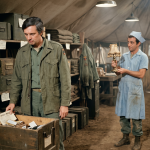
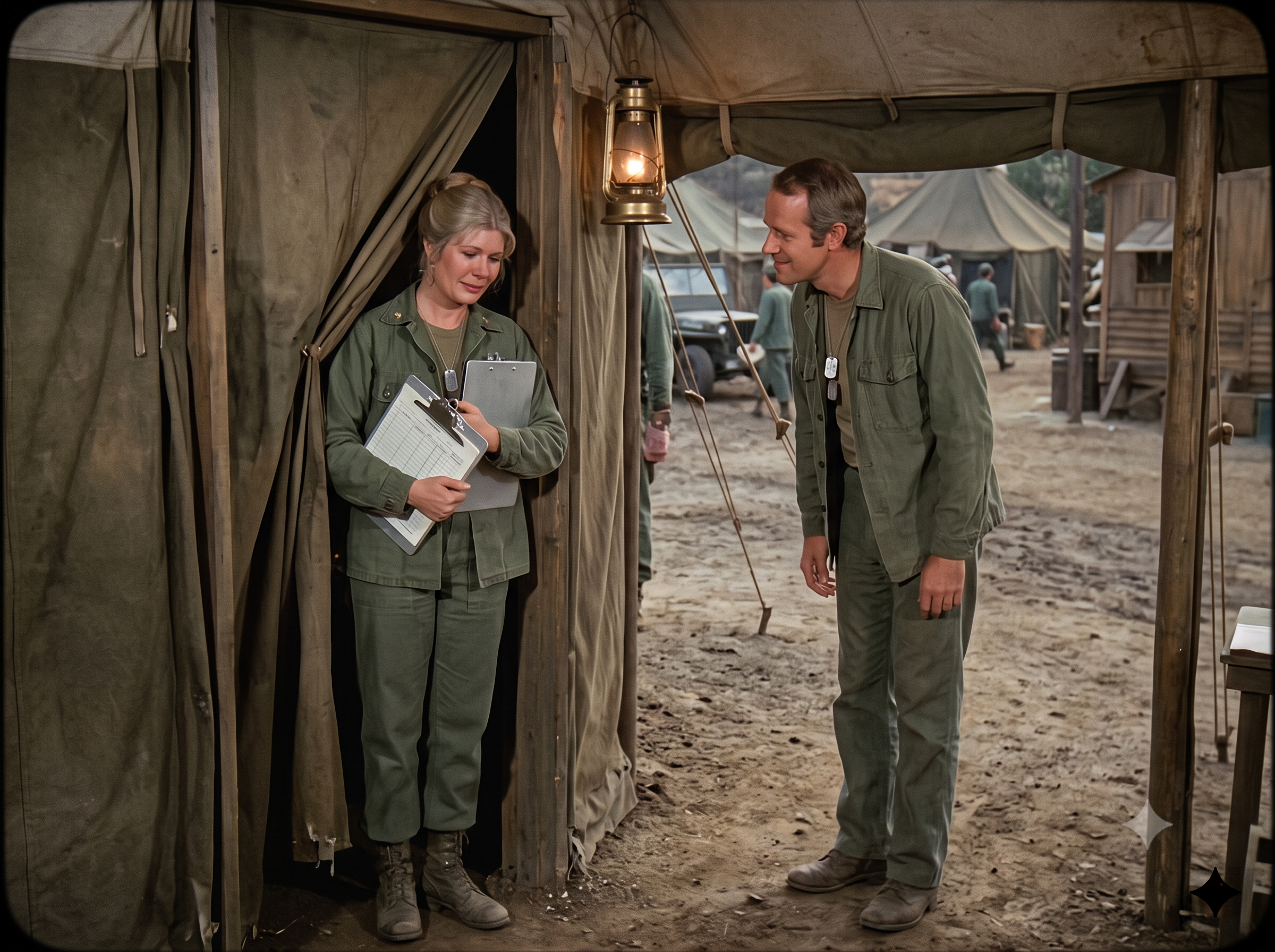
It was that brief, transitional hour at the 4077th when the harsh heat of the afternoon surrendered to the damp chill of the evening. The relentless hum of the generators was still there, but the camp had settled into a temporary, fragile peace. The dust hung in the air, catching the amber glow of the hanging kerosene lantern strung up just outside the nurses’ tent.
Margaret Houlihan stood halfway through the canvas doorway, caught between the sanctuary of her quarters and the demands of the compound.
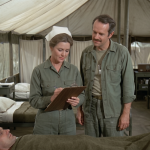
She was still in her green fatigues, the dog tags resting against her collarbone. In her hands, she clutched two medical clipboards. They were pressed against her chest like a makeshift shield. Normally, Margaret carried a clipboard like a weapon, wielding it to bark orders, assign double-shifts, or keep a rogue surgeon in line.
But tonight, the clipboard felt heavy.
They had just finished a grueling thirty-six-hour session in the OR. It was the kind of meat grinder that left everyone hollowed out, scrubbing blood from their fingernails and staring blankly into their coffee cups. They had saved most of them. They hadn’t saved all of them.
Margaret was doing her final rounds of the paperwork, tallying the transfer sheets for the morning’s chopper run. She had walked out to the dirt path to catch a breath of air, trying to pull her rigid, professional armor back into place.
She thought she was alone.
Then, B.J. Hunnicutt appeared on the path. He didn’t make a grand entrance, and he didn’t announce himself with a loud, biting joke the way Hawkeye usually did. B.J. just strolled up quietly, his boots scuffing softly against the dry dirt.
He stopped just a few feet away. He was still in his unbuttoned fatigue shirt, his own dog tags catching the lantern light. His shoulders slouched with the familiar, bone-deep exhaustion they all shared.
Margaret stiffened out of habit, lifting her chin to project the proud, unbothered posture of the Head Nurse. But as she looked at him, the effort faltered.
B.J. didn’t salute. He didn’t offer a sarcastic remark about the army. He just leaned forward gently, his hands resting loosely at his sides. He looked at her with warm, knowing eyes.
There was a quiet empathy in his expression, a silent offering of friendship that required no paperwork and no rank.
Margaret looked down at the top clipboard. The name of a nineteen-year-old corporal was written in her own neat, block lettering. A boy they had pulled back from the edge three times that afternoon.
Her breath hitched, just slightly. The proud, unyielding line of her shoulders softened, dropping a fraction of an inch. The exhaustion she had kept locked away behind her major’s oak leaves suddenly rushed to the surface, her face revealing a quietly moved, deeply vulnerable expression.
She gripped the metal clip of the board, trying desperately to hold back the sudden sting of tears. She was breaking, right there in the lantern light, and she couldn’t stop it.
B.J. didn’t look away, and more importantly, he didn’t step back.
He knew exactly what was happening. He had felt that exact same wall hit him an hour ago while washing his hands in the scrub room. He knew the sudden, overwhelming gravity that crashed down on you when the adrenaline finally ran out.
He took a half-step closer, remaining on the dirt path just outside her tent flap. He kept his voice low, his tone carrying the gentle, steady cadence of a country doctor making a house call.
“You got him on the manifest, Margaret?” B.J. asked softly.
He didn’t ask if she was okay. They both knew the answer to that. He gave her a lifeline, something practical to hold onto while she found her footing.
Margaret swallowed hard, her eyes still fixed on the paper. She nodded, a tight, small movement. “First chopper out tomorrow,” she whispered, her voice lacking its usual commanding edge. “He’s stabilized. Tokyo General will take him from here.”
“That was a good catch in post-op,” B.J. said. He leaned his head slightly to catch her gaze, offering a warm, reassuring smile. “His blood pressure started dropping, and you were on it before the monitors even knew what was happening. You saved him, Margaret.”
Margaret finally looked up. The lantern light caught the moisture pooling in her eyes, highlighting the pale, dusty beige palette of the canvas around her.
“I was just doing my job, Captain,” she said, though the words lacked their usual rigid discipline. It was a reflex, a defense mechanism she had relied on since she first put on the uniform.
B.J. let out a soft, tired chuckle. “Sure you were. And I just sew clothes together for a living. Come on, Margaret. You can let it be a victory. Lord knows we don’t get enough of them around here.”
Margaret leaned her shoulder lightly against the wooden frame of the tent door. For a moment, she let herself just be a person, not a ranking officer. The canvas wall behind her felt solid, a small comfort in a place where everything felt temporary.
“He looked just like a boy I grew up with,” she admitted quietly, the confession slipping out before she could catch it. “Back in Monterey. Same hair. Same awful, crooked smile.”
She looked back down at the clipboard, her thumb brushing over the edge of the paper. “It’s getting harder to just see them as serial numbers, B.J. I try. I really try to just see the charts. But lately…”
Her voice trailed off, the vulnerability hanging in the cool evening air.
“Lately, they just look like kids,” B.J. finished for her. His smile faded into a look of profound, shared understanding. “I know. I see it too. Every time I close my eyes, I see a hundred kids who should be back home, asking a girl to the movies or stealing their dad’s car.”
He paused, shifting his weight on the dirt path. “It means you’re still human, Margaret. It means this place hasn’t beaten the heart out of you yet.”
Margaret looked at him, really looked at him. She saw the lines of fatigue etched around his eyes, the dust clinging to his green shirt. She saw the steady, quiet goodness of a man who missed his wife and daughter so much it physically hurt him, yet who still had enough compassion left over to check on a tired nurse at the end of a bloody day.
A small, genuine smile touched the corners of her mouth. It wasn’t her polite, society smile, nor her commanding smirk. It was a soft, deeply grateful expression.
“You’re a good man, B.J. Hunnicutt,” she said quietly.
B.J. tapped his chest playfully. “Don’t spread it around. Hawkeye thinks I’m a scoundrel, and I have a reputation to maintain.”
Margaret let out a short, quiet laugh. It wasn’t much, but it was enough to break the heavy spell of the evening. The crushing weight of the clipboard seemed to lighten, just a fraction.
“I’ll keep your secret,” she said.
She stood up a little straighter, her posture returning, but softer this time. The brittle, defensive wall was gone, replaced by a quiet, shared resilience. She adjusted the clipboards under her arm.
“You should get some sleep, Captain,” she told him. “We have an inventory check at 0800, and I expect you and Pierce to actually be awake for it.”
“I’ll pencil it in right between my morning despair and my afternoon letters to Peg,” B.J. replied, offering a lazy, two-finger salute.
He didn’t turn to leave right away. He lingered for just a second longer, making sure she was really okay. Margaret gave him one last, silent nod of thanks.
Satisfied, B.J. turned and continued his slow walk down the dusty path, disappearing into the shadows of the compound.
Margaret watched him go. She took a deep breath of the cool, dusty air. The war was still here. The casualties would still come tomorrow. But for tonight, the burden felt a little less impossible to carry.
She stepped back inside the tent and let the canvas flap fall closed.
In a place designed to break you, the quiet moments of shared humanity were the only medicine that truly worked.