The Paperwork General
The war was, for a brief and miraculous moment, holding its breath.
There were no choppers echoing over the jagged Korean hills. The OR was scrubbed, silent, and smelling sharply of carbolic acid and cold canvas.
Inside the clerk’s office, however, a completely different kind of battle was raging.
The modest, busy station was illuminated by the soft, practical glow of a single desk lamp. The warm light pushed back the olive-drab gloom of the tent, highlighting the lived-in clutter of the 4077th’s nerve center.
A sleek grey Olivetti typewriter sat silent on the wooden desk, flanked by a heavy black field phone and stacked file trays. Front and center rested a neatly painted wooden block: CPL W. O’REILLY – CLERK.
Behind that desk stood the boy who kept the entire mobile hospital from collapsing into the mud.
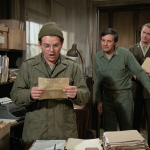
Corporal Walter Eugene O’Reilly was currently holding a terrifyingly thick stack of mismatched military paperwork. The papers were a chaotic rainbow of white, yellow, pink, and pale blue carbon copies.
Radar stared down at the top page, which boldly read REQUISITION FORM – C.O. in heavy black ink. He wore an expression of earnest focus mixed with nervous, deeply uncomfortable confusion. A tiny, shy smile tugged at the corner of his mouth, the kind of smile he wore when he knew he was about to test the limits of military sanity.
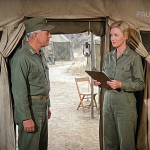
Standing opposite him, leaning slightly forward over the desk, was Colonel Sherman T. Potter.
Potter’s compact posture radiated a grounded, unshakeable authority. He wore his standard-issue green fatigue jacket, the golden crosses of the medical corps pinned neatly to his collar, and his silver dog tags resting casually over his olive undershirt.
Underneath the brim of his star-pinned cap, Potter’s face was a study in dry, fatherly exasperation.
He offered Radar a look of amused disbelief, a quiet kind of fondness shining in his eyes. He had come into the office expecting to sign a routine weekly duty roster. Instead, he had been handed a bureaucratic novel.
“Let me make sure my ears are working, son,” Potter said, his voice a low, gravelly rumble that barely disturbed the quiet room. “You are telling me that I cannot sign for our weekly shipment of plasma…”
“…until you sign this requisition for three dozen inflatable rubber life rafts, sir,” Radar finished quietly, looking over the rims of his round glasses.
Potter sighed, a long, weary breath that seemed to carry thirty years of Regular Army service. He leaned a little closer to the desk, his eyes darting from the trembling stack of papers in Radar’s hands to the boy’s earnest face.
“Radar,” Potter said gently. “We are in the middle of a landlocked peninsula. The nearest body of water larger than a puddle is the Sea of Japan. Why in the name of jumping Jehoshaphat do we need life rafts?”
Radar swallowed hard. His fingers tightened on the stack of forms, wrinkling the edges of the pink carbon copy.
“Well, sir,” Radar began, his voice taking on that rapid, panicked cadence it always got when he had to explain the impossible. “We don’t need life rafts. We need the plasma. But Supply Depot Red in Seoul won’t release the plasma unless we send them a Form 42-B, which requires a signature from a naval liaison.”
Potter’s eyebrows crept slowly toward the brim of his cap.
“But,” Radar continued hastily, his shy smile returning as he held up a bright yellow sheet from the middle of the stack. “If we order the life rafts, it triggers a maritime surplus loophole in I Corps’ new efficiency directive…”
Potter stared at the yellow paper. He stared at Radar. The silence in the office stretched out, heavy and expectant.
“Son,” Potter said softly, the amusement finally cracking through his stern facade. “Tell me you didn’t forge an admiral’s signature.”
Radar’s eyes went wide. He clutched the paperwork to his chest like a shield.
“Oh, no, sir! Never!” Radar squeaked. He looked down at the papers, biting his lip. “I… I just traded the rafts to a Marine supply sergeant for the plasma. On paper, anyway. But I need you to sign for the rafts so the Marines think we have them, so they can pretend to lose them, so we can actually get the blood.”
Radar held out the stack of mismatched papers, offering them like a fragile peace treaty.
Potter didn’t take them. He just stood there, letting the absolute absurdity of the United States military wash over him in the warm light of the desk lamp.
Potter slowly brought a weathered hand up to rub the back of his neck.
He looked around the cramped office. He took in the bulletin board behind Radar, plastered with the 4077 MASH Area Map and dozens of pinned notes. He looked at the heavy black rotary phone, the lifeline that connected this muddy little camp to the rest of the burning world.
And then he looked back at the nineteen-year-old kid in the olive drab sweater and fatigue cap.
Radar was standing perfectly still, his eyes darting nervously between Potter’s face and the requisition forms. He looked so incredibly young. He looked like a boy who should be worrying about passing geometry or asking a girl to the harvest dance back in Iowa.
Instead, he was standing in a freezing tent in a war zone, manipulating a multi-million-dollar global supply chain just to make sure dying men had enough blood in their veins.
The fatherly exasperation on Potter’s face melted away. It was replaced by a deep, quiet wave of tenderness and profound respect.
“You traded phantom boats for real blood,” Potter said quietly.
“Yes, sir,” Radar whispered. “It was the only way. Supply said we were over our quota for the month. But they didn’t say anything about maritime survival gear.”
Potter let out a soft, genuine chuckle. It was a dry, warm sound that filled the small space between them. He rested both hands firmly on the edge of the brown desk.
“Corporal,” Potter said, shaking his head slowly. “If the generals in Washington had half the tactical genius you have in your left pinky, this war would have been over three years before it started.”
Radar flushed a deep, bright pink. He looked down at his boots, the shy smile blooming fully across his face.
“Aw, gee, Colonel,” Radar mumbled, shuffling his feet. “It’s just paperwork. You just gotta know how to read the fine print.”
“It’s not just paperwork, son,” Potter corrected gently. “It’s a miracle wrapped in red tape. And you’re the only one who knows how to unwrap it.”
Potter reached across the desk and finally took the heavy stack of mismatched forms from Radar’s hands.
He laid the papers flat on the wooden surface, right next to the Olivetti typewriter. He reached into his breast pocket and pulled out his silver fountain pen.
“Show me where to sign for the armada, Admiral O’Reilly,” Potter said, unscrewing the cap of his pen.
Radar’s face lit up. He quickly stepped out from behind the desk, pointing a slightly trembling finger at the bottom of the top page.
“Right here on the yellow copy, sir,” Radar instructed eagerly. “And then initial the pink one. Oh, and you have to sign the blue one twice, once as the Commanding Officer and once as the… uh… the acting Harbor Master.”
Potter didn’t even blink. He just nodded solemnly.
“Harbor Master,” Potter muttered as he scribbled his signature across the blue carbon paper. “Wait until Mildred hears about my promotion. She always did love a man in a sailor suit.”
Radar let out a short, surprised laugh. The lingering tension in the boy’s shoulders vanished entirely.
For a few quiet moments, the only sound in the office was the steady, rhythmic scratching of Potter’s pen against the military-grade paper.
It was a small, mundane sound. But in a place where the sounds were usually screams, sirens, and the terrifying roar of incoming artillery, the scratch of a pen was a beautiful, human comfort.
It was the sound of care. It was the sound of a family looking out for its own.
Potter finished the last signature with a flourish. He capped his pen, tapped it twice on the desk, and slid it back into his pocket. He pushed the neat stack of newly authorized absurdities back toward Radar.
“There you go, son,” Potter said, his voice thick with affection. “Three dozen invisible life rafts. See that they don’t block the mess tent.”
Radar gathered the papers up with practiced care, tapping the edges on the desk to perfectly align the stack.
“I’ll have them properly stored in the imaginary dry dock, sir,” Radar said with a perfectly straight face.
Potter smiled. It was a broad, genuine smile that crinkled the corners of his tired eyes. He gave the edge of Radar’s desk a solid, affectionate pat.
“Good man,” Potter said.
He stood up straight, adjusting his fatigue jacket. He looked at Radar one last time, taking in the earnest young face, the wire-rimmed glasses, and the modest, chaotic little empire the boy commanded.
“Get some sleep tonight, Walter,” Potter ordered softly. “That’s a medical directive. No requisition forms required.”
Radar stopped organizing the papers. He looked up, his eyes softening.
“Yes, sir,” Radar replied quietly. “Thank you, Colonel.”
Potter gave a small nod, turned, and walked out of the office, stepping back into the damp Korean evening.
Radar stood alone in the warm light of the desk lamp. He looked down at the signed papers in his hands. He ran his thumb over Potter’s bold, dark signature. A quiet sense of safety settled over him, a feeling that no matter how crazy the army got, there was someone solid standing right behind him.
He turned toward the filing cabinets, the shy smile still lingering on his face, ready to file the miracle away.
In a war that made no sense, the only things that truly held them together were the absurdities they shared and the quiet ways they loved each other.