The Currency of a Shared Smile
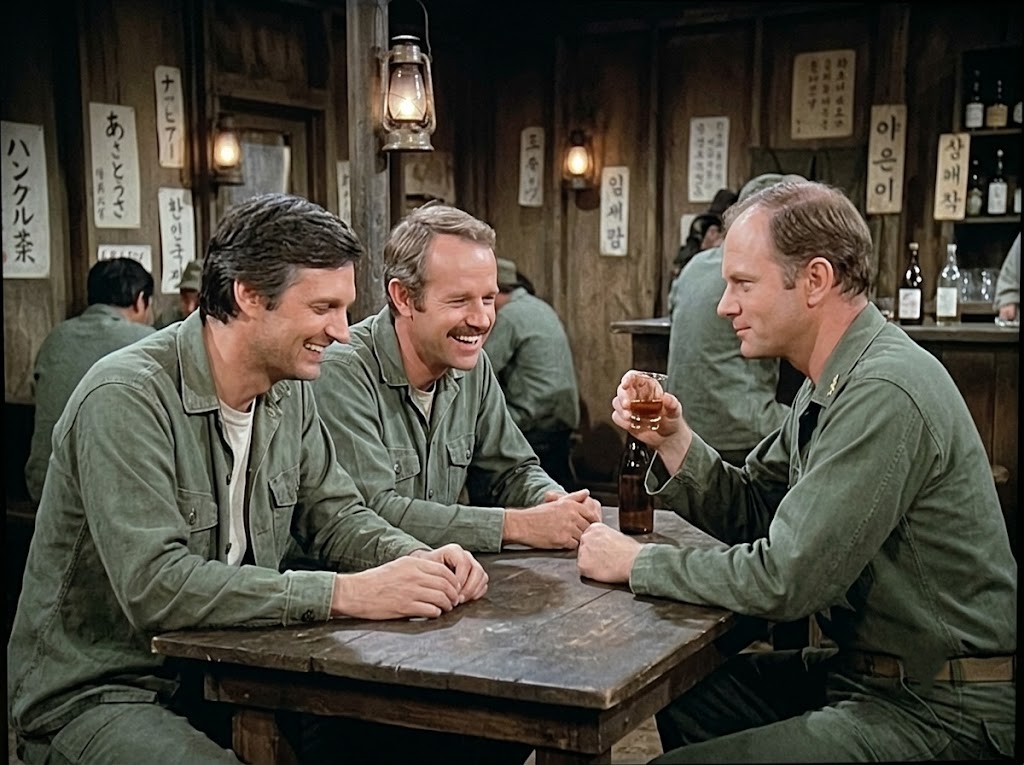
The mud in Korea has a way of clinging to your boots long after you’ve stepped inside, a constant reminder of the miles between the 4077th and anything resembling home. But inside the dim, lantern-lit sanctuary of Rosie’s Bar, the relentless thump of artillery usually fades into the background, replaced by the familiar clink of cheap glasses and the low hum of tired voices.
On this particular evening, the air was thick with the scent of damp wool, stale beer, and the unmistakable exhaustion that follows a thirty-six-hour session in the Operating Room.
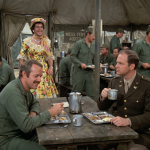
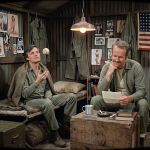
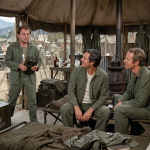
Hawkeye Pierce sat at the worn wooden table, his shoulders slumped beneath his faded olive drabs, yet a genuine, unburdened smile broke across his face. Beside him, B.J. Hunnicutt leaned forward, his mustache twitching as a hearty, rumbling chuckle escaped his chest.
Across from them sat Charles Emerson Winchester III, holding a single shot glass aloft with the precise, deliberate elegance of a man toast-mastering a Boston gala.
“Do not mistake this for affection, Pierce,” Charles intoned, his voice rich and dripping with its usual aristocratic varnish, though his eyes remained fixed on the amber liquid. “It is merely a clinical observation that your presence tonight is marginally more tolerable than the silence of the Swamp.”
“Careful, Charles,” Hawkeye laughed, resting his forearms on the table. “You keep talking like that, and people might think you actually tolerate our company. We have a reputation to uphold as the local degenerates.”
“God forbid,” Charles shot back, though the corner of his mouth twitched upward. He looked at the shot glass, then at the two men across from him, his expression softening just enough to betray the lonely soul beneath the silk-lined armor.
The three of them had just survived a deluge of casualties that had pushed every one of them to their absolute limits. In the OR, there were no class distinctions, no Boston blue-bloods or Maine country boys—only hands working in unison to stop the bleeding. Now, under the warm glow of the hurricane lamps hanging from the wooden posts, the remnants of that high-wire tension began to dissolve into something remarkably like peace.
B.J. shook his head, his eyes crinkling with warmth as he watched their resident aristocrat attempt to casualize a shot of local whiskey. “Come on, Charles. Just say it. You missed us. You couldn’t bear the thought of drinking alone while we were busy making Rosie rich.”
“I am a Winchester, Hunnicutt. We do not ‘miss’ people,” Charles sniffed, though he didn’t lower the glass. “We merely endure their absence until we can properly reprimand them for it.”
Hawkeye’s laugh was light, a temporary escape from the ghosts that usually crowded his mind after a long shift. For a moment, the war felt a million miles away, locked outside the wooden walls adorned with hand-painted signs.
Then, the heavy wooden door of the bar swung open with a sudden, sharp bang, letting in a gust of cold, wet wind that caused the lanterns to flicker violently.
Every head in the room turned toward the entrance as a breathless Radar O’Reilly stepped inside, his oversized fatigue cap dripping with rain, holding an official-looking western union envelope tightly against his chest.
—
The sudden chill from the open door seemed to freeze the laughter right out of the air. Radar stood there for a second, panting, his wide eyes scanning the room until they landed on the trio at the corner table.
“Sirs,” Radar stammered, his voice cracking slightly as he adjusted his glasses with a trembling hand. “Colonel Potter needs… well, he doesn’t need you in O.R., but he needs you in his office. Right away. Especially you, Major Winchester.”
Charles’s hand remained steady, holding the shot glass, but the playful arrogance vanished from his eyes in an instant, replaced by a guarded, professional stillness. “What is it, Radar? Has the brass decided my talent is finally required in a civilized time zone?”
Radar swallowed hard, looking down at the yellow envelope. “It’s a telegram, sir. From Boston.”
The silence in Rosie’s Bar grew heavy, the kind of silence that usually preceded a mortar shell. In the 4077th, a telegram from home was rarely a harbinger of ordinary news; it was either a joyous miracle or a devastating blow, with very little middle ground.
Hawkeye and B.J. exchanged a quick, sober look, the lighthearted banter of a moment ago evaporating completely. Hawkeye reached out, his hand instinctively resting on the table near Charles’s arm, a silent gesture of solidarity.
Charles slowly lowered the shot glass, setting it down on the scarred wood with meticulous care, as if a sudden movement might shatter the fragile reality around them. He stood up, smoothing the front of his olive-drab jacket, his posture rigid, reassembling the formidable wall he wore so well.
“Well,” Charles said, his voice entirely devoid of its earlier warmth, returning to its crisp, detached Bostonian cadence. “Duty, it seems, is an uncompromising mistress. Excuse me, gentlemen.”
As Charles walked past Radar and out into the downpour, Hawkeye and B.J. rose without a word, leaving their drinks behind. They followed the young corporal through the ankle-deep mud, the rain stinging their faces as they crossed the compound toward the administrative tent.
Inside Colonel Potter’s office, the air smelled of pipe tobacco and damp paper. Potter sat behind his desk, looking every bit the tired old cavalryman, his face lined with the accumulated weight of a hundred different tragedies. Beside him stood Margaret Houlihan, her uniform immaculate despite the hour, her expression a mix of strict discipline and profound, quiet worry. Father Mulcahy sat in the corner, his rosary beads slipping quietly through his fingers.
Charles stood in front of the desk, his back straight as a ramrod, his face completely unreadable as Potter handed him the unsealed telegram.
For a long, agonizing minute, the only sound was the rhythmic drumming of the rain against the canvas roof. Charles read the words, his eyes moving slowly across the page. Hawkeye watched him closely, watching for the slight tremor in the jaw, the subtle tightening of the shoulders—the tells that every surgeon knew.
Then, Charles let out a long, slow breath. The rigid posture didn’t break, but a profound wave of relief seemed to wash over his features, softening the sharp lines around his mouth.
“It is from my father,” Charles announced to the quiet room, his voice steady but noticeably lighter. “The historical society in Beacon Hill has officially recognized our family’s ancestral estate as a landmark. He… he thought I should know.”
A collective sigh of relief rippled through the small office. Margaret let out a breath she seemed to have been holding for ten miles, her hand resting briefly on Charles’s sleeve in a gesture of pure, maternal comfort. “Thank God, Charles. We thought…”
“I know what you thought, Major,” Charles said softly, looking around the room at the anxious faces of his colleagues. He looked at Potter, who was nodding with a fatherly smile, and then at Hawkeye and B.J., who were leaning against the doorframe, grinning like two schoolboys who had just avoided a scolding.
“Well, Winchester,” Potter barked mildly, clearing his throat to hide his own emotion. “Next time your family decides to make history, tell them to use regular mail. You’re giving my ulcer an ulcer. Dismissed.”
The walk back to Rosie’s was much faster, the rain feeling less like a burden and more like a necessary cleansing. When they reclaimed their table, the lanterns were still burning low, casting the same warm, amber shadows across the wood.
Charles took his seat, picked up his shot glass, and looked at Hawkeye and B.J. The defensive walls were still there, but the gate was open, just a fraction.
“As I was saying before we were so rudely interrupted by the Commonwealth of Massachusetts,” Charles murmured, raising his glass once more. “To the rare, fleeting moments where the company is almost tolerable.”
Hawkeye raised his glass, his smile returning, full of the deep, unspoken affection that tied the makeshift family together. “To Boston, Charles. May it always keep its history to itself.”
B.J. clinked his glass against theirs, his eyes twinkling in the lantern light. “And to staying right here, where the drinks are terrible, but the family is free.”
They drank, the cheap whiskey burning its way down, followed quickly by the shared, easy laughter of three men who knew exactly how lucky they were to have each other in the middle of nowhere.
Amidst the mud and the madness of the 4077th, home wasn’t always a place on a map—sometimes, it was just a shaky wooden table and the friends who refused to let you sit alone.