The Weight of the Unspoken (A 4077th Tribute)
Some days in Korea don’t end with the sound of incoming choppers or the frantic shouting in the OR.
Sometimes, the hardest days are the ones that simply refuse to fade, leaving a heavy, silent ache in the air long after the last suture is tied.
The Mud 77th was finally quiet, baked under a pale, indifferent sky that seemed to trap the heat and the exhaustion right down in the dirt.
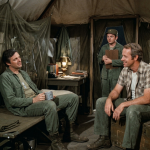
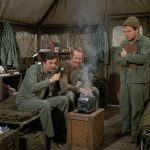
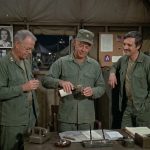
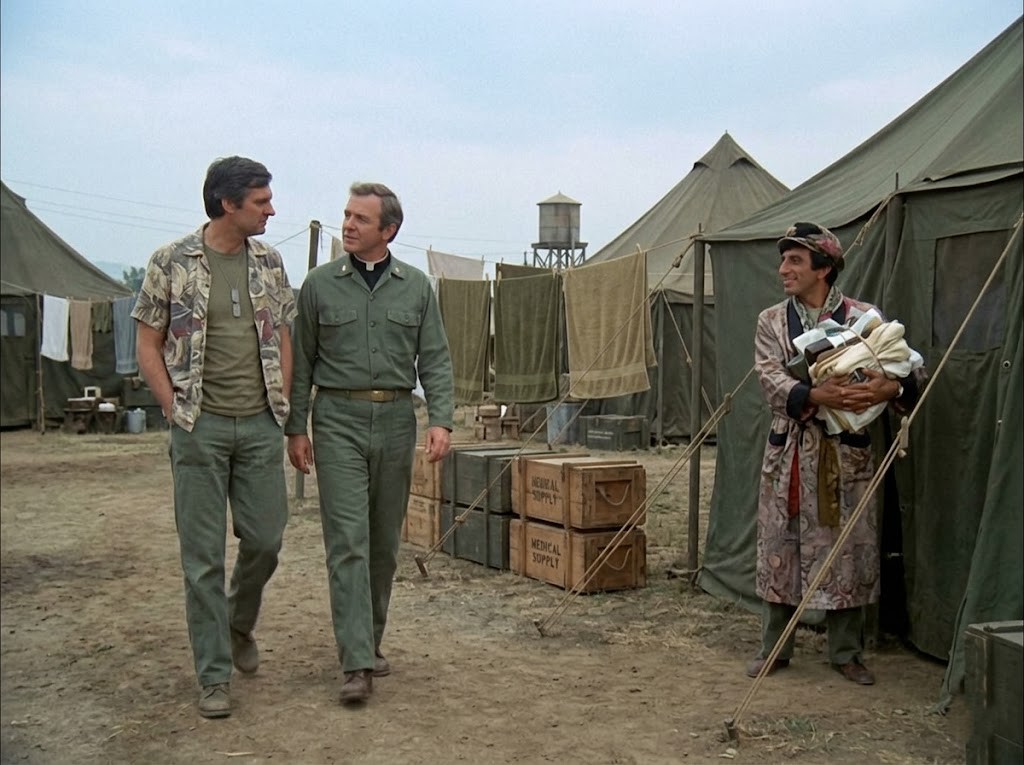
Hawkeye Pierce walked with his hands stuffed deep into his pockets, his posture slouched under the invisible weight of the last seventy-two hours. He wore his favorite loud, faded Hawaiian shirt open over a olive-drab undershirt—a stubborn, colorful protest against the drab monotony of the army. His dog tags clinked softly against his chest, a rhythmic, metallic heartbeat that reminded him he was still here. Still breathing.
Beside him walked Father Mulcahy, his hands clasped gently behind his back, his uniform immaculate despite the dust. The gentle priest looked at Hawkeye not with the eyes of a superior officer, but with the deep, enduring concern of a man who watched young souls fracture and mend every single day.
They walked along the dirt path between the olive-drab tents, past the rows of faded green towels hanging on the clotheslines like laundry lines in a tired Brooklyn neighborhood.
“You’re quiet today, Pierce,” Mulcahy said softly, his voice a calm anchor in the camp’s stagnant heat. “Usually, by this hour, you’ve treated me to at least three bad puns and an existential monologue.”
Hawkeye offered a dry, fleeting smirk that didn’t quite reach his eyes, looking down at his scuffed boots. “Just saving my breath, Father. I think the swamp gas has finally compromised my vocabulary.”
But they both knew it wasn’t the swamp gas; it was the twelve-year-old boy from the local village they had spent all night trying to save, only to watch the light slip from his eyes just before dawn.
Just ahead of them, stepping out from the shadow of the supply tent, was Klinger.
He wasn’t in a gown today, but rather a patterned, flowered housecoat worn over his fatigues, a silk scarf knotted loosely around his neck and a heavily decorated cap perched on his head. In his arms, he clutched a massive, chaotic bundle of freshly laundered sheets, towels, and a couple of smuggled civilian blankets.
Seeing the doctor and the chaplain approaching, Klinger stopped in his tracks, a wide, knowing grin spreading across his face.
“Ah, the top brass of the evening shift!” Klinger called out, his voice a theatrical theatrical whisper as he hugged the laundry tightly to his chest. “Just the two men I wanted to see. I have a little something for the soul, straight from the black market of Seoul.”
Hawkeye stopped, looking at Klinger with a mixture of fondness and sheer, bone-deep fatigue.
“Not today, Klinger,” Hawkeye said, his voice dropping into a rare, vulnerable quietness. “Whatever you’re selling, or whatever discharge papers you need signed… I just don’t have the ink in me.”
Klinger’s smile faltered slightly, his sharp eyes catching the subtle tremor in Hawkeye’s shoulders and the heavy, shadowed look in the priest’s eyes. The camp gossip traveled fast, and Klinger knew exactly what had happened in Pre-Op a few hours ago.
He adjusted the heavy bundle in his arms, his expression shifting from a salesman’s hustle to something deeply tender and protective.
“Who said anything about selling, Doc?” Klinger said softly, stepping closer until the three of them formed a small, isolated circle in the middle of the compound. “I’m talking about a delivery. A very specific delivery.”
Father Mulcahy looked at the bundle of linens, then up at Klinger, his brow furrowing with gentle curiosity. “What sort of delivery, Max?”
Klinger looked around conspiratorially, then lowered his voice, his eyes locked onto Hawkeye’s tired face. “A delivery that took me three miles past the checkpoint and cost me a pair of silk stockings I’ll never get back.”
Hawkeye sighed, running a hand over his face, wishing he could wash away the phantom smell of ether and copper. “Klinger, please. If it’s a bottle of local gin, give it to BJ. If it’s a request for a hardship discharge based on psychological wardrobe malfunction, give it to Potter.”
“It’s neither, Captain,” Klinger said, his theatricality dropping away completely, leaving only the raw, decent kid from Toledo.
With a careful, deliberate movement, Klinger shifted the top layer of the laundry bundle. Tucked securely deep inside the warm, clean folds of the blankets was a small, wooden crate. Through the slats, the unmistakable rich, dark glass of two genuine, unbroken bottles of premium American cream soda gleamed in the dull Korean light.
And wrapped around the neck of one bottle was a small, hand-knitted woolen scarf—bright red, completely impractical for the climate, and clearly made by someone’s grandmother back home.
“Found it in a supply truck that got diverted from the officers’ club in Seoul,” Klinger whispered, a genuine, soft smile returning to his face. “The driver owed me a favor from the time I fixed his radiator. I thought… well, I thought maybe a couple of guys who spent the whole night fighting the good fight could use a taste of something that doesn’t taste like the bottom of a foxhole.”
Hawkeye stared at the bottles. For a long moment, the brilliant wit of the 4077th’s best surgeon completely failed him. His throat tightened, and he had to look away toward the distant, dusty mountains to keep his eyes from blurring.
It wasn’t just the soda. It was the fact that in a place surrounded by misery and miles of barbed wire, a guy in a flowered bathrobe had gone out of his way to bring a piece of home to a friend who was hurting.
Father Mulcahy smiled, a warm, radiant expression that seemed to chase away the shadows under the tents. He reached out and gently patted Klinger’s arm, right over the bundle of stolen comfort.
“The Good Book talks a lot about offering a cup of cold water to the thirsty, Max,” Mulcahy said, his voice thick with genuine affection. “But I think, under the circumstances, the Lord will happily overlook the carbonation.”
Klinger chuckled, a sound full of warmth and relief. “Just doing my civic duty, Father. Can’t have our best surgeon passing out from a lack of sugar. The camp average depends on him.”
Hawkeye looked back, a real, slow smile finally breaking through his exhaustion. It wasn’t his usual sarcastic grin, but something softer, smaller, and infinitely more human. He reached out, his hand lingering for a second on the bright red woolen scarf wrapped around the bottle.
“You’re a beautiful man, Max Klinger,” Hawkeye said quietly, his voice rich with an unspoken gratitude that words could never fully capture. “Even if that robe completely clashes with your complexion.”
“Hey, a fashion statement waits for no man, Doc,” Klinger shot back, his chest swelling with pride as he hugged his laundry close again. “Now get out of here and drink those before Winchester finds out and demands a glass with ice.”
As Klinger turned and ambled back toward the tents, his bathrobe fluttering slightly in the dry wind, Hawkeye and Father Mulcahy watched him go. The heavy silence that had hung over them just minutes ago hadn’t completely disappeared—the war was still there, just beyond the hills—but the weight of it felt a little lighter now.
Hawkeye looked at the priest, the colorful fabric of his Hawaiian shirt catching the faint afternoon light.
“Come on, Father,” Hawkeye said, his voice returning to its familiar, comforting cadence. “Let’s go find BJ, find a couple of rusty bottle openers, and pretend, just for twenty minutes, that we’re sitting on a porch in Maine.”
They walked on together, two men in olive drab, finding their way through the dust of a faraway peninsula, held together by nothing more than a shared bottle of soda and the stubborn, beautiful humanity of the 4077th.
Because in the end, it wasn’t the army that kept them sane—it was each other.