Grace and Mystery Meat at the 4077th
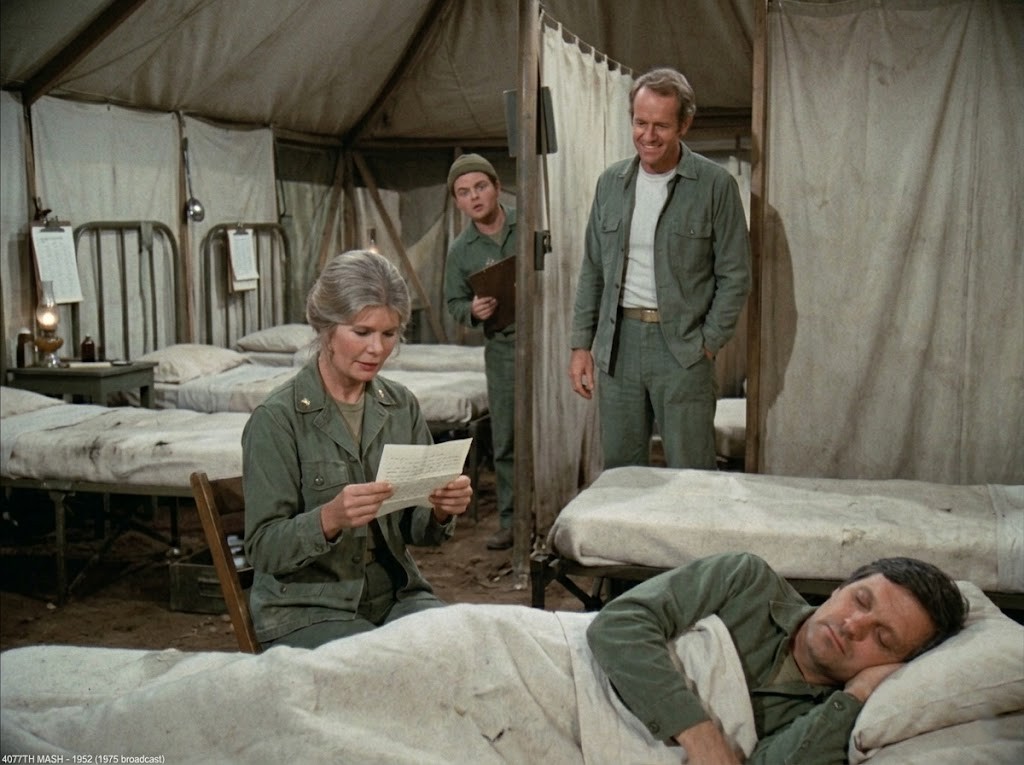
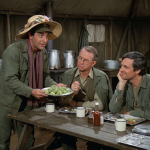
There were days at the 4077th when the hardest battle wasn’t fought over an operating table. Sometimes, the most daunting challenge a man faced was simply sitting down at a wooden table in the mess tent.
It was late afternoon, though the dim, olive-drab light filtering through the canvas walls made time feel entirely irrelevant. The O.R. had finally gone quiet after an agonizing, eighteen-hour marathon of arriving choppers and screaming sirens.
Colonel Sherman T. Potter sat heavily on the hard wooden bench. He didn’t just sit down; he sank into the wood, letting gravity take the full weight of his weary bones.
His olive-drab jacket felt heavy on his shoulders, carrying the invisible dust of a hundred impossible, life-or-death decisions. He had scrubbed his hands so many times they were raw, but the fatigue had settled deep into his joints.
He stared down at his metal tray.
In the partitioned steel squares sat a gelatinous, unidentifiable brown lump. It was resting suspiciously close to a scoop of something aggressively yellow, surrounded by a puddle of gray gravy that looked more like motor oil than food.
Across the narrow table sat Father Francis Mulcahy.
The chaplain was nursing a chipped aluminum mug of coffee, both hands wrapped tightly around the metal to steal whatever fleeting warmth it had left to offer. He wore his familiar olive knit watch cap, pulled down securely against the relentless Korean draft.
Mulcahy watched the Colonel with a quiet, knowing smile. It was the gentle, patient smile of a man who had heard a thousand desperate confessions and still managed to find room in his heart for human grace.
“Father,” Potter murmured, his voice a dry, gravelly rasp. “I am a man of the world. I served in two World Wars. I rode horses into battle. I have eaten cavalry rations that would crack a horseshoe.”
Potter picked up his fork, using it to tentatively poke the brown lump on his tray. It didn’t yield to the metal tines; it merely jiggled in stubborn defiance.
“But I truly believe,” Potter continued, his eyes narrowing at the tray, “that our beloved Corporal Igor has finally defied the laws of physics. He has invented a completely new, indestructible element.”
“I have it on very good authority that it’s meant to be meatloaf, Colonel,” Mulcahy replied gently. His eyes crinkled at the corners with genuine, quiet amusement.
Potter sighed. He dropped the fork.
It clattered against the tin tray, a hollow, lonely sound that seemed to perfectly echo how the commander felt inside.
The dry humor of the moment suddenly evaporated, leaving behind the raw, unvarnished exhaustion of an old soldier. The background noise of the mess tent—the clinking of spoons, the muted, tired murmurs of enlisted men eating in a daze—seemed to fade entirely away.
Potter rubbed a calloused hand over his face, suddenly looking every single one of his years.
“Francis,” he said, his voice dropping to a heavy, vulnerable whisper. “I have to sit at my desk in my tent tonight. I have to write a letter to a mother in Omaha.”
He looked up from the miserable tray, his tired eyes meeting the priest’s. The armor of the tough, regular-army cavalry officer was completely gone.
“The boy was just nineteen,” Potter said, his voice cracking ever so slightly. “And for the life of me, Father… I am completely out of words. How do you keep finding them?”
Father Mulcahy didn’t answer right away.
He didn’t offer a quick, rehearsed platitude, and he didn’t reach for a hollow scripture verse. That simply wasn’t his way.
Instead, he held his warm mug and let the quiet silence sit between them. He understood that sometimes, a man just needs someone else to acknowledge the impossible weight he is carrying.
Around them, the mundane life of the camp stubbornly continued. Two corporals a few tables over were quietly trading powdered eggs for an extra slice of stale bread. A tired surgeon leaned his head against a canvas tent pole, his eyes closed as he chewed on autopilot.
“There are no perfect words, Sherman,” Mulcahy finally said, his voice acting as a soft, steady anchor in the noisy room. “There are only honest ones.”
Potter leaned back, resting his heavy hands on his knees.
“Honest words,” the Colonel repeated bitterly. “The honest words are that her boy shouldn’t have been here in the mud. The honest words are that my people did absolutely everything they could, and it still wasn’t enough.”
“And that is exactly what she needs to hear,” Mulcahy said gently.
Potter looked at the chaplain, a flicker of surprise breaking through his thick fog of fatigue.
“She doesn’t need poetry, Colonel,” Mulcahy continued, leaning forward slightly across the wooden planks. “She needs to know that her son was in the hands of a man who cared. A man who is sitting in a drafty mess tent right now, losing his appetite because his heart aches for a boy he barely knew.”
Mulcahy offered a warm, deeply empathetic smile.
“The fact that you still struggle to find the words, Sherman… the fact that it still hurts you this much to write those letters… that is its own kind of grace,” the Father said softly. “It means this terrible place hasn’t won. It means you haven’t lost your humanity.”
Potter sat very still, absorbing the words.
He stared at the worn wooden grain of the table, letting the chaplain’s quiet, profound wisdom wash over him. The tight, painful knot in his chest didn’t magically disappear, but it loosened just enough to let him breathe again.
He let out a long, slow exhale.
The old cavalry officer slowly returned, sitting a little straighter, his shoulders squaring up on the uncomfortable wooden bench.
“You’re a good man, Francis,” Potter said softly.
“I just serve the coffee, Colonel,” Mulcahy deflected with modest, endearing charm, raising his aluminum mug an inch in a mock toast. “Though, I must confess, I use the term ‘coffee’ in the loosest, most spiritual sense of the word.”
Potter chuckled.
It was a small, dusty sound, but it was real. The heavy fog of grief had lifted just enough to let a sliver of light back into the room.
He looked back down at his metal tray, eyeing the gelatinous brown lump with renewed, albeit cynical, determination.
“Well,” Potter grumbled, picking up his fork once more and gripping it like a scalpel. “If I can find the courage to write to Omaha tonight, I suppose I can find the grit to tackle Igor’s mystery meat.”
Mulcahy’s smile widened, his eyes twinkling brightly under the brim of his woolen cap.
“I always suggest a silent prayer before the first bite, Colonel,” Mulcahy advised warmly. “It’s standard operating procedure for me in this establishment.”
“I’ll keep that in mind, Padre,” Potter replied.
He took a deep breath, scooped up a small piece of the unidentifiable food, and put it in his mouth. He chewed slowly, his face freezing in a rigid mask of polite, soldierly horror.
Mulcahy simply sat across from him, sipping his terrible coffee.
The priest offered the silent, steadfast companionship that held the whole frantic, blood-soaked camp together. They sat there together in the noisy, crowded tent.
They were two men separated by rank and calling, but totally united by the quiet, enduring comfort of friendship at the very edge of the world.
In a place designed to break people apart, it was the quiet moments shared across a wooden table that put them back together.