The Fabric of the Forty-Ninth Pair
The mud in Korea doesn’t just stick to your boots; it seeps into your thoughts, heavy and cold, reminding you exactly how many thousands of miles away you are from anything that makes sense.
When the wind comes howling down from the mountains through the canvas walls of the 4077th, the only thing standing between a person and utter despair is a clean, dry pair of olive-drab socks.
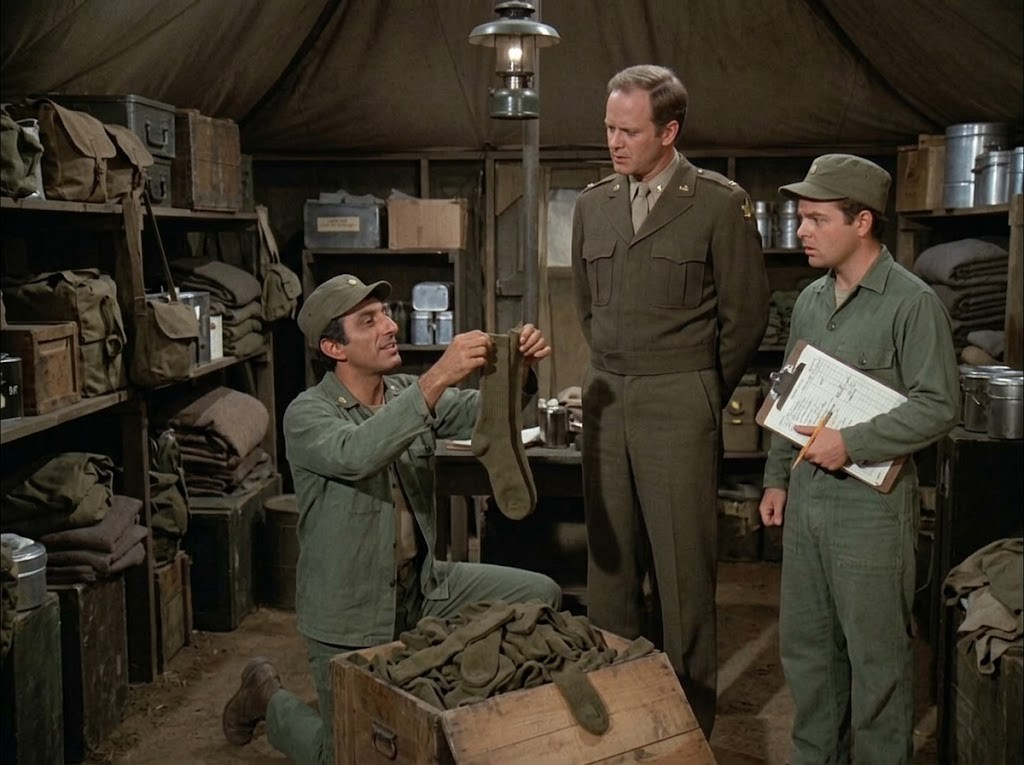
Inside the dim, cramped supply tent, illuminated only by the steady, amber glow of a single hanging lantern, the air smelled of canvas, damp wool, and old cardboard.
Corporal Max Klinger knelt on the dirt floor, his knees pressed against a rough wooden crate that had arrived on the back of a sputtered supply truck just an hour before.
He wasn’t wearing one of his famous chiffon gowns or a flowered sun hat today; he wore his standard-issue fatigue jacket and cap, his face etched with the deep, universal exhaustion shared by every soul in the compound.
In his hands, he held a single, thick wool sock, stretching it between his fingers as if testing the tensile strength of life itself.
“Look at this, Major,” Klinger said, his voice dropping its usual theatrical pitch to find a rare, quiet sincerity. “Just look at the weave on this one. It’s thick. It’s actual, genuine wool, not the recycled burlap we’ve been getting from Seoul.”
Major Charles Emerson Winchester III stood just a foot away, his arms folded firmly behind his back, looking like a displaced monarch visiting a peasants’ workshop.
His posture was impeccably straight, his pristine officer’s uniform a stark contrast to the cluttered shelves of blankets, canteens, and wooden boxes that stacked up into the shadows behind him.
He peered down his aristocratic nose at the sock in Klinger’s hands, his expression a careful mixture of profound skepticism and reluctant interest.
“Corporal, please,” Charles intoned, his deep, resonant Boston accent cutting through the chill of the tent. “You speak of a standard-issue military garment as if it were a rare silk tapestry woven by artisans in the south of France.”
Beside Charles stood Radar O’Reilly, his clipboard tucked securely against his ribs, a yellow pencil poised like a weapon against the chaos of army bureaucracy.
Radar’s large glasses caught the lantern light as he leaned forward, his eyes darting from Klinger’s face to the clipboard, his brow furrowed with the earnest anxiety of a boy carrying the weight of an entire unit on his small shoulders.
“The manifest says there are supposed to be exactly fifty pairs in this crate, Klinger,” Radar muttered, his voice hushed, as if the supply sergeant in Seoul might hear him through the mountains. “But I’ve already counted twice, and something isn’t right.”
“What isn’t right, Radar, is that the boys in the pre-op ward are using frozen gauze to keep their toes warm,” Klinger countered, his fingers smoothing over the toe of the sock. “This crate is gold. Pure, unadulterated, foot-saving gold.”
Charles shifted his weight, his eyes lingering on the pile of green wool overflowing from the wooden box.
For all his talk of Boston society, his own feet had been numb since Tuesday, a secret he guarded with the fierce pride of a Winchester.
“If the inventory is incorrect, Corporal O’Reilly, we are bound by regulations to report the discrepancy,” Charles said, though his tone lacked its usual biting edge, replaced instead by a strange, uncharacteristic hesitation.
Radar looked up from his clipboard, his face suddenly turning pale as he checked the numbers one more time, his pencil trembling slightly against the paper.
“Major… it’s not just a small mistake,” Radar whispered, his eyes wide. “We’re short. We’re short exactly one pair, and Colonel Potter already signed the arrival voucher for the full count.”
The silence that followed Radar’s announcement was heavy, filled only by the distant, rhythmic thrum of a generator outside the tent.
In the 4077th, a missing pair of socks wasn’t just a clerical error; it was a minor tragedy, a piece of comfort denied to someone who desperately needed it.
Klinger looked up from his kneeling position, his dark eyes locking onto Radar’s anxious face, the humor completely draining from his expression.
“We can’t be short, Radar,” Klinger said softly, his voice carrying the protective weight of a man who looked after his own. “I personally watched the driver unload this box. Nobody touched it but me.”
Charles didn’t move, but his eyes drifted down to the wooden crate, watching the way the green wool caught the dim yellow light of the lantern.
“A discrepancy of such minor physical proportions,” Charles murmured, his voice uncharacteristically quiet, “yet in this wilderness, it assumes the dimensions of a monumental crisis.”
“If the inspectors from the 8055th come through next week and find out our physical count doesn’t match the signed voucher, they’ll have the Colonel’s head,” Radar said, his pencil tapping nervously against the wood of his clipboard. “You know how they are about the paperwork, Major. They don’t care about cold feet. They care about lines on a page.”
Klinger stood up slowly, wiping his hands on his fatigue trousers, his theatrical resilience returning in a flash of determination.
“Then we don’t let them find out,” Klinger declared, crossing his arms. “We find the missing pair. Or, better yet, we make the numbers work.”
“Forge a military document, Corporal?” Charles raised an eyebrow, though there was no real anger in his voice, only a weary amusement. “How delightfully predictable.”
“It’s not forging, Major, it’s… creative accounting for the human condition,” Klinger said, gesturing broadly with his hands. “We’ve got forty-nine pairs of top-quality, bone-dry socks here. That’s forty-nine soldiers who won’t get trench foot during the next push.”
Radar looked between the two men, his instincts humming with the quiet understanding that always made him feel things before they actually happened.
He looked down at the crate, then at the clipboard, and then he looked directly at Charles’s boots, noticing the slight, involuntary twitch of the Major’s left foot against the cold dirt floor.
“Major,” Radar said gently, his voice breaking through Charles’s defensive posture. “Your feet are freezing, aren’t they?”
Charles stiffened, his chin rising slightly as if he had been insulted in the middle of the Boston Symphony Hall.
“My physical comfort, Corporal O’Reilly, is entirely beside the point,” Charles snapped, though his eyes darted away, unable to meet the young boy’s innocent, searching gaze. “I am merely concerned with the proper execution of military protocol.”
Klinger looked at Charles, a slow, understanding smile softening the sharp angles of his face.
He reached into the crate, pulled out the exceptionally thick pair of socks he had been examining, and held them out toward the aristocratic surgeon.
“Take ’em, Major,” Klinger said quietly, the teasing tone entirely gone from his voice. “From one soldier to another. No paperwork. No signatures.”
Charles looked at the socks held out in Klinger’s hands, his expression softening into something raw, human, and deeply tired.
For a long moment, the Boston privilege faded away, leaving only a man who was cold, exhausted, and deeply touched by the simple kindness of a companion in adversity.
“And what of the missing pair on the manifest, Corporal?” Charles asked, his voice losing its grand resonance, becoming small and genuine.
Radar smiled softly, pulling his pencil from behind his ear and drawing a neat, firm line through the top digit on his clipboard, rewriting the total with a steady hand.
“I’ll just tell the Colonel that one pair was damaged in transit by a rogue piece of shrapnel,” Radar said, looking up with a small, knowing wink. “The army understands shrapnel. They don’t understand how a Major from Boston can get cold feet just like the rest of us.”
Charles reached out, his large hand closing over the warm wool socks, his fingers squeezing them gently as if anchoring himself to the moment.
“Thank you, Klinger,” Charles said, his voice thick with a quiet, dignified gratitude that filled the small supply tent with an unexpected, beautiful warmth. “And thank you, Walter.”
Klinger knelt back down by the crate, his face brightening as he went back to sorting the remaining garments, his heart lighter than it had been in weeks.
Outside, the Korean wind continued to howl against the canvas, but inside the tent, under the light of a single lantern, three men stood together, bound by the invisible, unbreakable threads of a family they had never asked for, but would never lose.
In the coldest corners of the world, it’s the quiet, unrecorded kindnesses that keep the heart from freezing over.