The Heavy Burden of Corporal Klinger
There were days at the 4077th when the war seemed to hold its breath.
No choppers chopped through the sky. No sirens wailed from the PA system. The O.R. was scrubbed, silent, and smelling faintly of bleach and exhaustion.
On these rare, quiet afternoons, the compound settled into a heavy, dusty boredom.
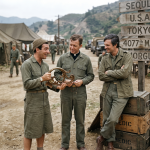
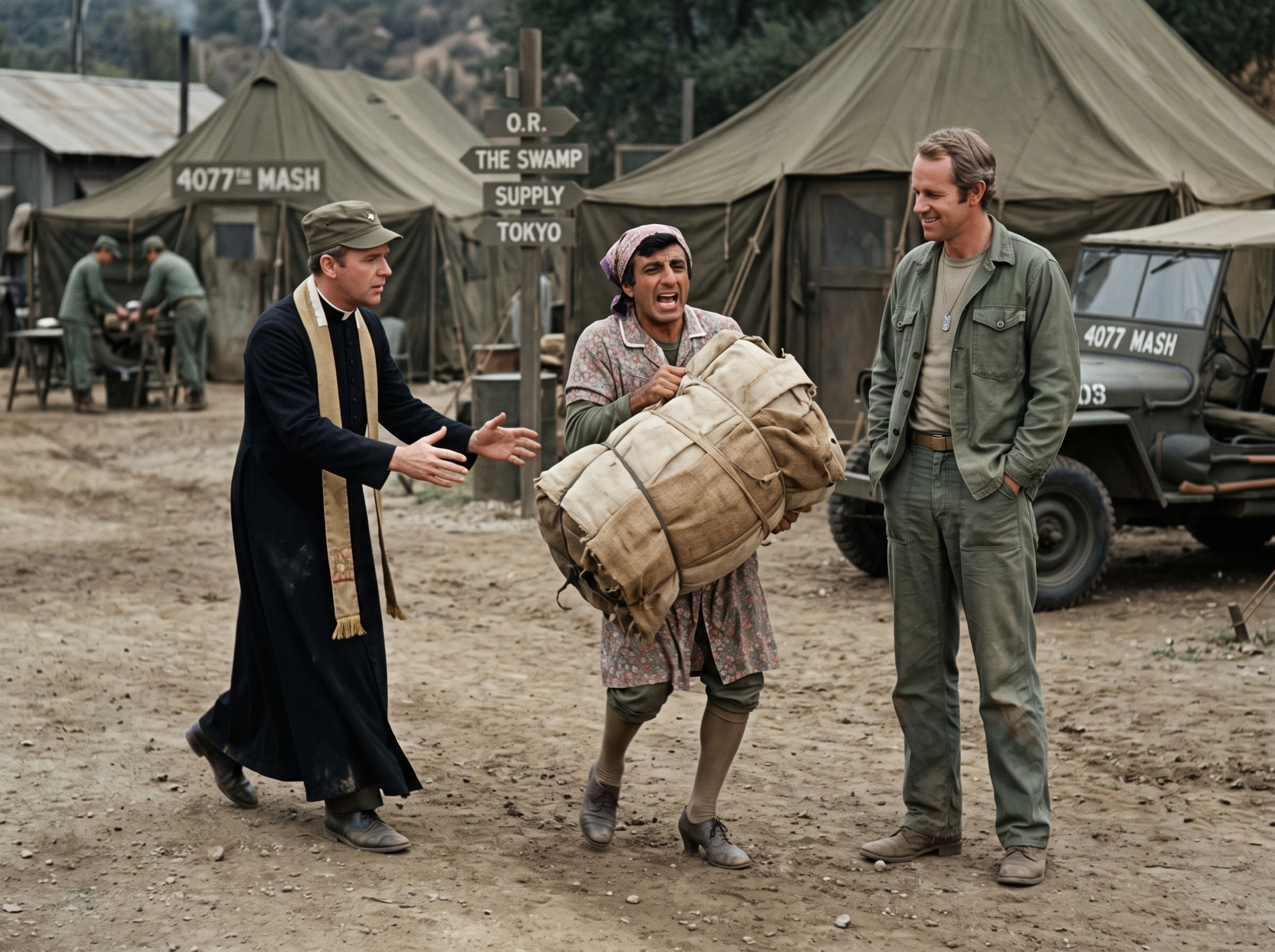
Captain B.J. Hunnicutt was taking full advantage of the lull. He stood near a parked jeep by the center signpost, his hands shoved deep into the pockets of his green fatigues.
He was thousands of miles away from San Francisco, missing his wife with an ache that never quite faded, but right now, he was thoroughly entertained.
A wide, amused smile spread across B.J.’s face, curling the edges of his mustache.
He was watching the best matinee show in all of South Korea.
Trudging through the center of the compound, kicking up small clouds of dry dirt with every awkward step, was Corporal Maxwell Q. Klinger.
Klinger was entirely in his element, yet clearly in a state of sheer physical agony.
He was wearing a faded floral day dress, hemmed just below the knee, paired with sensible, dark low-heeled pumps and tan knee-high socks. A pink bandana was tied securely around his hair, keeping the sweat out of his eyes.
But it wasn’t the outfit that had B.J. grinning. It was what Klinger was carrying.
Wrapped in heavy, coarse burlap and tied furiously with thick hemp rope, Klinger was hauling a massive, lumpy bundle. It was nearly the size of a small refrigerator and looked like it weighed about as much.
He had his arms wrapped tightly around the center of it, leaning backward to counter the tremendous weight, his face twisted in a comical grimace of strain and determination.
“Don’t just stand there, Captain!” Klinger strained, his voice pitching up an octave as he shuffled past the directional signs pointing to Tokyo and The Swamp. “I am a delicate flower, and my petals are currently being crushed by a hundred pounds of dead weight!”
B.J. didn’t move an inch. He just chuckled, shifting his weight. “I don’t know, Klinger. You’ve got a great stride going. It does wonders for your posture.”
Before Klinger could fire back a Toledo-bred insult, a dark blur rushed into the frame.
Father Mulcahy, still wearing his vestments and a beautifully embroidered stole over his black clerics, came hurrying out from the direction of the mess tent.
The chaplain’s face was painted with immediate, genuine alarm.
“Good heavens, Max!” Mulcahy cried out, his hands reaching forward, fingers splayed as if he could magically absorb the weight through the air. “What on earth are you doing? You’re going to rupture a disc!”
“Father, please! Stay back!” Klinger gasped, his knees buckling slightly. “If I lose my center of gravity, I’m going down, and I’m taking this dress with me! It’s dry-clean only!”
Mulcahy wasn’t listening. His pastoral instinct to help was far too strong. He stepped right into Klinger’s path, his hands hovering over the rough burlap, desperate to take a corner of the massive load.
“Let me help you, son. The human spine is a miracle of the Lord’s design, but it was never intended to be used as a forklift.”
“Father, I got it, I got it!” Klinger whined, his grip slipping on the rope.
B.J. leaned against the jeep, highly amused by the standoff. “Careful, Father. If you touch it, you might become an accomplice to whatever black-market enterprise he’s got wrapped up in there. My guess is salami. Or a disassembled jeep.”
“It’s not contraband!” Klinger shouted, insulted. But as he turned his head to glare at B.J., his sensible right pump caught the edge of a deep tire rut in the dirt.
Klinger’s ankle twisted. His balance vanished.
With a yelp of panic, Klinger tumbled backward. The massive burlap sack slipped from his sweaty grasp and hit the hard dirt with a tremendous, heavy thud.
The impact was too much for the old rope. With a sharp snap, the knots gave way, and the thick burlap began to tear open right in the middle of the compound.
Mulcahy gasped, jumping back. B.J. finally pulled his hands out of his pockets, his smile fading into a look of sudden curiosity.
Whatever Klinger had fought so hard to carry, whatever he was guarding with his life, was about to spill out into the light of day.
The heavy burlap sack slumped open, the rough fabric falling away to reveal the treasure Klinger had carried through the dust.
It wasn’t black-market Toledo salami. It wasn’t silk parachutes, or rubber rafts, or a collection of stolen hubcaps.
It was canvas mailbags. Three of them. Stuffed to the brim and overflowing with letters, brown paper parcels, and small cardboard care packages.
The wind caught a few loose envelopes that had slipped from the top bag, scattering them lightly across the dirt.
For a moment, the compound was entirely silent, save for Klinger’s heavy panting as he sat in the dirt, rubbing his sore ankle.
B.J.’s amused grin vanished completely.
The camp hadn’t received mail in over three weeks. A supply chain error in Seoul, combined with a string of bad weather, had left the 4077th entirely cut off from the outside world. The lack of letters had hung over the camp like a dark cloud, making the long shifts in the O.R. feel even longer, and the nights feel infinitely colder.
B.J. took a slow step forward. He looked down at the pile.
Right at the top of the spilled pile, resting against a dented tin of cookies, was a pale blue envelope. Even from a few feet away, B.J. recognized the neat, cursive handwriting.
It was from Peg.
Suddenly, the joke was over. The deep, aching homesickness that B.J. carried with him every single day rose to the surface, softening his eyes and melting away his sarcastic armor.
Father Mulcahy dropped instantly to his knees in the dirt, ignoring the dust on his trousers. He began gently gathering the loose envelopes, treating them with the reverence of sacred relics.
“Max…” Mulcahy whispered, looking up at the sweating corporal in the floral dress. “The mail jeep was reported broken down five miles down the road this morning. Motor pool said it would take two days to tow it.”
Klinger huffed, adjusting his pink bandana and refusing to make eye contact.
“Yeah, well,” Klinger muttered, dusting off his skirt. “Sparky called me on the radio. He said the driver was just sitting there on the side of the road. And… well, I was expecting a very important shipment of spring chiffon from my Uncle Habib. It’s time-sensitive, Father. Chiffon doesn’t wait for the motor pool.”
B.J. stared at Klinger.
He knew Klinger was lying. Uncle Habib didn’t send chiffon in the spring.
Klinger had heard the mail was stalled. And instead of waiting, this ridiculous, beautiful lunatic had walked five miles down a dirt road in sensible pumps, loaded eighty pounds of mail into a scavenged burlap sack, and dragged it all the way back to camp by himself.
He had carried the hopes, the love, and the lifelines of two hundred people on his back, just so they wouldn’t have to wait another day.
B.J. walked over, crouching down beside the pile. He picked up the pale blue envelope, running his thumb over his wife’s handwriting. A quiet, profound wave of gratitude washed over him.
He looked up at Klinger, who was now massaging his calves and grumbling about the state of his pantyhose.
“Klinger,” B.J. said softly, his voice thick with genuine emotion. “You’re a crazy man.”
“I have the paperwork to prove it, Captain, if the Colonel would just sign it,” Klinger shot back, though there was a soft, pleased gleam in his dark eyes.
Mulcahy smiled gently, reaching out to pat Klinger on the knee. “It is a heavy burden to carry the joy of others, Max. But you bore it wonderfully. The Lord sees your kindness.”
“The Lord can buy me a new pair of shoes, Father. These heels are shot.”
Voices began to murmur from the tents. Radar emerged from the clerk’s office, stopping dead in his tracks at the sight of the canvas bags. Within seconds, the word “Mail!” was shouted across the compound, echoing through the Swamp and the mess tent.
The quiet, bored purgatory of the 4077th was suddenly broken. People began rushing out, their faces alight with desperate hope.
B.J. stood up, clutching his letter to his chest. He reached down and offered Klinger a hand.
With a dramatic groan, Klinger let B.J. pull him up from the dirt.
“Come on, Corporal,” B.J. smiled, clapping Klinger warmly on the shoulder. “Let’s get you inside. I think Hawkeye has a bottle of something awful hidden in his footlocker that you’ve earned.”
Klinger smoothed his dress, reclaiming his dignity. “Only if it’s served in a clean glass, Captain. I am a lady, after all.”
As the camp swarmed the mailbags, finding pieces of home in the Korean dirt, B.J. and Mulcahy flanked Klinger, walking him toward the tents.
They were thousands of miles from home, surrounded by war, exhaustion, and fear. But in this strange, dusty place, they had found something else, too. They had found each other.
In a place built to mend broken bodies, it was often the craziest among them who knew exactly how to heal their hearts.