Dust and Grace at the 4077th
It was the dust, they always said, that got in your pores and stayed there, an unwelcome memento of a war nobody wanted to attend. But sometimes, just sometimes, the dust settled. The operating lamps dimmed. The last helicopter rotor faded into silence.
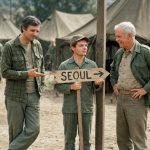
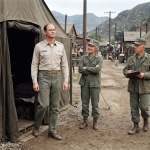
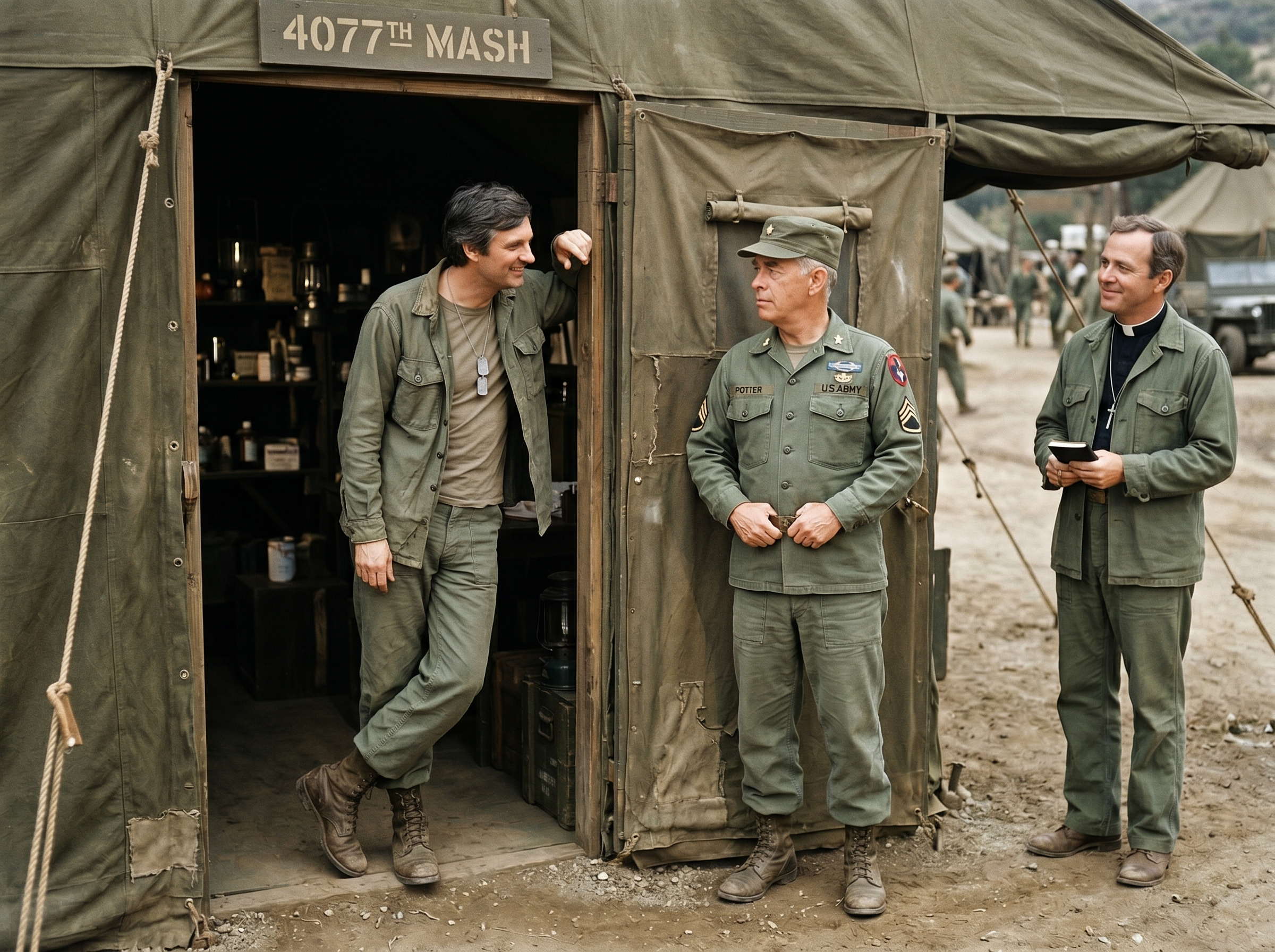
That’s where we found them. Right outside the Swamp. A trio of men who, in any other world, might never have spoken, but here, they were family.
Captain Hawkeye Pierce was leaning, as only Hawkeye could lean, against the flimsy wooden frame of the tent door. His posture was a masterpiece of defiant exhaustion. He’d just spent twelve hours in the OR, his fingers stained and his wit sharpened, using humor as the only armor he could afford. He looked, at that moment, like a man trying to decide whether to collapse or deliver one final punchline to an audience of dust motes. His dog tags were visible against his shirt, a heavy reminder of his identity in a world that seemed hellbent on erasing it. He was wearing that tired, slightly lopsided smirk that could either soothe a patient or annoy a colonel, depending on the second.
In the center stood Colonel Potter, neat as a polished button, even after a full night’s duty. His hands were clasped in front of him, a picture of disciplined patience and quiet command. The “4077TH MASH” sign above the door felt right there, just above his head, a title he wore with a mixture of professional pride and deep, fatherly weariness. He was listening. That was his gift: really listening, when the rest of the world was just shouting. He was the anchor they all relied on, the steady voice that made sense when logic had deserted the base.
And then there was Father Mulcahy. To their right, neat in his clerical collar and pristine uniform, smiling that gentle, earnest smile that seemed to provide more warmth than the camp’s stove. He was holding something. A small black notebook. It was a familiar object, filled with lists of names, prayers, perhaps a quick recipe for oatmeal cookies to send home.
But tonight, the notebook was open.
Mulcahy had been reading a letter. Not a letter to him, mind you, but one he’d found tucked into a Bible belonging to a young patient he’d just comforted. The patient was asleep, a simple wound, thank goodness, but the letter had caught Mulcahy’s eye. It was from the boy’s sister.
“Captain,” Mulcahy said softly, gesturing with the tiny book. “This… this letter. It’s quite extraordinary.”
Hawkeye smirked, a hint of his defensive wit returning. “Well, Father, if it’s from the front office about getting more gauze, that *is* a miracle. If it’s from my father complaining about the weather in Maine, I’ve heard it all before.” He glanced at Colonel Potter. “You see, Colonel? Even the Padre is finding amusement in the absurdity.”
Potter’s face didn’t move. He continued to watch Mulcahy. “Go on, Father.”
Mulcahy adjusted his grip on the notebook. The gentle breeze ruffled the edges of the page. “She writes, ‘Keep holding on to the good men around you. They are the only true map we have when we’re lost.'”
Hawkeye’s smirk faltered. Just a flicker. The words, simple and true, landed in the tired silence like a small stone in a still pond. The smile remained, but his eyes softened. He was a master of evasion, a black belt in emotional distance, but this was a direct hit. He didn’t have a joke ready. He didn’t even have a sigh.
Potter didn’t speak. His eyes just met Mulcahy’s. There was a respect there, a shared understanding that transcends rank or faith. The dust seemed to hold its breath.
Mulcahy looked up from the page, locking eyes with Hawkeye. The smile was gone from his own face now, replaced by a deep, quiet earnestness. “I think… I think this boy is going to be alright, Captain Pierce. Not just physically. He has good men around him.”
That was the high point. The moment the humor died, the defenses fell, and the three of them were simply three tired men looking at each other, confronted by the raw, beautiful possibility that they were, in fact, the map for each other. The tension was delicate. The silence was heavy.
The moment hung there, delicate and fragile, like a soap bubble in a crosswind. The silence outside the Swamp stretched, expanding past the immediate space and into the camp itself. Even the random shouting in the distance seemed to know it was time to shut up.
Hawkeye felt the weight of it. It was the same weight he felt every time he had to tell a mother her son wasn’t coming home. But this wasn’t sorrow. This was… hope. And for Hawkeye Pierce, hope was more terrifying than grief. Hope meant you could still be hurt. He wanted to make a joke. He wanted to say, ‘Oh, I’m not a map, I’m a loose leaf notebook that lost its staples,’ but the words wouldn’t form. He just stood there, leaning, his smirk having dissolved into something more vulnerable, more genuine.
Potter didn’t need words. His face, etched with the experience of two wars, held a look that was part command, part fatherly affection. He looked at Hawkeye, then back at Mulcahy, a slight nod his only acknowledgement of the profound truth the Father had shared. It was the look of a man who knew the cost of connection, but also its absolute necessity. He didn’t break the moment; he contained it.
Mulcahy, seeing the impact of his words, did not press the point. He didn’t try to deliver a sermon. He didn’t need to. The words were simple, and their truth resonated in the exhausted silence. He gently closed the small black notebook. It was a soft, final sound that released the breath they hadn’t realized they were holding.
“A simple letter,” Mulcahy said, his voice quiet, almost a whisper. “Just a letter.”
Hawkeye took a shallow breath, his own voice returning, small and stripped of its usual bravado. “It… it was beautiful, Padre. Truly.” He pushed off the wooden frame, stepping onto the dry, dusty earth, his boots making a soft, crunching sound. He didn’t say anything more. He didn’t have to. The simple admission was enough. He looked back at Potter, and the two men shared a silent understanding. No salutes, no formal words. Just the mutual respect of shared endurance.
The moment was a reset. The humor would return. The jokes would be cracked. Hawkeye would surely regain his shield. But for right now, the humor wasn’t needed. The found-family they had built—Potter the steady father, Mulcahy the spiritual heart, and yes, Hawkeye, the brilliant, damaged brother—felt, in that instant, like the only real thing in a world of ghosts.
“Well,” Colonel Potter said, clearing his throat and reclaiming his role as the anchor. “I think the coffee in the Mess Tent might be approaching a human-consumable temperature. We can discuss the gauze situation then, Captain Pierce.”
Hawkeye managed a genuine, albeit tired, smile. “Coffee? At this hour? Colonel, you’re trying to kill us with kindness.” He started to walk, his weary stride finding its rhythm again. He tapped Mulcahy on the arm as he passed. “Good work, Padre. You may have just won the war without firing a single shot.”
Mulcahy gave a small, quiet laugh. “God willing, Captain. God willing.”
The three men walked together, their paths converging. The “4077TH MASH” sign receded behind them, but the feeling of that quiet respite stayed. The dust might always get in your pores, but in moments like this, they found the grace to let it go, at least for a little while. They had each other. And sometimes, in a place that tried so hard to tear you apart, that was the only map you needed to find your way.
They found their map, and it was the faces that looked back at them.