The Cabbage Stand at the 4077th
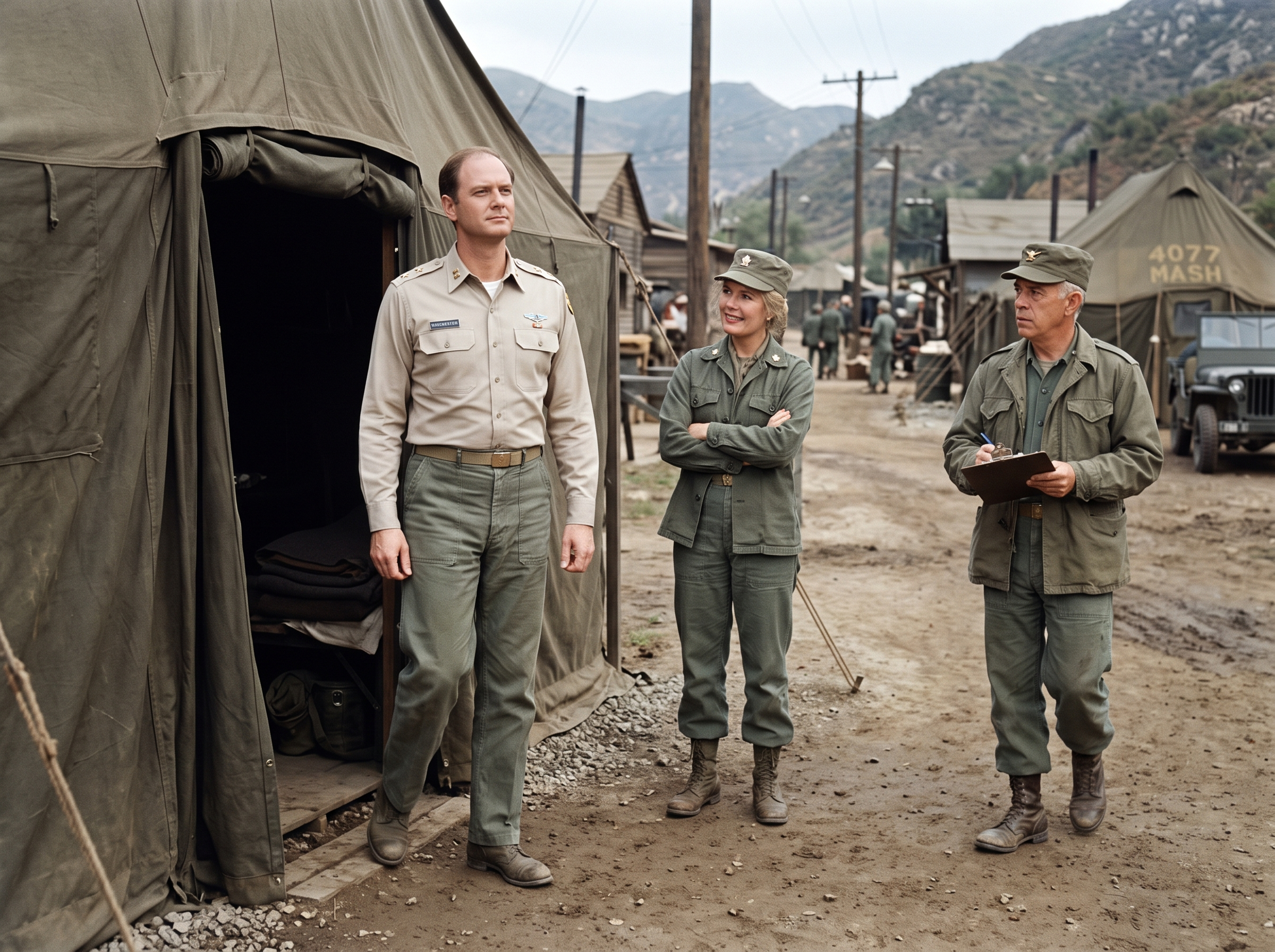
It was another grey, dust-bitten morning at the 4077th M*A*S*H unit. The air was thick with the scent of cheap diesel and impending rain, and the overall mood was as tired as the canvas tents. Yet, in the midst of it all, a small, impeccable figure was staging a protest, his back to a pile of supplies near the main compound.
Major Charles Emerson Winchester III stood perfectly rigid. His uniform, a crisp, starch-defying light khaki that stood in stark contrast to the standard green fatigues, seemed to repel the clinging Korean dirt. His face was a mask of tightly controlled, blue-blooded disapproval, his mouth set in a thin, imperceptibly quivering line. His eyes were fixed somewhere past the mud and utility poles, perhaps on a distant memory of a decent oyster bar in Boston. He was, in his own mind, the last bastion of civilization in a camp that had collectively decided to live in the mud.
Behind him, the familiar olive drab shape of the unit’s main administration tent rose, a sign bearing the number “4077 MASH” visible to any visitor (if any visitor were desperate enough). A jeep was parked nearby, half-submerged in a puddle. In the far distance, the barren mountains, those omnipresent Korean sentinels, looked down. But Winchester’s focus was entirely local. He was objecting to the recent shipment of “withered brassica”—his fancy term for a crate of substandard cabbage.
Facing him, looking almost like a concerned parent and a slightly amused observer, were Colonel Sherman T. Potter and Major Margaret Houlihan. Potter, a man of simple pleasures and deep patience, wore his standard-issue green fatigue jacket and pants. His cap was pulled low, his mustache slightly furrowed. He held a clipboard and a pen, the tools of his frustrating trade as camp commander. His expression, as he looked at the younger man, was an open book: a mixture of weary exasperation, amusement, and genuine concern. He was poised to write an order, or perhaps just to stop Winchester before he went too far.
Margaret stood at Potter’s side, her arms crossed and a pleasant, slightly conspiratorial smile on her face. She was also in fatigues, her blonde hair neatly tucked beneath her cap, looking every bit the professional head nurse. Her eyes were fixed on Winchester, and it was clear she was enjoying this immensely. Winchester, in his high-society stiffness, was always good for a show, and she secretly loved seeing the unflappable Bostonian lose his composure over something as mundane as produce. It was the perfect small-camp drama to cut the crushing fatigue.
“Major,” Potter said, his voice a gravelly rumble. “I understand you have a concern, but my clipboard only has so much space for complaints. It’s Korean. It grows in the dirt. It’s what they call a ‘cash crop.’ And it is what we are eating.” He gestured with his pen, a subtle order to move along.
Winchester didn’t budge. He drew himself up even taller, his chest swelling with self-importance. “Colonel, ‘eating’ is a generous term for the culinary abuse that occurs in that mess tent daily. But this cabbage… this cabbage is an insult to the entire vegetable kingdom. It is withered. It is brown. It is, frankly, morally questionable. To present this as nourishment is to imply we are no better than goats. Nay, Colonel, I will not be complicit in the goat-ification of the 4077th!”
Winchester, having delivered this grand (and slightly ridiculous) declaration, stared down Potter and Houlihan with the fiery righteousness of a man whose only remaining joy was being correct. He was holding his ground, a small but significant act of defiance against the crushing reality of war and mediocrity. Potter, pen hovering, prepares to give an order that will either crush Winchester’s pride or elevate this trivial argument to a whole new level of camp absurdity.
Potter didn’t move. He continued to look at Winchester, his face showing a new level of weary comprehension. This wasn’t about cabbage. This was about the grinding exhaustion, the endless stream of wounded, and the total lack of control they all felt. This was about trying to grasp one small bit of normal in a world gone mad. The stiff posture, the perfect uniform—it was Winchester’s armor, and this objection was his last-ditch defense.
Slowly, Potter lower his clipboard. A gentle expression softened his face, replacing the exasperation. He put a hand on Margaret’s arm for a moment, a silent message, and she uncrossed her arms, her smile turning into something softer. The underlying humanity of the 4077th, that invisible tether of found family, began to hum in the grey morning.
Potter looked past Winchester, towards the messy supply pile. “It’s tough, Major. I know. I miss a decent steak and a glass of bourbon that hasn’t traveled in a Jerry can. And frankly, this cabbage wouldn’t pass inspection at a high school cafeteria, let alone my dinner table. But we are here. And so is it.”
Potter looked at Winchester with a genuine, quiet warmth. “The job here, Major—it wears a person down. To the bone. Sometimes, the only thing that keeps you from feeling completely helpless is knowing you can still make a difference in a single life. Or, in this case, on a single plate.”
He paused, letting the silence of the camp fill the space. A helicopter could be heard faintly in the distance, a reminder of the endless conveyor belt of suffering. “If you let this go, Charles… if you let the cabbage get you down… then what’s next? You stop caring about the laundry? You stop making sure the sutures are clean? This small comfort… it matters. Not because the cabbage is good, but because we are showing each other that we still care enough to want it to be good.”
Winchester looked at Potter, his stiffness visibly faltering. His impeccably starched uniform seemed to soften slightly, matching the emotional shift. The fiery, haughty expression was replaced by a look of profound, weary acceptance. He swallowed, hard. The truth was, he missed a lot of things. His family, his books, his opera… and yes, a decent piece of produce. His protest wasn’t about food; it was about feeling.
Margaret’s smile grew, now completely soft and empathetic. She gave a small nod to Potter, understanding. This was the fatherly wisdom they all needed. The shared burden. She saw in Winchester a man who was hurting, not just complaining. It made her feel closer to him, and closer to everyone in the unit.
Potter finally clicked his pen and made a notation on his clipboard. “Now, here’s what’s going to happen. You will take this case of ‘brassica’—which I’m sure is still superior to anything Klinger has attempted in the last month—and you will take it to the mess tent. And you will ensure the cooks prepare it. You will not complain. You will not criticize. You will eat it with a smile, because it’s food, and it’s what we have. And you will do it because I’ve ordered it, and because we all need to remember what normal feels like. Even if normal tastes like muddy cabbage.”
Winchester, the wind completely out of his sails, simply gave a small, defeated nod. His grand stand was over, but something important had been gained. “Yes, Colonel,” he said, his voice subdued but finally human. “Goat-ification it is.” A slight, self-deprecating smile touched his lips, the classic M*A*S*H blend of dry wit and humble realization.
He picked up the crate of substandard cabbage and turned to walk towards the mess tent. The perfect starch of his uniform was still there, but the man inside was different. He was one of them, fighting the same tired, human battle. Potter and Houlihan watched him go, a shared, silent understanding passing between them.
The three of them stood for a moment, the visual from the image frozen in time. Winchester, now a figure of weary resignation, walking away with his burden. Potter, the protective father figure, pen clicked closed. Houlihan, the understanding presence, a small smile on her face. They were three very different people, brought together by circumstance, and united by a shared, bittersweet humanity. A small war over a vegetable had ended, but a quiet, enduring victory for friendship and compassion had just been won in the Korean dust.
In a place where everything was broken, it was the small, shared imperfections that held them together.