The Weight of an Unwritten Letter
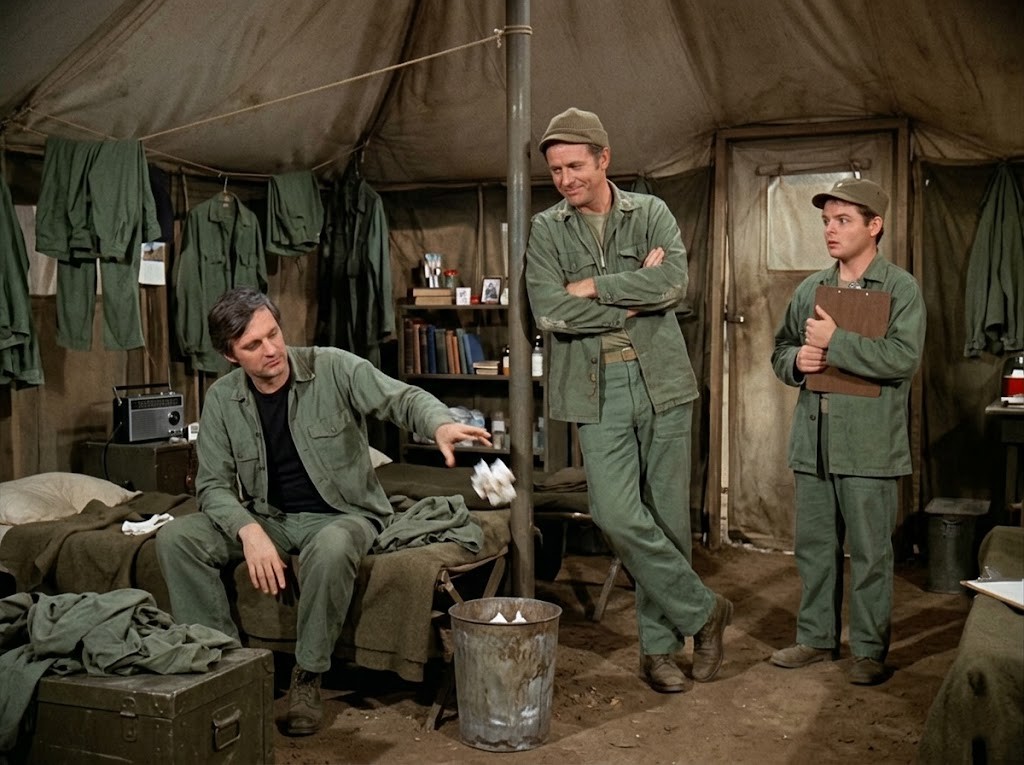
Some nights in the 4077th, the silence inside the Swamp was louder than the artillery rumbling over the hills. It was the kind of heavy, suffocating quiet that only followed a thirty-six-hour shift in Post-Op, where the smell of ether seemed to stain the very air you breathed.
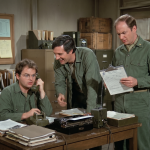
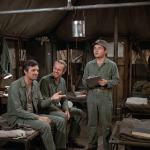
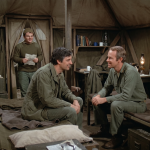
Hawkeye Pierce sat on the edge of his cot, his frame hunched forward under the weight of an exhaustion that went straight to the bone. He was still wearing his olive-drab fatigues, the fabric stiff with sweat and dust, his dark hair disheveled. In his hand, he held a crumpled ball of paper, staring at it as if it held the answers to a completely different life.
Across the tent, B.J. Hunnicutt leaned casually against the central wooden support pole, his arms crossed over his chest. A faint, knowing smile played on his lips, though his eyes carried the same deep, shadowed weariness that everyone in South Korea shared. He wore his familiar knit cap, tilted back just enough to watch his tentmate’s slow-motion battle with a blank page.
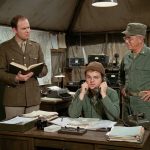
Standing near the canvas doorway was Radar Reilly, clutching a wooden clipboard tightly against his chest like a shield. His cap was pulled straight, his oversized glasses reflecting the dim light of the tent, and his face was a portrait of earnest, anxious concern. He had come in to deliver the evening mail, but instead, he had walked into a quiet crisis of the heart.
“That’s number seven, Hawk,” B.J. said softly, his voice cutting through the hum of the distant generator. “If you keep this up, Sparky is going to have to ration our supply of standard-issue stationery.”
Hawkeye didn’t laugh; he didn’t even look up. With a flick of his wrist, he tossed the crumpled ball toward the rusted galvanized trash can sitting in the middle of the dirt floor. It bounced off the rim with a soft thud and joined a half-dozen identical paper wads already filling the bin.
“It’s not a letter, Beej,” Hawkeye muttered, his voice raspy and devoid of its usual rapid-fire cadence. “It’s an obituary for my vocabulary. I’ve forgotten how to speak to people who don’t have shrapnel in them.”
Radar shifted his weight from one boot to the other, the clipboard creaking slightly in his grip. “Uh, Captain Pierce, sir? The mail jeep is leaving for Seoul in twenty minutes. If you want this to get on the bird to Maine, it kind of needs to be… written.”
Hawkeye finally looked up, his eyes bloodshot, fixing Radar with a look that was half-mocking and half-broken. “That’s the beauty of it, Radar. It is written. It’s just written in a secret code that looks exactly like a blank sheet of paper.”
“He’s writing to his dad, Radar,” B.J. explained, his tone shifting from playful to quietly protective. “But apparently, the English language has failed him.”
“It hasn’t failed me,” Hawkeye snapped gently, running a hand over his face. “I just don’t know how to tell a retired doctor in Crabapple Cove that I spent the last two days putting boys younger than Radar back together with twine and hope, without making him wish he’d raised a dentist.”
Radar took a small step forward, his lower lip twitching slightly as he looked from the trash can back to Hawkeye. He knew every piece of mail that entered and left this camp, and he knew how much those letters from Maine kept Hawkeye anchored to the earth.
“Your dad just wants to know you’re okay, sir,” Radar said, his voice dropping to that quiet, innocent register that always managed to disarm the cynics. “He doesn’t need a medical report.”
“That’s just it, Walter,” Hawkeye said, using Radar’s real name, a rare sign of absolute sincerity. “I’m not sure I am okay today. And he’ll know. He always knows.”
Hawkeye reached over to his footlocker, picked up a fresh sheet of paper, and stared at it. His hand hovered over the page, the pen trembling just a fraction of an inch above the surface, completely paralyzed.
The silence stretched out again, longer this time, filled only with the distant, rhythmic ticking of the small radio on the shelf behind Hawkeye. B.J. didn’t move from the pole, understanding that some distances couldn’t be crossed with a step, only with time.
“Write about the food,” B.J. suggested quietly, trying to inject a bit of home into the tent. “Tell him Igor tried to pass off something called ‘lamb ragout’ today, and three separate platoons used it to patch the tires on their trucks.”
Hawkeye let out a dry, breathy chuckle, but his eyes stayed fixed on the blank paper. “He’s heard the food jokes, Beej. I’ve used them all. I’ve used them to cover up the smell of the OR, the sound of the choppers, the rain that never stops. I’m out of jokes.”
Radar took another hesitant step, his boots crunching lightly on the dirt floor. He looked down at his clipboard, then up at Hawkeye, his expression shifting from anxiety to a profound, old-soul understanding that bypassed his youth entirely.
“When I write to my mom,” Radar said softly, looking down at his own boots, “I don’t tell her about the shelling. Or how cold it gets in the office at night. I just tell her about the stray dog I found behind the mess tent, or how Colonel Potter reminded me of Uncle Ed when he got mad at his typewriter.”
Hawkeye looked up at the young clerk, the sharp edges of his exhaustion softening just a bit.
“She likes hearing about the small stuff,” Radar continued, encouragement warming his voice. “She says it helps her picture me just… living. Not just being in a war. Maybe your dad just wants to picture you sitting in a tent, talking to your friends.”
B.J. nodded, pushing himself away from the wooden support pole and walking over to stand near the foot of Hawkeye’s cot. He placed a heavy, reassuring hand on Hawkeye’s shoulder, a solid weight in an unstable world.
“The kid’s right, Hawk,” B.J. said warmly. “You don’t have to explain the war to him. He knows what a war is. Just tell him we’re here. Tell him I’m still wearing the sweater Peg knit for me, even though it’s missing a sleeve. Tell him we’re looking after each other.”
Hawkeye looked at B.J., then at Radar, who was smiling hopefully through his thick lenses. The crushing isolation that had filled the Swamp only moments before began to thinned out, replaced by the simple, undeniable reality of the men standing beside him. They were miles from home, living in a canvas bubble surrounded by madness, but they weren’t alone.
Hawkeye looked down at the paper again. The pen didn’t feel quite as heavy this time.
“Dear Dad,” Hawkeye said aloud as his pen finally touched the paper, the ink flowing smoothly. “If you’re wondering how I am, just look at the nearest mirror. I’m tired, I’m stubborn, and I’m missing home. But I’m surrounded by the best people a terrible place could ever bring together.”
He paused, looking up at Radar with a sudden flash of his old, familiar grin. “How’s that for an opening, corporate?”
Radar beamed, a look of pure relief washing over his face as he checked his watch. “That’s real good, Captain. You’ve got exactly fourteen minutes to finish the rest, or it’s staying in Korea until Tuesday.”
“Go on, get out of here, you taskmaster,” Hawkeye joked, his pen already moving rapidly across the page, the words pouring out like a dam breaking.
Radar nodded quickly, clutching his clipboard to his chest with a bright smile, and slipped out through the tent flap into the gathering Korean dusk. B.J. walked back over to his own cot, kicking off his boots with a contented sigh, watching his friend write with a quiet, steady peace finally returning to the room.
In a place where tomorrow was never promised, a few words on a scrap of paper were the only bridge back to the people we used to be.