A Glimpse of Home, Hold the Dry Cleaning
If there was one universal truth at the 4077th, it was that the dry spells lasted longer than the monsoon season. And I’m not talking about the rain.
Every single one of us was thirsty—thirsty for news, for music that wasn’t propaganda, for food that hadn’t been dehydrated, but mostly just thirsty for a single moment that didn’t smell like ether.
You could feel the collective fatigue clinging to the canvas, heavy as the dust outside.
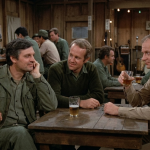
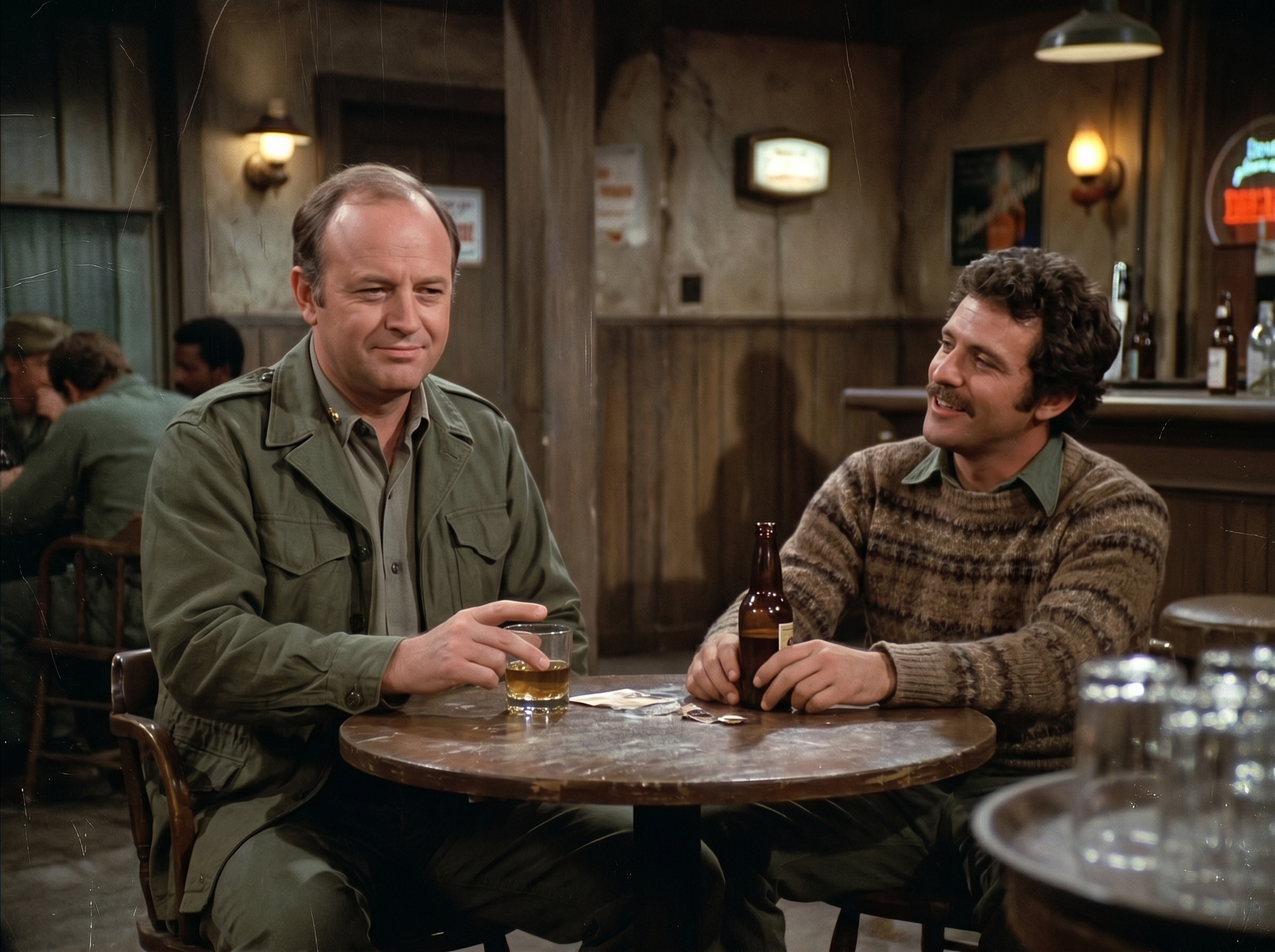
The Officers’ Club was the eye of the storm, the one place where, for an hour or two, the only triage happening was deciding between a lukewarm beer or something the bartender swore was gin.
Inside, the lighting was always dim, a hazy golden brown that perfectly matched the vintage of almost everything we drank.
On this particular Tuesday, there was a quiet stillness to the air, a rare gift.
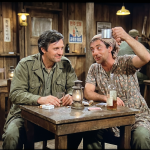
In a back booth, the kind with the padded benches that cracked and squeaked, sat two doctors who had seen more things than any man should have to carry.
B.J. Hunnicutt, ever the grounded one, was leaning in, that easy, comforting smile on his face, looking up from his beer.
He wore that soft, comfortable knit sweater of his, the kind that reminded you of crisp fall days back in San Francisco, not the unrelenting grey of this place.
Opposite him, Charles Emerson Winchester III held court in his own, quiet way.
Even in his field jacket, buttoned all the way up, Charles managed to project an air of Boston royalty that completely ignored the dirt floor beneath his boots.
He was holding his glass of scotch, a single amber pool, but he wasn’t looking at it. He was looking past it, past the table, past the room.
The expression on Charles’s face was complex, a carefully constructed fortress of dignity with a tiny crack showing, a mix of mild irritation and deep, guarded nostalgia.
What had brought this on? It wasn’t the surgery (that had been yesterday) or the artillery (that was an hour ago).
It was a letter.
Partially tucked under B.J.’s bottle of beer was an envelope. The address was written in precise, elegant script.
A letter from home. From the Winchesters.
And it wasn’t good news, not exactly. It was worse. It was mundane news that felt like a knife twisting in the ribs.
Charles took a slow sip. “You see, Hunnicutt,” he began, his voice surprisingly devoid of its usual caustic edge, “one simply cannot get good help these days. Even in Boston.”
“The situation is untenable.” He gestured vaguely with his free hand, like he was trying to wave away the absurdity of it.
B.J. nodded, his eyes sympathetic. He knew this kind of rambling. It was the pressure release valve before the engine burst.
“The dry cleaners,” Charles stated, as if that explained the entire universe. “The *reputable* dry cleaners. My favorite. They have… they have changed. Their process. Their standards. Their entire ethos is gone.”
B.J.’s eyes twinkled slightly. He couldn’t help it. “Charles, you’re talking about dry cleaning. In the middle of a war zone. I can get my shirt done here for two bucks and a prayer.”
Charles shot him a glance that could freeze a martini. “This isn’t about *cost*, Hunnicutt. It’s about civilization! This particular cashmere… it requires… it mandates… *decency*.”
He stopped, his throat tightening.
He was still holding his scotch, but it had tilted. Just a fraction. A tear was dangerously close to the corner of his eye, and the hand holding the glass was beginning to tremble.
This was Charles Winchester III, and he was about to break, all because of his dry cleaner.
The tension in the booth was thick. This wasn’t funny anymore. It was heartbreaking.
B.J. didn’t move a muscle. He didn’t want to break the spell, didn’t want Charles to retreat back into his cold shell. He knew the feeling. The sheer, crushing weight of mundane loss that feels more real than any battle.
In that dim, smoky air, a tear, finally, silently, spilled. Just one. It wasn’t a sob. It was a single, silent tear of pure, undistilled longing for a world that used to make sense.
“It’s the cashmere,” Charles repeated, his voice barely a whisper, the tremble in his hand now impossible to ignore. “My sister sent it. For Christmas. The winter of ‘48.”
He wasn’t looking at B.J. He was looking directly through him, into a dining room on Beacon Hill, with the smell of old paper and woodfires.
“And now… I can’t send it home. If I do, they’ll handle it with their *new, inferior process*.” The word *inferior* was spat out, a tiny spark of his old self. “It will be ruined. It will become… *unwearable*.”
He took another shaky sip of scotch, the glass clinking against his teeth.
B.J. watched him. He wanted to tell him it was just a sweater. He wanted to say that *people* were the only thing that mattered. But he didn’t. He knew better.
He knew that for Charles, a properly maintained cashmere sweater was a link to dignity, to history, to the life he was supposed to be living. It was his anchor in this muddy, chaotic sea.
“The dry cleaners,” Charles said again, this time with a deep, weary sigh, like the weight of the entire world had just settled on that one problem. “My father is furious, of course. My mother is beside herself.”
“It’s just… it’s one more thing, Hunnicutt. One more beautiful thing that can’t survive.”
He finally looked at B.J. The fortress was gone. His eyes were wide, wet, and absolutely vulnerable. It was the look of a child whose favorite toy has been broken.
B.J. slowly reached across the table. He didn’t touch Charles’s hand—he knew better than that—but he placed his own hand on the wooden table, right next to the letter. It was a gesture of presence, of shared space.
“My dad’s car,” B.J. said quietly. “A ‘38 Ford coupe. He loved that car. He used to take me to the park on Sundays. To get ice cream. To look at the ducks.”
Charles’s expression softened. The single tear had dried, but the vulnerability remained.
“He sent a letter too. A few months ago. He had to sell it. To pay for the new water heater.” B.J.’s voice was low, and his own gaze wandered. “He said he felt like he was selling his youth. Like he was officially old.”
B.J. met Charles’s eyes again. He gave a tiny, almost imperceptible nod. “I’m not in California. He’s not in the park. And your sweater is right here. It’s warm. It’s cashmere. And you look terrific in it.”
He tapped the table near the letter. “Your family, Charles. They’re right there in that envelope. They care enough to get furious about dry cleaning on your behalf. That’s love, Boston style.”
Charles stared at B.J., the words sinking in. Slowly, the focus came back to his eyes. He blinked, a couple of times. He let out a long, slow breath, a puff of weary breath that smelled faintly of scotch.
The hand holding the glass stopped trembling. He carefully placed the glass back on the table, not spilling a single drop.
A different smile started to touch Charles’s lips. It wasn’t his usual patronizing smirk. It was smaller, warmer, a smile of genuine amusement mixed with profound relief.
“Hunnicutt,” he said, his voice regaining some of its familiar texture, the Boston patrician tone back, but this time with a layer of something soft and new. “I believe I may have overreacted.”
He reached for the letter, tapping the envelope against the bottle. “The Winchesters. We do excel at being trivial.”
B.J. laughed. It was a warm, easy laugh that echoed softly in the quiet club. “Glad you noticed. I was worried we were going to have to do an emergency dry-cleaning intervention.”
Charles shook his head, but his eyes were shining with a kind of quiet strength. “Intervention. Good heavens. Next thing I know, you’ll be staging a sit-in for a properly aged cheese.”
He held up his glass, just a little, in B.J.’s direction. “To triviality. And to cashmere.”
B.J. raised his beer bottle. “And to families who still care enough to get mad.”
They clinked. A glass and a bottle. A scotch and a beer. A Brahmin and a beatnik. The sound was small, but in that quiet, dim room, it felt like the most profound thing either of them had said all week.
Outside, the wind kicked up a vortex of dust, rattling the windows. The distant crump of artillery came again, a faint reminder of the world they were temporarily avoiding.
Inside, the light still felt a hazy golden brown. But the two doctors in the booth were different now. The tension had gone, replaced by a quiet, warm tenderness.
They sat there for a long time, not talking. Just being. Being in this place, with this friend. Sharing the weight, holding the line. Together.
A small glimpse of home, held in a moment that was, in its own absurd way, absolutely perfect.
It’s the small, trivial things they hold onto that save them, together.