A Form of Kindness
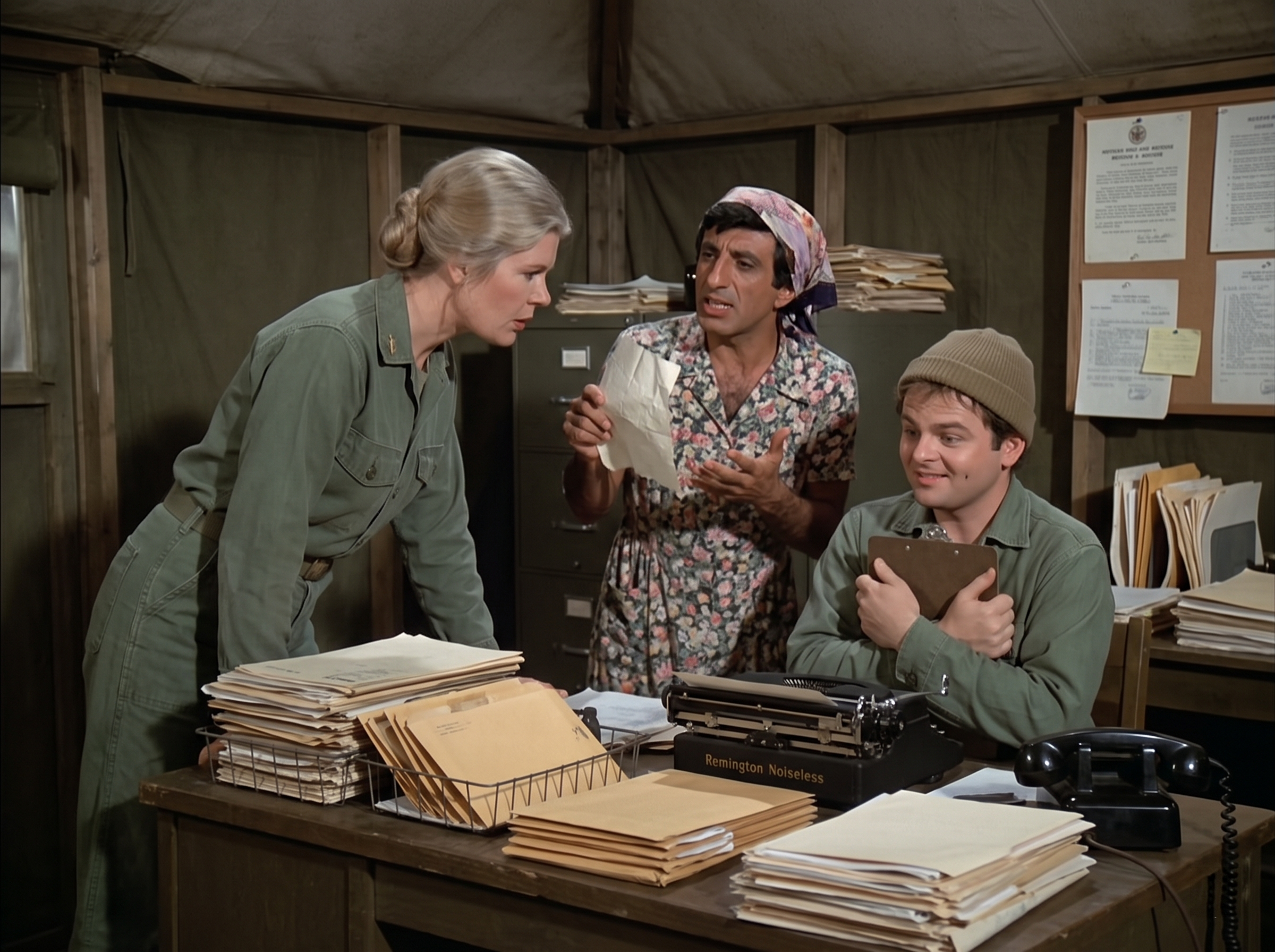
The war could wait, but Major Margaret Houlihan’s paperwork could not.
In a mobile hospital where the rules of civilization were routinely shattered by incoming choppers, the neat rows of forms and carbon copies were her only defense against total anarchy.
Right now, however, anarchy was winning.
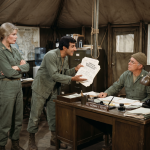
The midday heat had baked the Company Clerk’s office into a stifling canvas oven. Radar O’Reilly’s usually meticulous domain—a crowded, modest corner of administration—felt like a pressure cooker.
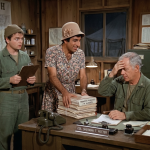
Stacks of beige papers, manila envelopes, and olive drab file trays threatened to spill over the edges of his wooden desk. In the center of it all sat his prized Remington Noiseless typewriter, an iron anchor in a sea of bureaucratic chaos.
Behind the desk sat Radar, trapped. He was clutching a brown wooden clipboard tightly to his chest, pulling it up under his chin like a shield. A nervous, completely innocent smile was frozen on his face.
He was trying very hard to disappear into his green knit cap.
Leaning intensely over the desk was Margaret. Her olive drab fatigues were worn but perfectly pressed, her blonde hair pulled back into an immaculate, regulation bun.
She wasn’t yelling. She didn’t need to. Her expression was sharply focused, professionally composed, and vibrating with an exhaustion that made her quietly terrifying.
“I am going to ask you one more time, Corporal O’Reilly,” Margaret said, her voice dangerously even. “Where is the quarterly surgical supply manifest?”
“I-I swear, Major,” Radar stammered, hugging the clipboard tighter. “I put it right there in the outgoing tray this morning. Right next to the requisitions for the tongue depressors.”
Before Margaret could escalate her interrogation, the screen door banged open.
In walked Corporal Maxwell Klinger, looking less like a soldier and more like a distressed housewife late for a neighborhood block party. He wore a loud, short-sleeved floral print dress, accessorized with a matching floral headscarf tied tightly under his chin.
He was muttering to himself, completely oblivious to the tension in the room. But what caught Margaret’s immediate attention was the piece of paper crumpled in his right hand.
It had a distinct pink carbon edge. The exact edge of a quarterly surgical supply manifest.
Margaret slowly stood upright, her eyes locking onto the paper. “Corporal Klinger.”
Klinger froze. He looked at Margaret, then down at the crumpled paper, then back up at Margaret. His theatrical panic engaged immediately.
“Major!” Klinger gasped, taking a dramatic step back and gesturing wildly with the paper. “I can explain! This is not what it looks like!”
“It looks,” Margaret said, her voice dropping an octave as she leaned back down over the desk, invading Klinger’s space, “like the only copy of my surgical inventory. The inventory that Colonel Potter needs in exactly ten minutes.”
Klinger held the paper away from her like it was a sacred relic. His face was a mask of wounded dignity.
“Major, please! You must understand!” Klinger pleaded, his voice rising in an operatic crescendo. “This is a document of profound psychological torment! The desperate ravings of a mind shattered by the unrelenting horrors of military service!”
Radar squeaked from behind the desk, his eyes darting between the two adults, completely overwhelmed by the comedic, administrative storm breaking over his head.
Margaret didn’t blink. She extended one steady, commanding hand across the cluttered desk.
“Give me the manifest, Klinger,” she whispered. “Before I personally see to it that you spend the rest of this war digging latrines in high heels.”
The silence in the office stretched out, heavy and thick with the dust motes dancing in the shafts of sunlight. Klinger stood frozen in his floral dress, his hands raised in a gesture of exaggerated surrender.
He looked at Margaret’s unwavering, outstretched hand. He looked down at Radar, hoping for a lifeline, but the young clerk just offered another helpless, wide-eyed smile and hugged his clipboard even closer to his chest.
“Major, I assure you, my intentions were purely medical,” Klinger tried one last time, though the theatrical bravado was rapidly leaking from his voice.
“Five seconds, Klinger,” Margaret said. “Four.”
With a heavy, dramatic sigh that ruffled the edges of his headscarf, Klinger surrendered. He gently placed the crumpled paper into Margaret’s palm, looking away as if he were handing over his own firstborn child.
Margaret snatched the paper. She smoothed it out on the edge of Radar’s desk, right next to the Remington typewriter.
It was, undeniably, the missing surgical supply manifest. The pink carbon edges were unmistakable. But as Margaret’s eyes scanned the page, her stern expression began to falter.
She frowned, leaning closer. The front of the form was covered in her meticulous handwriting, listing bandages, plasma, and sterile sutures.
But the back of the paper—the blank side—was completely covered in Klinger’s messy, frantic scrawl.
“What is this?” Margaret muttered, her professional composure cracking into genuine confusion. She squinted at the hastily scribbled columns.
She read a few lines aloud, her tone shifting from anger to bewilderment. “‘Four cases of Grade-A penicillin… trade for one jeep transmission… trade for three dozen jars of lanolin hand cream. Two crates of powdered eggs… trade for real coffee beans… trade for six pairs of thick wool socks.'”
Margaret stopped reading. She slowly looked up from the desk.
Klinger was no longer striking a pose of wounded dignity. He was just standing there, looking unusually sheepish, nervously picking at a loose thread on his floral dress.
“I was, uh… I was running out of scrap paper, Major,” Klinger mumbled, dropping the high-pitched theatrical voice entirely. “And I needed to do some black-market calculus.”
Margaret stared at him, the exhaustion of the 4077th weighing heavily on her shoulders. “You stole my surgical inventory… to calculate a trade for hand cream and wool socks?”
Klinger sighed, leaning against the filing cabinet. The camp suddenly felt very quiet around them.
“I saw Nurse Bigelow crying in the mess tent yesterday,” Klinger said softly. “Her hands were cracked and bleeding from that lye soap we’ve been using in the scrub room. And…” He hesitated, glancing at Margaret. “With all due respect, Major, you look like you haven’t felt your toes since November. You’re all working thirty-six-hour shifts.”
Margaret said nothing. The fierce, commanding officer vanished for a brief second, replaced by a tired, deeply moved woman. She looked down at her own hands, raw and red from endless hours of scrubbing into surgery.
Klinger had hijacked her vital military paperwork not to fake another mental illness, but to run a quiet, illegal supply line to keep her nurses from falling apart.
The tension in the room evaporated, leaving behind a profound, tender ache. It was the strange, upside-down reality of their shared existence. The only way to survive the madness was to care for each other, even if it meant breaking every rule in the book.
From behind the desk, Radar finally lowered his wooden clipboard.
“Uh, Major?” Radar said, his voice quiet but steady.
Margaret looked over at the young clerk. Radar carefully unclipped a pristine, perfectly typed piece of paper and held it out to her.
“I, um, I knew Klinger took your draft copy this morning,” Radar explained, offering that same innocent smile, only this time it was genuine. “I already typed up a clean copy for Colonel Potter. It’s ready to go.”
Margaret looked at the clean form in Radar’s hand, then at the crumpled, scribbled form on the desk, and finally at Klinger, who was still wearing a floral dress and waiting for his punishment.
A slow, soft smile touched the corners of Margaret’s mouth. It was a rare, genuine expression of warmth that she saved only for her people.
She reached out and took the clean copy from Radar. “Thank you, Corporal O’Reilly. Your efficiency is, as always, commendable.”
Then, she picked up the crumpled draft and held it out to Klinger.
Klinger took it carefully, confused. “Major? Am I not going to be digging latrines?”
Margaret straightened her uniform jacket, her professional mask sliding back into place, though her eyes remained unusually soft.
“Just make sure you get a good exchange rate on those powdered eggs, Klinger,” Margaret said quietly. “And I expect that lanolin cream to be delivered to the nurses’ tent by nightfall.”
Klinger’s face lit up with a brilliant, relieved smile. He offered a sharp, completely un-ironic salute. “Yes, ma’am. Only the finest black market goods for our girls.”
Margaret turned and walked out of the cramped office, leaving the door to bang shut behind her.
In the quiet that followed, Radar placed his clipboard back on the desk and let out a long, shaky breath. Klinger looked at the paper in his hand, smoothed out the wrinkles, and tucked it safely into the pocket of his dress.
They didn’t say anything to each other. They didn’t have to.
It was just another afternoon at the 4077th, where family came first, sanity came second, and the paperwork always eventually found its way.