The Silent O.R.
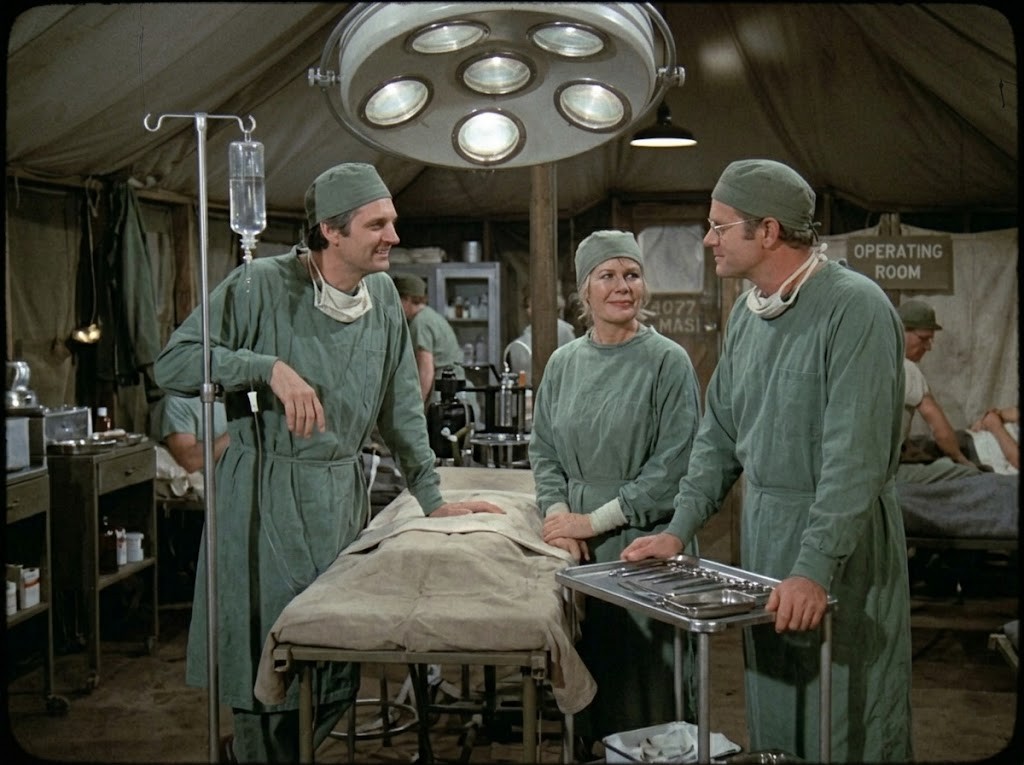
Sometimes, after the last suture is tied and the doors finally swing shut, the silence of the Operating Room is louder than any choppers.
It was one of those nights. We had been in here for fourteen hours straight, a conveyor belt of bodies, blood, and the smell of fear.
Now, the room was empty of patients, but the air still felt thick. The heavy, round surgical lamp overhead casts a tired, warm glow, pressing down on us like a humid blanket.
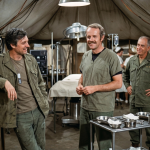
I was standing by the tray of instruments, my hands aching, a tremor I’d never admit to just starting in my fingers. Every muscle screamed, and I was pretty sure my feet were fused to my boots.
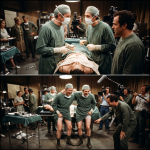
I looked over at Pierce and Margaret. They were framed perfectly in the dimness, separated only by the empty gurney where we’d seen so much pain.
Margaret was still in her gown, her hands clasped, a look on her face I only saw when she thought no one was watching. Not Major Houlihan, the Chief Nurse—just Margaret, a woman who’d given everything she had.
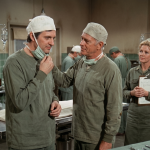
Pierce was near the I.V. pole, his hand resting on the gurney as if trying to stabilize himself. His mask was down, and I could see the lines etched around his eyes by exhaustion, deeper than I’d ever seen them.
I knew that look. We all did. It was the moment the exhaustion finally broke through the wall of gags and sarcasm.
“Well,” Pierce said, his voice ragged. He didn’t smile. He just looked at me. “That was… efficient.”
Margaret let out a short breath, not quite a sigh, her eyes fixed somewhere on the fabric of the gurney cover. “Nobody died in the last two hours,” she murmured. “We call that a win.”
I tried to think of something to say. Something that would offer some kind of balance, some anchor. But my brain was too fogged, and my heart felt heavy as a cinder block.
We just stood there, the three of us, suspended in that terrible, warm silence.
It felt like the lightest touch, the smallest word, would break all of us. I could see Pierce’s knuckles turning white where he held the gurney. Margaret’s gaze hadn’t wavered.
Then, the tent flap near the door rustled, and I knew before I even heard his boots that something had changed.
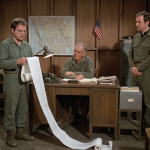
A shadow appeared in the doorway, and the faint scent of cigar smoke drifted into the sterile room. Colonel Potter stepped through, his expression unreadable, holding a clipboard like a shield.
We didn’t move. We were almost frozen, a tableau of fatigue and silent understanding.
Colonel Potter stopped just inside, his eyes scanning the room, taking us in. He looked tired too, his own posture a bit more slumped than usual, his face lined with the worry that never quite leaves a commanding officer’s eyes.
He didn’t speak right away. He just looked from Margaret, to me, to Pierce. I saw the muscles in his jaw tighten, and for a fleeting moment, he looked almost… tender.
“Sir?” I finally managed, my voice sounding strange in the quiet.
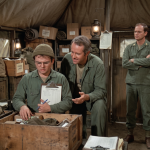
Potter didn’t answer me. He looked directly at Hawkeye. “Pierce,” he said, his voice surprisingly quiet. “Klinger’s found a cache of… well, it’s not exactly medical supplies.”
Hawkeye finally cracked. A weak, tired smile touched his lips. “Define ‘not exactly medical,’ Colonel.”
A dry, appreciative chuckle rumbled in Potter’s chest. “Looks like some officers left behind a case of remarkably passable Scotch and some decent cheese. Radar says Klinger is currently wearing it.”
“The cheese?” I asked.
Potter’s smile widened. “No, Hunnicutt. The Scotch. He’s insisting it’s camouflage. He’s currently hiding in a jeep, telling Father Mulcahy it’s a form of holy water.”
Margaret actually let out a short, surprised laugh, the tension leaving her shoulders. I felt my own shoulders relax, and even Hawkeye looked a little brighter.
“It’s not exactly regulation,” Potter continued, looking toward the O.R. sign. “But I figure we all need to remember what color Scotch is, outside of this tent. It’s early morning. There are no choppers. We did good today.”
He gestured with the clipboard toward the doorway. “I suggest we all find out what color it is, as a tribute to camouflage and holy water.”
He looked again at the three of us, his gaze fatherly and warm, acknowledging everything we’d done, all the pain we’d witnessed and held back. “We have the best damn surgical staff in Korea,” he said, his voice thick.
“Well,” Hawkeye said, pushing himself off the gurney, the lines around his eyes finally softening into a genuine smile. “I wouldn’t want to break regulations. But I do feel a sudden, strong need to inspect this… camouflage.”
He reached out and lightly, almost imperceptibly, patted Margaret’s arm. “You coming, Major? You could probably identify the region of origin with that nose of yours.”
Margaret rolled her eyes, but the warmth was back in them. “Someone has to make sure you two don’t drink the evidence,” she retorted, turning.
I picked up the tray. “You coming, Colonel?”
“I’ll be there directly, Son,” Potter said, already turning to leave, but looking back over his shoulder. “I need to go rescue the chaplain from a jeep.”
As we walked out into the cool Korean air, leaving the dim, silent Operating Room behind, I looked up at the stars. They seemed clearer now.
We weren’t just colleagues. We weren’t just soldiers.
We were a family, forged in the heat of a tent and the shared silence of the O.R.
We would get through this night. We would get through all the nights. Because we were here, and we had each other, and sometimes, that had to be enough.
—
It was just another long night at the 4077th, but it was *our* night, and that made all the difference.