A Quiet Kind of Victory
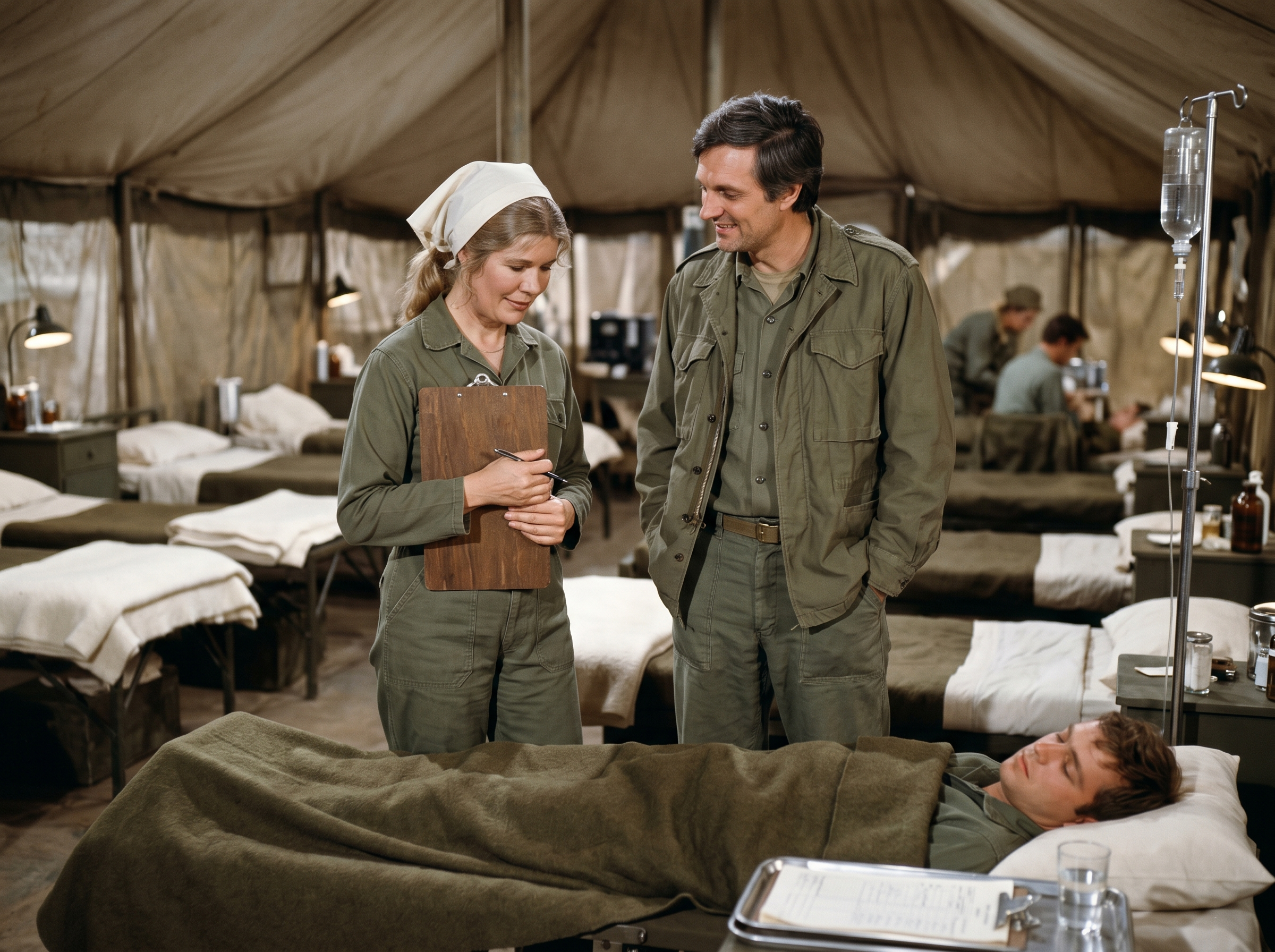
The rain had finally stopped, leaving the canvas of the Post-Op recovery tent sagging heavily under the weight of water and a lingering chill. Inside, the quiet was profound. It was a rare kind of quiet that only settled over the 4077th after a forty-hour OR session, a stillness that somehow felt louder than the artillery on the hill. It was the collective breath before the next storm, and it was the only time the unit seemed to rest.
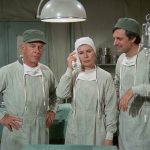
Margaret Houlihan stood by cot four, her head nurse’s scarf immaculate even now, despite the dark circles under her eyes. She was holding a clipboard, her pen poised above the chart, but she wasn’t writing. She was looking down at the young soldier sleeping under the olive-drab blankets—a boy named Miller who couldn’t have been more than nineteen, his face smooth and untroubled in sleep for the first time in months. And Margaret was smiling. It was a genuine, unexpected smile, warm and soft and entirely inconsistent with the Major Houlihan the camp usually saw.
Hawkeye Pierce saw it first. He was slouching nearby, his own M-65 field jacket draped loosely over his shoulders, trying to remember what clean sheets felt like. He’d just finished his own rounds and was heading to the Swamp, but the unexpected vulnerability on Margaret’s face had stopped him in his tracks. He didn’t say anything. He didn’t drop a zinger or mock the cleanliness of the charts. He just stood there, matching her soft expression with a slow, knowing smile of his own.
It was a strange, silent moment. Their usual professional armor was gone, stripped away by fatigue and the profound human truth of the recovery ward. They were just two tired people in a cold tent, sharing a look over a sleeping kid that said more than any argument they’d ever had. Hawkeye moved a step closer, his eyes fixed on whatever it was Margaret was really looking at on that clipboard.
The air felt still and heavy, charged with a gentle kind of curiosity. He knew she saw him, and she hadn’t bristled. She hadn’t snapped to attention or ordered him out. Instead, she seemed content to let him share the quiet. He was about to ask her what she found so compelling, already feeling the light-hearted quip forming on his lips to break the spell. And that’s when Margaret did something truly shocking: she didn’t look up, but she did tilt the clipboard slightly, allowing him to see what was clipped beneath the official medical records.
Hawkeye’s gaze dropped. There, clipped to the paper, was not an X-ray or a lab result, but a small, crinkled drawing of a bright yellow tractor, made with crayons by a hand far younger and more innocent than anyone currently in the tent. A single sentence was scrawled at the bottom, just visible in the practical light.
A single sentence scrawled at the bottom read: “Safe home, Uncle Tommy, this tractor will stay in the field where I left it for you.”
Hawkeye’s humor evaporated. The quip died in his throat, replaced by a strange, expanding tightness in his chest. He looked back up at Margaret, and their shared smile—the one captured so clearly in the soft light of the tent—took on a entirely different meaning. It was a smile born of shared relief and profound, hidden tenderness.
Margaret had always been the strongest shield the 4077th had. She commanded her nurses like a general and maintained an iron discipline that frustrated Hawkeye’s chaotic energy. But here, over the body of a boy who had broken down from battle fatigue, not bullets, her strength revealed its true nature: it was a fierce, protective wall. The kid, Miller, had arrived near-catatonic, refusing to speak, his body tense with constant, invisible nightmares.
They all knew how hard the case had been. Margaret had been the one to find the drawing tucked into his tunic. She hadn’t treated it like contraband; she’d kept it safe. It was Radar who had slipped into the Post-Op ward earlier, with mail and the news that Klinger was organizing a camp-wide scavenger hunt to distract the patients. The drawing, so simple and filled with innocent hope, had been the key. Margaret had sat with Miller for three hours, not saying a word, just holding the crayon drawing in front of him. Finally, the soldier had cried. And after he cried, he had slept, like this, with a genuine peace they hadn’t thought possible a day ago.
Hawkeye understood now. His tired posture relaxed into something softer as he absorbed the story behind the silence. Margaret wasn’t looking down with pity; she was looking down with pride. And he wasn’t smiling at her because she was human; he was smiling because he was genuinely proud of her. For one moment, the endless debate between cynicism and discipline, of rank and chaos, was utterly irrelevant. There were no officers here, and no surgeons. Just two people in a war zone, witnessing a quiet kind of victory over despair.
Margaret’s smile deepened slightly as she shifted her weight. She made a subtle mark on the chart, perhaps the notation ‘Patient resting comfortably. Psychological outlook improved.’ She didn’t look up as she spoke, but her voice was different—modest, gentle, and utterly devoid of rank.
“Radar brought this mail earlier. He seemed particularly concerned about this one.”
“Of course he did,” Hawkeye murmured, matching her tone. A quiet chuckle escaped him. “That kid is an emotional early warning system. He probably heard the tractor idling through the mail sack.”
She did look up then, for just a fraction of a second, her expression holding a flash of amusement before she returned her gaze to the chart. She didn’t tell him to leave. She didn’t correct his language. They simply existed in that space, together, for a minute longer. The background noise of the ward—other patients shifting, an IV stand chiming—faded into a comfortable, shared reality. The simple human connection in the ward felt far more powerful than any surgery they could perform.
Hawkeye finally took a deep breath, the sound barely audible. He glanced towards the tent flap. The moment was over, but the feeling it created remained. The profound respect between them was a sturdy bridge that would carry them through the next crisis. They were bound not just by exhaustion and medical skill, but by a shared understanding of the cost of the human spirit. He nodded subtly to Margaret, a single, silent gesture of goodbye and shared memory. Then he turned, his boots muffled by the tent floor, and walked towards the Swamp. Behind him, Margaret Houlihan finally put her pen back on the clipboard and moved to the next cot, her focus once again perfect and professional, but her smile lingering just beneath the surface, warmed by a memory that belonged only to the 4077th.
In the end, it was the quiet, shared moments over a sleeping soldier that proved the heart of the 4077th always found a way to win.