The Quiet Corner of the 4077th
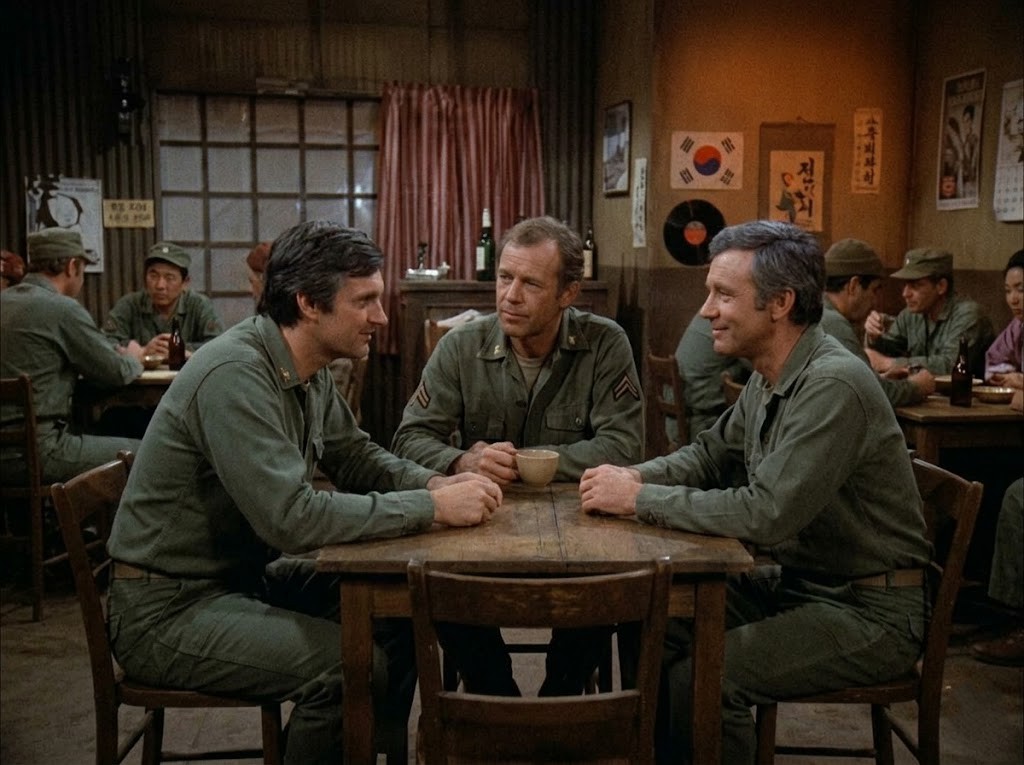
The mud of Korea has a way of settling into the soul just as deeply as it settles into the floorboards of the mess tent. It was one of those evenings where the silence felt heavier than the shelling—a rare, fragile pocket of time where the war seemed to have momentarily forgotten us.
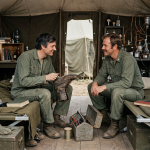
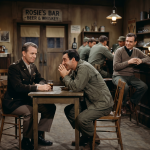
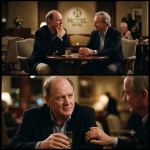
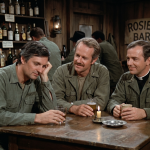
Hawkeye sat at the scarred wooden table, his shoulders slumped with a fatigue that no amount of coffee could ever truly chase away. Across from him, B.J. held a steaming cup of that infamous powdered brew, his eyes scanning the room with the steady, grounded warmth that usually kept the rest of us from drifting off into the void. Between them sat Charles, looking as though he had been dropped into a dive bar by mistake, yet somehow anchoring the table with his stubborn, upright posture.
They weren’t talking about surgery. They weren’t talking about the wounded or the weather or the madness of the front lines. They were just sitting.
Hawkeye picked at a splinter on the table edge, his trademark smirk absent, replaced by a contemplative stillness. “I think,” he started, his voice raspy and barely above a whisper, “that if I have to look at another crate of canned peaches, I might actually try to petition the United Nations for a divorce from this army.”
B.J. chuckled, a low, rumbling sound that felt like home. “Careful, Hawk. You know the army doesn’t believe in alimony. They’d probably just send you to an even colder tent with worse company.”
Charles sighed, the sound echoing with theatrical disdain. “And yet, you would still be subjected to the same subpar swill they masquerade as ‘coffee.’ Honestly, the lack of standards in this godforsaken theater of operations is the true tragedy of the century.”
It was a classic rhythm, a dance they had performed a thousand times before. But tonight, the air felt thick with something unsaid. Hawkeye leaned forward, his expression shifting from dry sarcasm to something raw, something that flickered with the ghost of a thousand memories he couldn’t quite put to bed.
“You know,” Hawkeye murmured, stopping mid-sentence, his gaze darting toward the window as a distant, dull thud vibrated through the ground. The cup in B.J.’s hand wobbled, a splash of brown liquid hitting the wood, and for a heartbeat, the banter died entirely. The silence that followed was suffocating, a sudden, sharp reminder that peace at the 4077th was always on loan.
The thud didn’t come again. We waited, our breath held in unison, until the normalcy of the mess tent—the clinking of tin plates, the low murmur of soldiers in the background—crept back in.
B.J. took a slow, deliberate sip of his coffee, as if trying to prove that his hands weren’t shaking. He met Hawkeye’s gaze, and the tension that had tightened in the air began to unspool, replaced by that quiet, unspoken understanding that brothers-in-arms share.
“It’s okay, Hawk,” B.J. said quietly, his voice dropping the humor entirely. “We’re still here. And for tonight, at least, that’s enough.”
Charles, usually the first to retreat behind a wall of arrogance, let his guard slip just an inch. He looked at the two men across from him—men who had seen the same horrors he had, men who had held the same fragile threads of sanity together in the middle of the night. He didn’t offer a biting retort or a lecture on social graces. Instead, he simply reached out and adjusted the position of the sugar bowl, his movements precise and strangely gentle.
“I suppose,” Charles conceded, his voice losing its sharp edge, “that in the grand architecture of this chaotic life, a mediocre cup of coffee among friends is not the worst foundation upon which to build an evening.”
Hawkeye looked at them both, the tightness around his eyes softening. He saw the fatigue on their faces—the same fatigue he felt in his own bones—but he also saw the resolve. There was no grand speech to be made, no heroic gesture to be performed. There was only the act of sitting together, of proving to the universe that they hadn’t been hollowed out yet.
We found our moments where we could. Sometimes it was a prank, sometimes it was a bottle of gin, and sometimes, it was just sitting at a beat-up table, letting the day’s debris settle so we could stand up and face the next one.
The mess tent hummed with the lives of people just trying to make it to sunrise. Watching the three of them—Hawkeye’s weary eyes finding light in his friends, B.J.’s steady presence acting as a lighthouse, and Charles, finally, truly, part of the circle—I realized that the war took a lot from us. It took our youth, our sleep, and our peace of mind.
But it didn’t take this. It didn’t take the way we learned to look after one another, to fill the quiet spaces with loyalty, and to find the humanity in a place where it was meant to disappear. As the light in the tent dimmed and the shadows lengthened, the camaraderie felt like a warm blanket against the cold, indifferent night.
We weren’t just doctors or soldiers anymore. In that messy, muddy, tired corner of the world, we were family. And somehow, in the middle of the madness, that was the most important thing of all.
Sometimes, the greatest act of courage is simply showing up for one another.