A Letter from Home in the Heart of the War
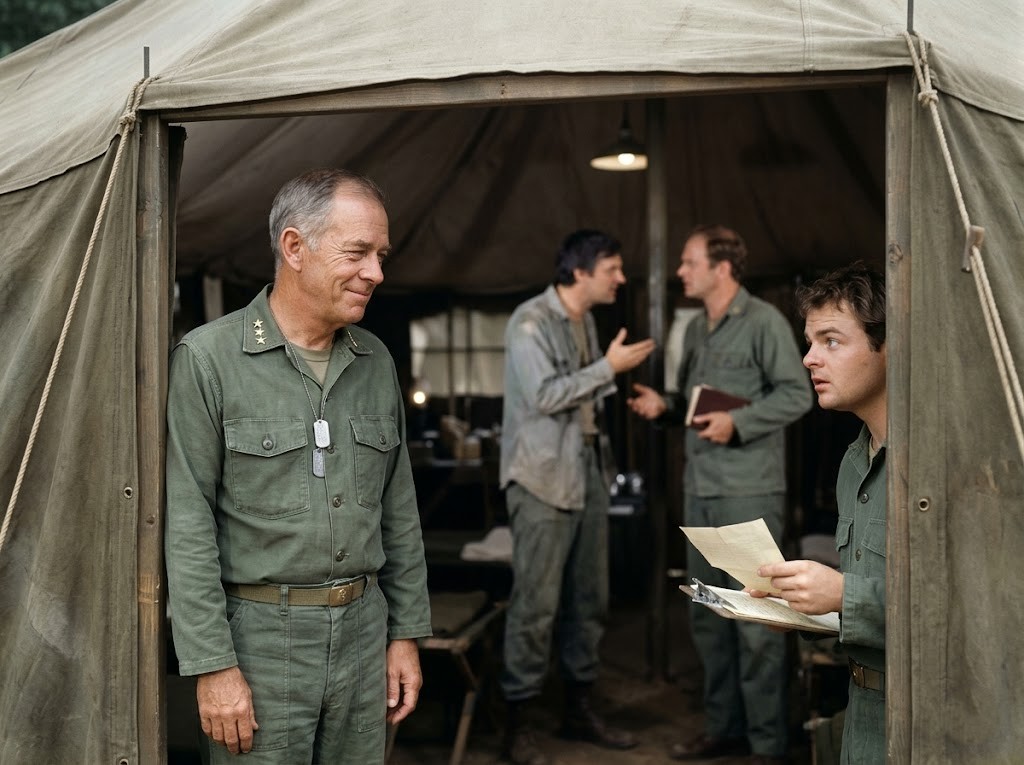
The 4077th Mobile Army Surgical Hospital ran on a delicate, highly unstable mixture of weak black coffee, terrible jokes, and the desperate, clinging hope of the morning mail call.
It was a rare, quiet morning in camp. The kind of morning where the dust settled just enough to let you forget, for a split second, that there was a war raging just over the nearest ridge. The sun was filtering through the olive-drab canvas of the command tent, casting long, lazy shadows across the dirt floor.
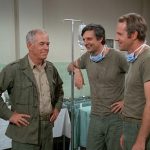
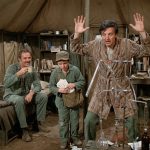
In the back of the tent, the war of words was fully underway. Hawkeye Pierce, looking entirely too awake for a man running on three hours of sleep, was gesturing wildly with his hands. He was deep into a passionate, highly technical argument with B.J. Hunnicutt regarding the exact trade value of two tins of smuggled smoked oysters versus a surprisingly clean pair of argyle socks.
B.J. leaned against a wooden crate, a battered paperback book resting in his hands. He was shaking his head with that quiet, tolerant amusement he reserved specifically for Hawkeye’s manic energy, occasionally tossing out a dry counter-offer that only wound his friend up further.
But at the entrance of the tent, the real world was quietly knocking.
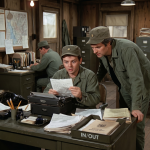
Corporal Radar O’Reilly stepped through the tent flaps, moving with that strange, shuffling urgency he always possessed. He was clutching his ever-present clipboard against his chest like a wooden shield. Tucked under the heavy metal clip was a single piece of crumpled, pale blue stationary.
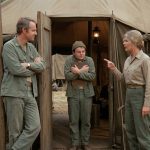
Radar stopped just inside the doorway. His oversized uniform hung off his narrow shoulders, and his round glasses slipped slightly down his nose. He looked up, his wide, earnest eyes locking onto the older man standing before him.
Colonel Sherman T. Potter stood casually near the center post, his dog tags resting against the faded green cotton of his fatigue shirt. Potter was a man who had seen too many wars, too many broken boys, and too many grim mornings. Yet, as he looked down at his young clerk, a remarkably soft, almost grandfatherly smile broke across his weathered face.
“What is it, son?” Potter asked, his voice a low, gravelly rumble that somehow managed to sound like a warm blanket. “You look like you just saw a ghost, or worse, Frank Burns without his hair gel.”
“It’s a letter, Colonel,” Radar stammered, his fingers nervously tracing the edge of the clipboard. “It’s not official army business, sir. It came in the mail sack from Seoul, but it got routed wrong. It’s from Ohio.”
“Well, spit it out, Corporal. My ears are open and the army isn’t paying us by the hour,” Potter said gently, leaning forward slightly.
Radar swallowed hard. He lifted the clipboard, his eyes scanning the neat, cursive handwriting on the blue paper. “It’s from a Mrs. Sarah Jenkins, sir. Her boy, Private First Class Tommy Jenkins… he came through here about a month ago. Shrapnel in the chest and legs. It was a real bad one, sir.”
Hawkeye and B.J. were still bickering softly in the background, their voices a low hum of comfortable distraction. They hadn’t tuned into the conversation at the front of the tent yet.
“She says…” Radar’s voice suddenly wavered, cracking under a sudden, unexpected weight. “She says the army telegram told her Tommy wasn’t expected to make the flight to Tokyo.”
Radar stopped reading. His young face went entirely pale. The piece of paper trembled against the wood of his clipboard. He looked up at Potter, his eyes suddenly swimming with tears, completely unable to finish the sentence as a heavy, crushing silence fell over the front of the tent.
The silence in the tent stretched out, thick and heavy.
In the background, the banter abruptly died. The doctors of the 4077th possessed a radar of their own—an instinct honed by months of trauma that told them exactly when the air in a room shifted from comedy to quiet crisis. Hawkeye lowered his hands, his exhausted face instantly sobering. B.J. quietly closed his book, his posture straightening as both men turned toward the young corporal.
Potter didn’t rush the boy. He didn’t issue a command. He simply stood there, his hands relaxed at his sides, maintaining that steady, anchoring presence.
“Take a breath, son,” Potter said softly. “Just take your time. What else does Mrs. Jenkins have to say about her boy?”
Radar took a shuddering breath, blinking rapidly behind his thick lenses. He adjusted his grip on the clipboard, anchoring himself to the familiar wood, and looked back down at the fragile blue paper.
“She says…” Radar began again, his voice barely above a whisper. “She says Tommy made it. He survived the flight. He’s at a VA hospital in Cleveland now. The doctors there say he’s going to walk again. He even gets to go home for Christmas.”
A collective, silent exhale seemed to wash through the canvas walls. Hawkeye leaned back against a support pole, rubbing a hand tiredly over his face, a small smile touching the corners of his mouth.
But Radar wasn’t finished. He looked up, his expression a mixture of confusion and overwhelming awe.
“But she didn’t write to thank the surgeons, Colonel,” Radar said, glancing nervously over Potter’s shoulder toward Hawkeye and B.J.
Hawkeye pushed himself off the pole and stepped slowly into the light. His typical, biting sarcasm was entirely absent, replaced by a profound, gentle weariness. “That’s okay, Radar. We get enough praise from our egos. Who did she write to?”
Radar looked back at the letter. “She says Tommy remembers waking up in the post-op ward in the middle of the night. He was hurting real bad, and he was terrified. He thought he was dying.” Radar swallowed hard. “She says a young corporal with round glasses and a soft voice sat by his cot.”
Potter’s smile deepened, his eyes crinkling at the corners as he looked down at the boy.
“She says the corporal sat there for three hours,” Radar continued, his voice trembling again. “She says he talked to Tommy about a family farm in Iowa. About a pregnant cow, and how the corn smells when it rains in the summer. And Tommy told his mom…” Radar had to stop to wipe a stray tear from his cheek. “Tommy told his mom that the corporal’s voice was the only thing that kept him from letting go in the dark.”
The tent was absolutely still. The distant, rhythmic chugging of the camp generator seemed to fade away entirely, leaving only the profound warmth of the shared moment.
Radar looked up at the three older men, genuinely bewildered by his own impact. “But Colonel… I didn’t do any medicine. I just talked to him ’cause he was shivering and the nurses were busy with the fresh wounded. I didn’t save his life.”
B.J. stepped forward, closing the distance. He reached out and tapped the edge of the clipboard. His voice was warm, grounded, and deeply sincere. “Walter, we just sew the holes together. We fix the plumbing. But sometimes, a guy needs a reason to want to wake up the next morning. You gave him that.”
Hawkeye nodded slowly, crossing his arms over his chest. “Beej is right, kid. The scalpel is just a piece of metal. You brought him a piece of home. Believe me, that is a hell of a lot harder to prescribe than morphine.”
Radar blushed a deep, furious red, his gaze dropping instantly to his dusty boots. He carefully smoothed out a tiny wrinkle on the edge of the blue stationary, treating the letter like a sacred, priceless relic.
Potter reached out, his large, calloused hand resting heavily on Radar’s shoulder. He gave the boy a firm, affectionate squeeze. It was a small gesture, but it carried the immense weight of a father’s quiet pride.
“You file that letter away in your personal records, Corporal,” Potter said, his voice thick with emotion. “Right at the top. And when this lousy war gets to be too much, you take it out and read it again.”
“Yes, sir,” Radar whispered, a small, proud smile finally breaking through his nerves.
Outside, the unmistakable, rhythmic chopping of helicopter blades began to echo faintly over the distant hills. The war was returning. The brief, precious moment of peace was coming to an end. Blood and chaos would soon be rolling through the compound gates.
But as they all turned to head out into the madness, the air in the tent felt just a little bit lighter, warmed by the quiet grace of a farm boy who never truly knew how important he was.
In a place surrounded by death, it was the smallest acts of humanity that kept them all alive.