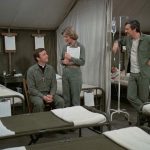
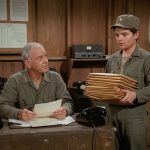
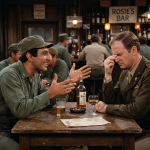
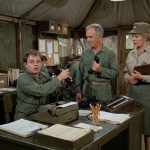
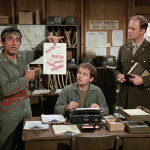
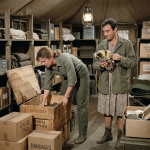
The Symphony in the Mud
You can learn a lot about a man by what he clings to when the world is falling apart.
In the 4077th, where the mud was thick enough to swallow a jeep and the smell of ether never quite washed out of your fatigues, survival meant finding a piece of home and holding onto it for dear life.
For Radar O’Reilly, it was Grape Nehi and the soft breathing of his hidden rabbits. For the newly arrived Major Charles Emerson Winchester III, it was something entirely different—and infinitely more fragile.
It had been a brutal seventy-two hour session in post-op, a relentless parade of broken bodies that left everyone bone-tired, hollow-eyed, and completely drained of words. When the choppers finally stopped coming, a heavy, suffocating silence settled over the camp, broken only by the distant, low rumble of artillery.
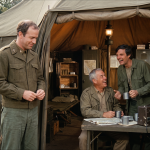
Charles had retreated to the Swamp, desperate to insulate his refined senses from the crude realities of the Korean peninsula. But peace was a luxury the army rarely permitted, and within an hour, a sudden, violent windstorm tore through the compound, threatening to rip the very canvas from the wooden frames.
When the wind finally died down, a frantic commotion outside drew Charles to the threshold of his tent.
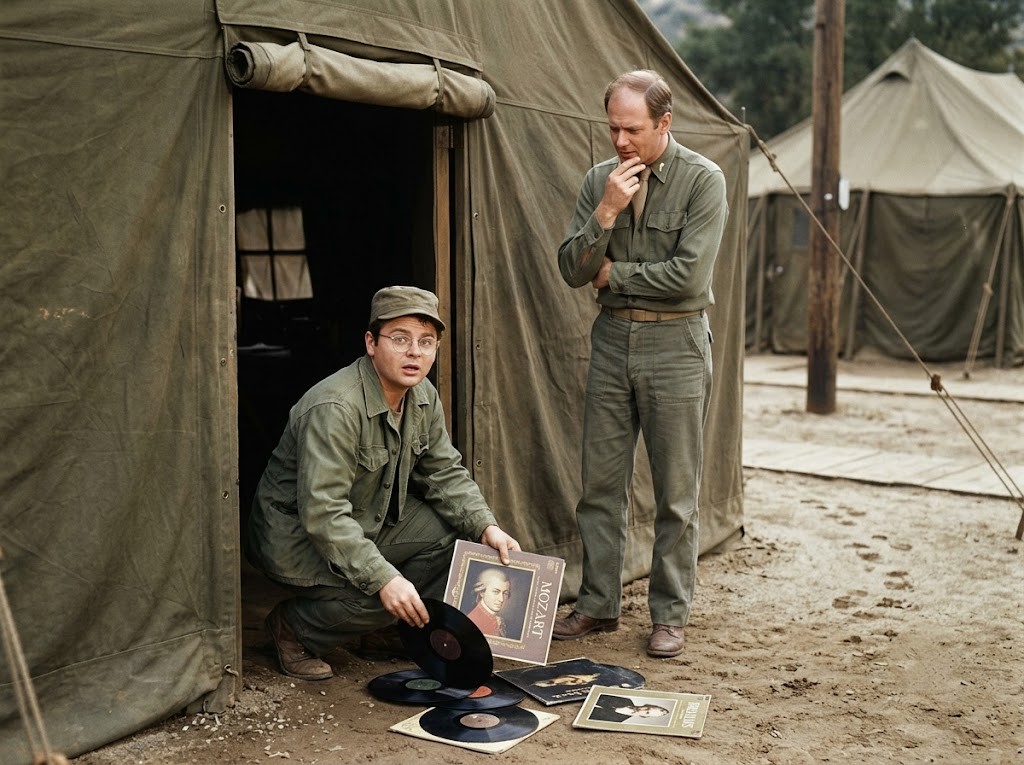
There, kneeling in the damp, unforgiving dirt right outside the doorway, was Radar. The young corporal was frantically gathering a scattered collection of large, black vinyl discs from the ground, his face pale and his oversized glasses sliding down his nose.
Charles froze, his eyes widening in a mixture of horror and disbelief as he looked down at the muddy earth.
Spread out across the dirt were his most prized possessions: his rare, imported classical phonograph records.
Radar looked up, holding a pristine copy of Mozart’s portrait against his chest like a shield, his jaw dropped in utter terror. He looked completely frozen, caught red-handed in what Charles would surely consider a capital offense.
Charles stood tall, one hand migrating to his chin, his brows furrowing as a wave of aristocratic fury began to brew beneath his tired exterior. “Corporal O’Reilly,” Charles said, his voice a low, dangerous rumble that vibrated with Bostonian indignation. “Please tell me those are not my immaculate, irreplaceable recordings of the masters currently sunbathing in the Korean mire.”
“I-I’m sorry, Major!” Radar squeaked, his voice cracking as he tried to juggle three records at once, accidentally letting one slip back onto the damp ground with a soft, sickening thud. “The wind… it caught the back flap of the Swamp, and the shelf just… well, it gave way, sir! I saw them flying out into the dirt, and I knew you’d… you’d…”
“I would what, Corporal? Have you drawn and quartered? Court-martialed? Shipped to the front lines with nothing but a butter knife?” Charles stepped forward, his boots squelching in the mud, his eyes fixed on a scratch that ran precariously close to the grooves of a Beethoven concerto.
“I just wanted to save them for you, sir,” Radar whispered, his eyes wide and earnest, looking small and vulnerable in his oversized fatigues. “I know how much they mean to you. I know they’re… they’re your family out here.”
Charles stopped in his tracks, the harsh words dying in his throat as he looked at the terrified farm boy from Iowa, who had risked a Boston-bred tongue-lashing just to keep a stranger’s classical music from being ruined by the rain.
But as Charles reached down to inspect the damage, his fingers brushed against the cold, wet vinyl, and the true weight of the loss seemed to hit him all at once. The Mozart sleeve was ruined, waterlogging the beautiful portrait, and the records themselves were coated in a fine layer of gritty, destructive Korean silt.
For a long, agonizing moment, neither man moved.
Radar braced himself for the explosion, pulling his shoulders into his neck, waiting for the high-society wrath of Charles Emerson Winchester III to rain down upon him.
Instead, a profound, heavy silence fell over the camp. Charles slowly knelt down in the dirt, completely ignoring the fact that his immaculate trousers were soaking in the mud—a sight that, under any other circumstances, would have caused Hawkeye Pierce to faint from shock.
With surprising gentleness, Charles took the Mozart record from Radar’s trembling hands. He didn’t yell. He didn’t bluster. He just stared at the damp cardboard, his thumb lightly tracing the edges of the ruined cover.
“Mozart,” Charles said softly, his voice devoid of its usual pomp and circumstance, carrying only a deep, resonant exhaustion. “He wrote this piece when he was barely more than a child, Corporal. It possesses a clarity… a perfect, unblemished order that reminds me that there is still sanity somewhere in this universe.”
Radar blinked, his defensive posture relaxing just a fraction as he looked at the Major. “It sounds real pretty, sir. Even from outside the tent, when you play it… it sort of makes the artillery sound further away.”
Charles looked up, genuinely surprised by the boy’s observation. The arrogance faded from his eyes, replaced by the raw, vulnerable humanity that he so carefully hid behind his wall of high culture.
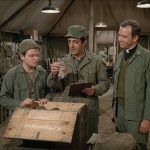
Just then, Hawkeye and B.J. sauntered out of the Swamp, alerted by the unusual quiet. Hawkeye opened his mouth, a sharp, witty quip about Charles playing in the sandbox ready on his lips, but B.J. caught him by the arm, catching the solemn mood instantly and shaking his head.
“Need a hand, Charles?” B.J. asked quietly, stepping down into the dirt and kneeling beside them, his voice warm and grounded.
“They require immediate, meticulous cleaning,” Charles said, his voice tight but controlled. “If the grit dries inside the grooves, the stylus will skip, and the music will be… permanently fractured.”
Without a word, Hawkeye stepped back into the Swamp and returned a moment later, not with a joke, but with a basin of distilled surgical water and several pieces of clean, soft sterile gauze. He sat down right there in the dirt next to Radar, completely abandoning his usual theatricality.
“Alright, Winchester,” Hawkeye said, his tone unusually soft, a quiet understanding passing between the roommates. “You’re the chief of surgery here. Guide our hands. How do we operate on Amadeus?”
For the next hour, a strange and beautiful thing happened outside the Swamp.
Under Charles’s strict, quiet, and surprisingly patient direction, the four men formed an assembly line in the mud. Radar carefully blew the loose dirt off the vinyl; Hawkeye applied the distilled water with surgical precision; B.J. wiped the grooves clean with the gentle touch of a father handling a newborn; and Charles inspected each piece under the dull Korean sun, ensuring not a single grain of sand remained.
Father Mulcahy walked past on his way to the mess tent, stopping to observe the quiet gathering. He smiled a small, knowing smile, adjusting his cross before walking away without saying a word, recognizing a holy moment when he saw one.
By the time the last record was cleaned and placed safely back inside the tent, the sun was beginning to dip below the hills, painting the sky in bruised shades of purple and orange.
Radar stood up, wiping his muddy hands on his pants, still looking a bit anxious. “Are they gonna be okay, Major?”
Charles stood up, brushing a thick layer of mud from his knees, entirely unbothered by the mess. He looked down at Radar, then at Hawkeye and B.J., who were stretched out against the tent poles, tired but smiling.
Charles cleared his throat, adjusting his collar as his aristocratic posture returned, though his eyes remained soft. “The fidelity may suffer a minor degradation, Corporal. A slight hiss, perhaps a pop here and there.”
He paused, looking at the dirty, exhausted faces of the men around him—this strange, found family he never asked for, but desperately needed.
“But I suspect,” Charles continued quietly, “that the music will taste all the sweeter for it. Thank you, Radar.”
Radar beamed, a flush of pure pride coloring his cheeks as he gave a quick, awkward nod and scurried off toward the orderly room, his boots clicking happily against the wooden pallets.
That evening, as the chill of the Korean night settled over the 4077th, the soft, scratchy strains of Mozart drifted out from the Swamp. It wasn’t perfect; there was a distinct, rhythmic pop every few seconds where the dirt had left its mark. But to everyone who heard it echoing across the compound, it sounded like the most beautiful thing in the world.
In the mud of Korea, we learned that perfection didn’t matter, as long as the music kept playing.