The Tea Set from Ottumwa
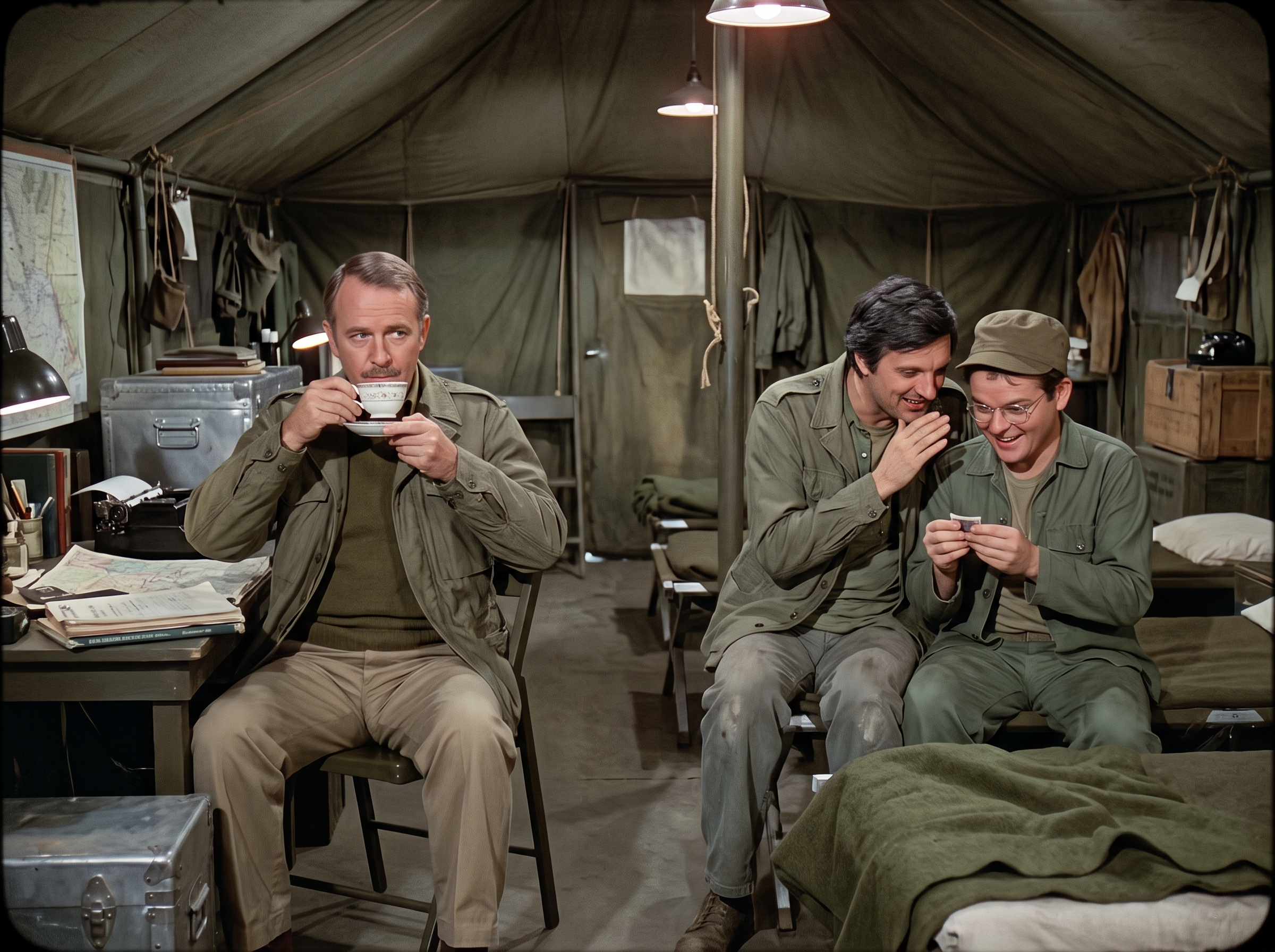
Sometimes, you just needed a minute. A brief truce with the noise.
It wasn’t quiet in Korea, ever, but in the small hours of the morning, it was sometimes *less* loud.
That’s when these moments happened, when the adrenaline faded, and the fatigue settled into your bones.
Radar arrived at the Swamp first. No clipboard. No urgent messages.
He carefully placed the cardboard box on Hawkeye’s foot locker and waited, radiating that peculiar brand of anxious excitement.
He was vibrating so hard the typewriter was practically rattling.
Hawkeye groaned, rolled over, and squinted against the overhead bulb. “Radar, it’s 0300. Whatever has arrived better be a functioning cease-fire or an unrationed quantity of gin.”
“Neither, Sir,” Radar said, grinning. “It’s from home.”
Hawkeye sat up. Mail call. The two most powerful words in the entire United States Army.
Radar watched, practically vibrating, as Hawkeye pulled out the object.
It wasn’t a ham, and it wasn’t socks.
It was a delicate, bone-china teacup and saucer. Pale white, with a gold rim and small, painted blue flowers.
It looked entirely, beautifully, *preposterously* out of place.
“I… requested it,” Radar whispered, looking down at his boots. “I wrote to Mom and said Colonel Potter really, really liked hot tea.”
He shifted his weight nervously. “And I thought… maybe if we had something nice. Something from home.”
“Ottumwa. A hotbed of delicate ceramic arts,” Hawkeye mused, turning the porcelain over in his hands. It weighed nothing.
He looked from the cup to Radar’s earnest face. The kid looked desperate for approval.
The Swamp was a cave of utility. Canvas, metal, dirt. The cup was… vulnerable.
Hawkeye felt a knot tighten in his chest. “It’s perfect, Radar.”
Radar beamed. “Do you think I should tell the Colonel? He’s usually up.”
Just then, the screen door slapped shut.
Major Charles Emerson Winchester III walked in, exhausted, his face smeared with O.R. grime.
He didn’t notice Radar or Hawkeye. He didn’t notice the box.
All Charles saw was the light. All he heard was the absence of surgery.
He stumbled toward his bunk and literally *collapsed* onto it, fully clothed. He didn’t even take off his boots.
He just crashed. Completely and utterly out.
And that’s when Hawkeye and Radar saw it.
The position he was in. His right arm was flung over his face. And his left arm was lying flat against his chest, the wrist slightly bent.
Radar’s fragile, gold-rimmed teacup and saucer were *already* in the box. Charles’s sleeping hand had landed directly *on top of it.*
Radar stopped breathing. “Sir.”
Hawkeye didn’t move either. “I see it.”
The teacup and saucer, a piece of porcelain from Ottumwa, Iowa, were pinned between Charles’s forearm and the edge of his cot.
Charles was out. The kind of out that only happens after a 24-hour shift in the O.R.
If he moved. If he *coughed.* If he so much as sighed too deeply, the pressure would shift, and that cup would shatter into a thousand pieces.
“Okay,” Hawkeye whispered. He slowly slid off his bunk. “No sudden movements. No loud noises. We approach the sleeping bear with extreme caution.”
Radar nodded, his eyes wide. He held his breath.
They both knew the protocol for waking Charles Winchester: you don’t.
Hawkeye crept forward. Radar was right behind him, a human shadow.
They reached Charles’s cot. His arm was heavy with sleep.
Hawkeye looked at Radar. *“Hold the box.”*
Radar got on his knees and braced the box.
Hawkeye ever-so-slowly began to slide his hand under Charles’s forearm.
Charles twitched.
His entire body gave a little shudder, and Hawkeye froze. Radar winced, waiting for the crunch.
But it was just a dream-twitch. Charles didn’t wake. His breathing remained deep and slow.
“Good boy,” Hawkeye whispered. “Good, sleeping, aristocratic boy.”
He eased his hand further in, his fingers now making contact with the cold curve of the cup itself.
He had to lift the entire forearm, a couple of inches, to get the saucer free.
Radar watched Hawkeye’s face. It was the face of a surgeon during a thoracic section. Pure, strained concentration.
Hawkeye lifted. The saucer moved. Radar’s breath hitched.
Hawkeye held it. He slid the other hand underneath the box.
Radar gently tugged the cardboard away, creating a tiny pocket of space.
“Got it.”
He held the two pieces, cupped carefully in both palms, and backed away from the cot.
Radar let out a silent sigh of relief and quickly checked the box. Everything else was packed in straw.
“Put it away,” Hawkeye said, his voice quiet. He didn’t want to wake Charles now.
Radar didn’t. He reached for his pocket instead. He pulled out a crumpled, olive-drab handkerchief and handed it to Hawkeye.
“No, I mean… in your locker, Radar.”
“I know,” Radar whispered. “But we can’t just put it back.”
He walked over to where Hawkeye stood. “It has to go somewhere special.”
Hawkeye looked at the kid, then down at the two delicate items he was holding.
They weren’t just china. They were a link to a kitchen in Iowa where someone missed him enough to mail him something they *knew* would get broken.
And in that moment, seeing Hawkeye holding them, seeing the look on Radar’s face… all the silly, pretentious jokes and eye-rolls were gone.
Nostalgia hit Hawkeye hard. It was a physical ache.
He slowly walked over to the makeshift table near his bunk—a stacked ammo box draped with a gray blanket.
He pulled his own footlocker open and lifted out his one luxury: an old, beat-up cigar humidor.
He gently placed the saucer inside it. Then the cup.
It took up all the space. There was no room for cigars.
He closed the lid, clicked the latch, and pushed the humidor back into his footlocker.
He sat on the edge of his cot and took a breath. Radar was still standing there.
“He’ll never know,” Radar whispered.
Hawkeye looked at him. “About the cup, or about how close he came to crushing it?”
“Both.”
Hawkeye smiled, a genuine, warm smile. “We won’t tell him. Let him have his peaceful ignorance.”
Just then, the screen door slapped *again.*
This time it was B.J. He walked in, took one look at the tension in the room, and then saw Charles sleeping.
“Don’t tell me,” B.J. said. “He found a place to sleep and you guys are just staring in awe.”
“Radar got a package from home,” Hawkeye said. “A very fragile package.”
B.J. nodded, understanding immediately. “Anything worth sharing?”
“In a manner of speaking,” Hawkeye said.
He stood up and walked to the still-open cardboard box on the footlocker.
Buried under more layers of tissue paper, Hawkeye found something else.
He pulled it out. It was a heavy glass bottle, wrapped in dark paper.
The label was old, and in a simple, hand-typed script: *Ottumwa Elderberry.*
Hawkeye uncoiled the cork. It smelled like warm fruit and dust and home.
Radar grabbed two metal mess-hall cups.
Hawkeye held the bottle over the first cup. Radar watched the dark liquid pour, like a prayer.
“Well,” Hawkeye said, lifting his cup. “A toast. To family.”
“To families near and far,” B.J. said, lifting his.
“And to ceramic resilience,” Hawkeye added, clinking his cup against B.J.’s.
Radar held his cup, waiting. He looked back at Charles, still dead to the world, then at the two doctors.
He smiled, a quiet, contented smile. In the face of all the mud and noise and pain, they had a cup, a saucer, and a little piece of home, safe.
The Swamp felt warm.
Sometimes, holding something that was never meant to be in a war zone was the only thing that made it bearable.