A Touch of Bizarre Refinement in the Warm Refuge of Rosie’s
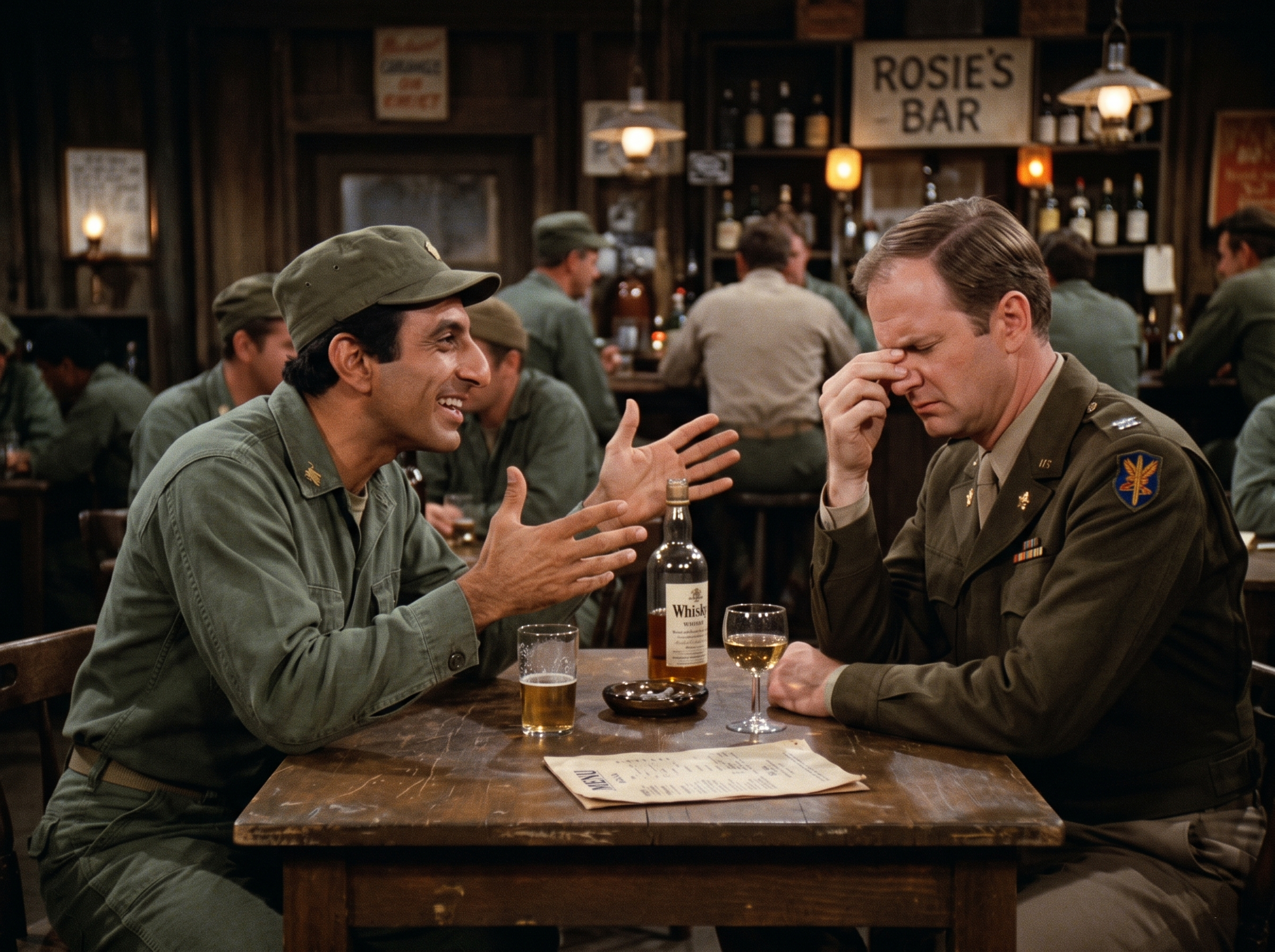
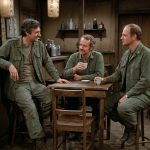
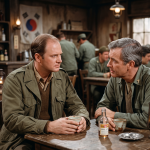
The dim amber light of Rosie’s Bar was the only reliable sun the 4077th ever knew after hours.
It wasn’t elegant, but it was warm. It smelled of cheap whisky, spilled beer, and the shared exhaustion of two dozen soldiers.
For Major Charles Emerson Winchester III, it was a necessary purgatory, a distant second to a concert hall, but the only sanctuary available.
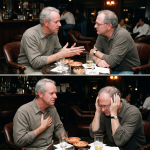
His formal dress uniform was meticulously kept, and he sat with a rigid, almost royal posture.
But right now, his eyes were clamped shut, and his right hand was pinched hard against the bridge of his nose.
His head was throbbing with a persistent ache that not even the glass of lukewarm wine before him could dull.
And the cause was standing directly in front of him, amplified by the low ceiling and the crowd.
Corporal Maxwell Klinger was not just talking; he was an operational force of chaotic theater.
He was in his standard green fatigues, standing, leaning dramatically across the worn wooden table.
His arms were spread wide in the air, hands gesturing with a theatricality that defied both gravity and silence.
Klinger was deep into the fifth act of a story that involved three distant cousins, a psychic mule, and a shipment of Aunt Martha’s prized (and supposedly medicinal) pickled okra.
“So there I am, Major, trapped between the mule and the okra, when Uncle Rashid says, ‘Klinger, the stars command you!‘ Command me? I’m already commanding a tent of twenty soldiers who look at me like I’m a menu!” Klinger’s voice rose, filling the small space.
Charles’s nose-pinch tightened. Every grand gesture, every wide grin from Klinger, sent a fresh spike of pain across his forehead.
He longed for the silence of his books, or the complex order of a Bach fugue. Instead, he was receiving a manic operetta.
Yet he had not gotten up to leave. He just sat there, enduring, his eyes shut tight against the sight and sound, while Klinger leaned closer, building towards the dramatic climax of his ridiculous tale.
The whiskey bottle and the beer glass sat between them, silent witnesses to a class collision that only the absurdity of war could produce.
It was a social collision that was rapidly becoming unbearable for Charles, who took a deep breath, his hand still up, dreading the next theatrical exclamation.
Charles let out a long, rattling breath, releasing the bridge of his nose but keeping his hand covering most of his face, sliding his thumb to his temple to massaged the persistent throbbing.
Klinger continued, undeterred, his arms still broad and his voice animated, detailing Uncle Rashid’s unfortunate encounter with the Korean terrain.
“If that mule didn’t start reciting poetry, I’m an MP!” Klinger exclaimed, hands coming together with a loud clap that echoed against the wooden panels and made Charles wince visibly.
Finally, Charles opened one eye. He didn’t look at Klinger directly; he looked at the worn tabletop, at the menu paper between them, and the simple glasses that defined their existence.
He saw not a theatrical conman, but a man from Toledo, Ohio, trapped just as surely as he was.
Klinger was noisy, yes. He was bizarre, undeniably. His stories defied all reason.
But Charles recognized the frantic energy. He saw the sweat, the practical wear on the fatigue uniform, and the human need to just speak into the silence of a country so far from home.
It was the same energy Charles channeled into his medicine, into his demanding perfection, into his silent dignity.
Klinger used noise; Charles used silence.
But the goal was the same: to find a place that wasn’t the Operating Room.
“Klinger,” Charles said, his voice quiet, almost an octave lower than the Corporal’s manic energy.
Klinger froze mid-gesture, one hand in the air, his smile faltering slightly as he saw the exhaustion etched into the Major’s face.
“Yes, Major? Too much detail about the okra?” Klinger asked, trying to lower his volume, which still sounded like a stage whisper that reached the back row.
Charles let his hand drop completely from his face, looking up at Klinger, his eyes soft with a tired sort of compassion that was rarely seen.
“Tell me about the mule again,” Charles sighed. “The poetry reciting mule.“
Klinger’s face lit up. It was a genuine smile, not a salesman’s performance. He lowered his arms, leaning back over the table, still gesturing, but more gently.
“Ah, the mule, Major! Shakespearean! The mule swore he was Hamlet, demanding oats like he was the Prince of Denmark!“
Klinger spoke, still animated, still standing, still theatrical, but perhaps just a little softer.
And Charles sat, rigid, refined, his hand resting near his wine, listening. He still had a headache.
But for the next few minutes, listening to the impossible tale of a literary mule, neither of them was in a war. They were just two soldiers, opposite in every way, finding a moment of bizarre sanity in the warm refuge of Rosie’s Bar.
In the end, it wasn’t the music Charles needed, but the beautiful, ridiculous noise that reminded him he was still human.