The Weight of a Scarf and a Mess Hall Smile
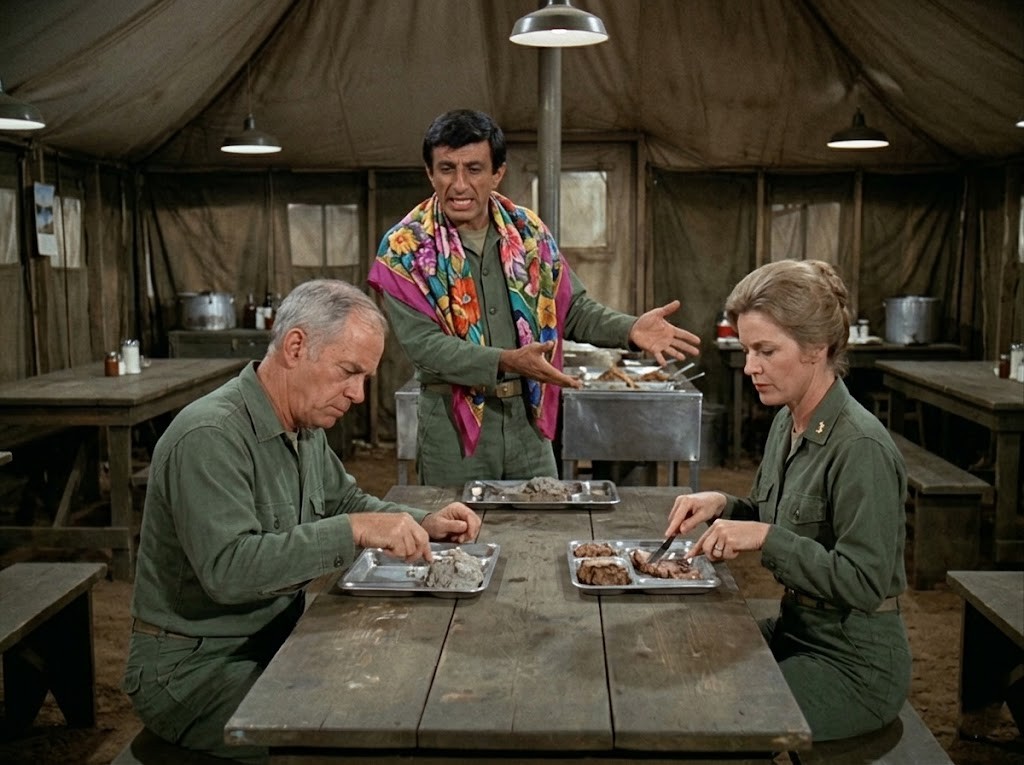
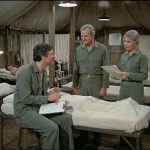
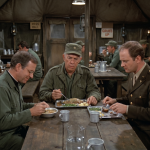
The Korean wind had a way of cutting through the canvas of the 4077th, carrying with it the constant, low-grade hum of generators and the distant, echoing thud of artillery. Inside the mess hall, the air was thick with the less-than-appetizing aroma of mystery meat and standard-issue gray gravy.
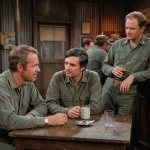
Colonel Sherman Potter sat at the long wooden table, his shoulders slightly hunched beneath his olive drab fatigue shirt. His fork picked half-heartedly at the lump of unidentifiable starch on his metal tray, his face lined with the deep, quiet exhaustion that only a commanding officer truly understood.
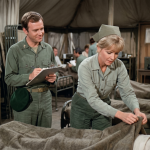
Across from him sat Major Margaret Houlihan, her blond hair pinned up in its usual immaculate, military fashion. She was maintaining her strict, professional posture, but her eyes held a heavy glaze of fatigue after a grueling twelve-hour shift in Post-Op.
The silence between them wasn’t tense; it was simply the quiet shared by two people who had seen too much suffering in a single morning to bother with small talk. Then, the screen door banged open.
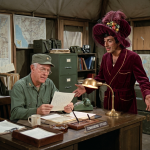
In strode Corporal Maxwell Klinger, bringing with him a sudden, vibrant explosion of color that broke the drab monotony of the olive-drab room. Draped over his shoulders, contrasting sharply with his green army fatigues, was a brilliant, silk scarf adorned with massive, vivid pink and orange tropical flowers.
Klinger stopped right at the end of their table, gesturing wildly with his hands, his face contorted in an expression of theatrical, desperate pleading. “Colonel, Major, you have to help me,” Klinger implored, his voice ringing out across the empty wooden benches. “This scarf is my ticket out! It was sent directly from Toledo by my Aunt Alberta. She says it possesses a rare, documented medical curse that induces severe psychological unfitness if worn in a combat zone!”
Colonel Potter didn’t look up immediately. He just closed his eyes for a long, slow second, letting out a soft sigh through his nose as he rested his fork against the tray.
Margaret stiffened slightly, her knife poised over her meat ration, her jaw tightening as she prepared to deliver a standard lecture on military dress codes and proper decorum.
“Klinger,” Potter finally grunted, his voice dry as a Texas trail. “The only curse in this tent is whatever the cooks did to this gravy. Now please, I am trying to identify this food before it identifies me.”
“But Colonel!” Klinger took a step closer, bending slightly, his hands outstretched as if offering the floral silk as a piece of vital evidence. “Look at the pattern! It’s vibrant! It’s chaotic! It completely shatters the military psyche! Just holding it makes me feel an overwhelming urge to desert and open a haberdashery in Toledo!”
Margaret slammed her knife down onto the tray with a sharp, metallic clatter, her eyes snapping up to lock onto Klinger’s desperate face.
“Corporal Klinger!” Margaret snapped, her voice cutting through the damp chill of the tent. “We have a hospital full of wounded men next door, the Colonel has been on his feet since four in the morning, and you are standing here parading around in a stolen sofa cover!”
Klinger looked genuinely wounded, pressing a hand to his olive-drab chest right where the pink silk met his collar. “Major, please, have some heart. This isn’t a sofa cover, it’s a cry for help. A colorful, imported cry for help.”
Colonel Potter finally looked up, his sharp, fatherly eyes surveying the scene. He looked at Klinger’s theatrical, anxious face, then at Margaret’s tense, rigid shoulders. He saw the genuine strain underneath Margaret’s anger, and the underlying exhaustion beneath Klinger’s daily performance.
In the 4077th, sanity was a fragile thing, maintained only by the strange rituals they all performed to keep the reality of the war at bay. Klinger’s dresses and scarves weren’t just a bid for a Section 8; they were a reminder that a world of color still existed outside the mud of Korea.
Potter reached out and gently tapped the edge of Klinger’s metal tray with his thumb. “Klinger, if I sectioned every man in this camp who was psychologically unfit to look at a floral pattern, I’d be the only one left here to drive the ambulances. And frankly, my knees can’t take the clutch anymore.”
A tiny, involuntary twitch appeared at the corner of Margaret’s mouth. She tried to suppress it, looking back down at her tray, but the sheer absurdity of the moment was breaking through her military armor.
“Besides,” Potter continued, a faint, nostalgic warmth softening his tired eyes. “My wife Mildred has a tablecloth just like that back in Hannibal. Used to put it out for the Fourth of July socials. Looking at it doesn’t make me want to desert, Corporal. It just makes me miss home.”
Klinger paused, his hands dropping slowly to his sides. The desperate showmanship faded from his eyes, replaced by a quiet, understanding softness. He looked at the old cavalryman, seeing the loneliness that the Colonel so rarely allowed himself to show.
“Mildred has good taste, sir,” Klinger said softly, his voice dropping its frantic edge. He adjusted the scarf, tucking the vibrant silk a little closer around his neck, no longer using it as a weapon for discharge, but wearing it almost like a badge of shared comfort. “It… it does remind you of a picnic, doesn’t it?”
“It does,” Potter nodded quietly. “Now go on, get yourself some of this gray glue before it hardens into cement. That’s an order.”
“Yes, sir. Thank you, sir,” Klinger murmured, giving a respectful, if highly unorthodox, little nod before turning toward the serving line.
Margaret watched him go, then looked across the table at Potter. The rigid tension had left her shoulders. She picked up her fork again, a gentle, tired smile finally breaking across her face.
“A Fourth of July tablecloth, Colonel?” she asked softly.
“Brightest thing in Missouri, Margaret,” Potter chuckled, finally taking a bite of his food with a renewed, quiet resilience. “Sometimes, a little color is exactly what a gray day needs.”
In the mud of Korea, sanity wasn’t found in the regulations, but in the colorful, crazy pieces of home they kept alive for each other.