A Stool, a Chart, and a Candlelit Charting
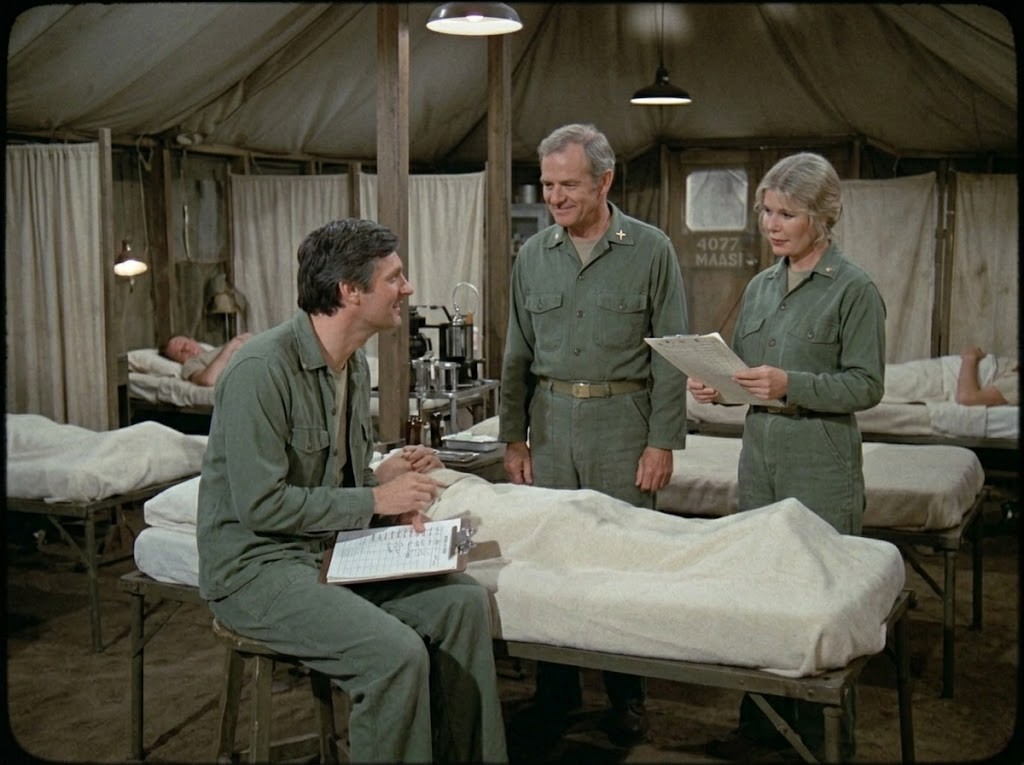
 The Post-Op. It’s always the Post-Op. Not the frantic operating room, but the hushed aftermath where the *real* waiting begins. You know the smell of this place? It’s a mix of canvas, antiseptic, sweat, and cheap coffee. And now, at 3 a.m., there’s this heavy, exhausted silence.
The light is harsh and yellow, dripping from the few bulbs that still work. A solitary mosquito buzzes, loud as a helicopter, near the ceiling. In a far cot, someone is snoring in that fitful, desperate way.
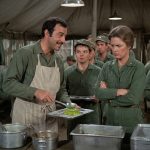
Look at him. The man on the stool. Hawk is *trying*. His smile is a masterpiece of deception, designed to keep the crushing weight of the world at bay for just one more hour. He looks tired. His shoulders are slumped under that worn green jacket, a physical manifestation of every life he couldn’t save.
He’s pretending to study a chart. His left hand is playing a delicate game with the patient’s blanket—tucking it, smoothing it, checking for a warmth that doesn’t quite last. He needs this boy to make it. Not just for the boy, but for himself. Every “one we lose” chips away at that brittle, sarcastic armor.
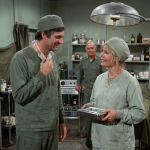
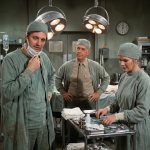
Potter and Margaret have arrived. Their shadows stretch long and dark against the canvas wall. They are the twin pillars of this place: the father who can fix anything and the mother who can sanitize anything, except the war.
The old man, Sherman T. Potter, stands with his hands clasped behind his back, a posture learned in a hundred other wars. He isn’t smiling. He’s *assessing*. His eyes move from the chart to the patient to Hawk, measuring the stress fracture in each. He knows exactly how close Hawk is to a break.
Margaret, on the other hand, is the professional. Her uniform is immaculate, even at this hour, a bulwark against chaos. She holds a clipboard with the kind of authority that says, “I will find the order in this mess.” She looks over Hawk’s shoulder, her face a mask of concentration.
“He spiked a temp at 0100,” Hawk says, his voice a little too loud in the quiet tent. He glances at Potter, his eyes searching for validation, for an order that says ‘it’s okay to have hope.’ “I gave him aspirin. He settled down. Look at his coloring, Colonel. It’s almost… reasonable.”
“‘Reasonable’ is not a medical term, Captain,” Margaret interjects, her voice crisp but not unkind. She doesn’t look up from her notes. The pen scratches a soft rhythm against the paper.
Potter sighs. He steps closer to the cot, looking at the silent patient. The boy is young. Younger than some of the soldiers who brought him in. “It’s been a long night, Pierce. Why don’t you head to the Swamp? Margaret and I can cover this.”
“The Swamp is depressing, Colonel,” Hawk says, his wit coming in like a tired old friend. “Frank is lecturing to an audience of dust bunnies about the merits of shoe-shining. I’d rather face the mosquito.” He touches the blanket again.
It’s just a small motion. But in the dim light, that single, repetitive action—that desperate need for the patient to be stable, to be *okay*—feels like a high-tension wire. Potter knows it. Margaret knows it. The patient… the patient doesn’t know anything right now.
The high point—that high-tension silence—is broken not by a sound, but by a light.
Margaret shifts her clipboard and a flicker of *something* catches Potter’s eye. He looks over his shoulder, then down at the worn wooden frame of the cot beside the patient’s head.
Hawk freezes. The hand that was tucking the blanket is now suspended, hovering just inches above a small, forgotten metal can. Tucked inside the can is a small, carefully prepared candle, waiting to be lit.
Potter, his voice gaining a soft, slightly amused rumble, gestures with his chin. “Planning on a romantic dinner for one, Captain?”
Hawk’s shoulders drop. The sarcastic mask slips, just a little. He looks down at the can, then up at Potter. His smile, when it comes, is smaller, more honest. It’s the smile of a tired man acknowledging a friend.
“I found it near the kitchen tent,” Hawk explains, his voice lower now. “I thought… in the quiet. When things get… dark.” He looks at the patient, the boy whose coloring is, yes, slightly reasonable. “Maybe a little warmth would help. For *both* of us.”
Margaret glances up from her chart, her face softening just slightly. The strict protocol officer sees the *why* behind the unconventional action. It’s not about the warmth. It’s about the *effort*. The small, deliberate act of defiance against the cold, unfeeling machinery of the war.
“The rules regarding open flames in a medical facility are quite clear, Captain,” Margaret says. Her voice is still crisp, but the sharp edge is gone. She returns to her charting, but her pen slows down.
Potter nods slowly. He doesn’t need to say anything about the rules. He looks at Hawk and sees a son. He sees a doctor who refuses to let the war take his humanity.
“The rules also say a doctor must use all available tools to care for his patient,” Potter says. He leans against the bed frame, his fatherly wisdom settled into his bones. “A little candlelit charting might be just what the doctor ordered. Both of ‘em.”
Hawk picks up the small, battered can. He doesn’t light the candle. He just holds it for a moment, feeling its simple presence. The tension in the Post-Op dissolves, replaced by a quiet, shared moment of understanding. They are tired. They are frustrated. They are in a place where people shouldn’t be. But for this moment, in this yellow tent, they are together.
Later, in the deepest part of the night, long after the colonel and the nurse have moved on to other beds, the mosquito is still buzzing. The boy on the cot is sleeping soundly. And at the small, wobbly stool, under the yellow light, a single, soft flame of a small candle burns. It illuminates nothing except a small patch of chart and the tired face of a doctor who is, against all odds, still hoping.
This was the quiet, human heart of the 4077th. Not the dramatic battles, but these small, unspoken covenants. The shared jokes, the comforting silence, the quiet defiance of a candlelit chart, all while trying to heal a world that seemed determined to break. A world that, somehow, we keep coming back to with a heavy heart and a knowing smile.
We all found our home in that tent.