The Quiet Graces of Mud-Slush Coffee
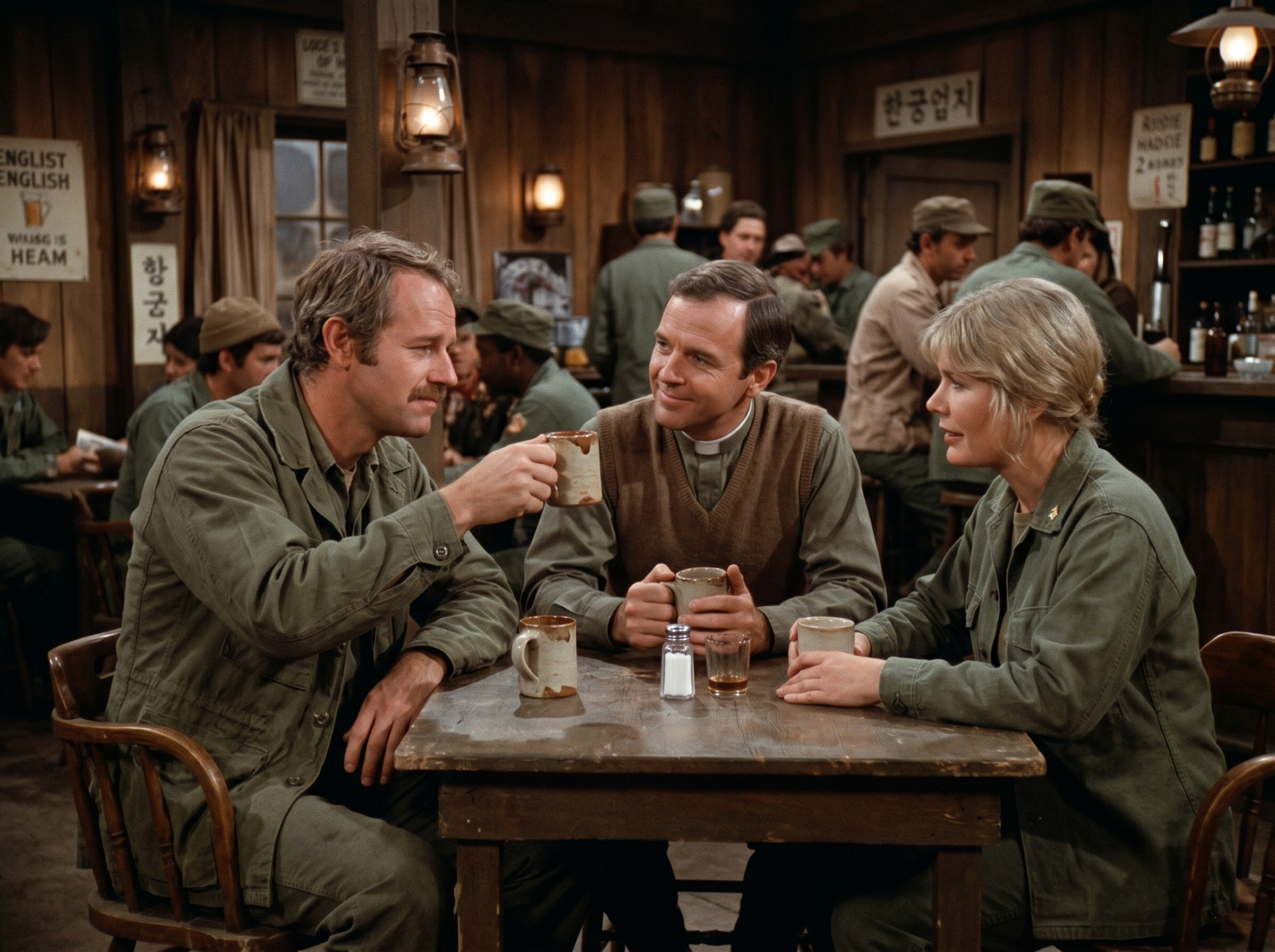
Some nights at the 4077th, the simple mud-slush of coffee tasted better than champagne ever could.
It was late, and the medevac choppers’ rotors had finally quieted, but their rhythm still pulsed in the heads of the staff.
Here in Rosie’s Bar, in the wooden warmth lit by lanterns casting long, comforting shadows, a silent refuge was possible.
This was the place where the war couldn’t quite reach, not unless you brought it in with you.
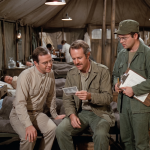
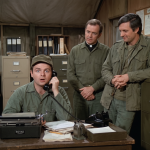
At a small, worn table, Captain Tex Arnold, a chopper pilot with a Texas drawl as long as his flight logs, sat, holding a ceramic mug.
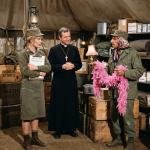
Beside him in the clerical collar sat Father John Mulcahy, a man whose gentle, enduring smile was its own form of medicine.
Across from them was Major Margaret Houlihan, impeccable even in fatigues, listening, her professional mask slightly softer than usual.
You knew this scene, the found-family trying to push back the fatigue and the memory of the O.R.
Tex was a pilot whose bravery was a given, but tonight, the lines around his eyes were deeper, etched with a close call.
His calloused hand, stained with helicopter grease, held the simple brown mug aloft, the amber liquid inside sloshing gently.
“Here’s to Rosie,” Tex said, a dry chuckle in his voice, looking between the Father and the Major.
“For making a place where a guy can sit down without checking his six, even if the ceiling might cave in from a stiff breeze.”
Mulcahy gave that soft, patient nod of deep understanding, while Margaret’s expression was an unusual blend of empathy and concern.
This wasn’t a celebratory toast; it was a *survivor’s* toast, a quiet acknowledgement of a few precious minutes of peace.
Tex continued, his voice softer, “And to the fact that we can sit here and complain about the mud instead of dodging mortal rounds.”
He looked tired, but the bravado was still there, the anchor he used to keep himself from thinking too much about the flying he had to do tomorrow.
But Margaret saw it, as she always did, the stress that Tex tried to hide beneath the humor and the pilot’s confident smile.
She saw the tiny, barely perceptible tremor in his grease-stained hand as it held the mug.
Father Mulcahy noticed it too, the tremor growing slightly more pronounced as Tex finished his toast.
A moment of silent connection passed between them, a recognition of a shared human frailty that they all understood, that they all felt.
Tex held the mug, the amber liquid sloshing with the unbidden shake of his hand, and the simple toast seemed to hang suspended, a small act that now held the full, painful weight of the long day.
He wasn’t drinking. He was frozen.
The tiny tremor in Tex’s hand was a silent, powerful confession, a scream echoing in the low light.
He stared into the ceramic cup, the amber liquid reflecting the tiny flicker of the lantern.
The sound of the bar faded to nothing; the only thing he knew was the ghost of that wire he nearly clipped near Old Baldy.
Margaret, whose strength was her armor and whose understanding was her soul, didn’t look at his hand.
She didn’t offer comfort or say a word that might break his composure.
Instead, with a movement so gentle and precise it might have been a surgeon’s delicate stitch, she reached out and moved the small shot glass of whiskey an inch closer to Tex.
The action was small, almost unnoticeable to anyone else, but it was a profound act of tenderness.
She wasn’t fixing him; she was acknowledging him, telling him with that simple act, *I see you, and it’s okay.*
Mulcahy, with that profound knowing smile, met Tex’s eyes.
He knew Sister Teresa used to say that any act of compassion, no matter how small, was communion.
The Father just added, with that quiet wisdom that made everyone in the 4077th feel a little safer, “You know, Tex, the smallest graces are often the most powerful.”
The light humor allowed the pilot to take a breath.
A short, strangled laugh escaped Tex, the first crack in his armor.
He finally lifted the mug, the shaking hand steadier now, and took a long, burning sip.
The whiskey anchored him, the familiarity of it, the simple reality of the taste in his mouth.
He set the mug down, then quickly picked up the small shot glass and drank it, too.
“Thanks,” he said, wiping his mouth with the back of his hand, looking at them both. “Just… thanks.”
Mulcahy smiled even more. “Sister Teresa also said that a little mud-slush communion never hurt anyone, as long as it’s shared with good souls.”
Tex gave a genuine laugh this time, the tension breaking.
He then took a breath and quietly confessed, “A nurse fainted today during a tricky arterial bleed. I was going to correction her. I just… I told her to get water. We’re all just trying to keep the wires from snapping.”
They sat in silence for a few moments more, the warmth of the room settling inside them, the understanding flowing between them.
The GIs at the bar were laughing again, and the chaos of the war was still out there, just waiting.
They finished their drinks, not magically fixed, but lighter, a profound burden shared and understood.
Tex stood, his flight suit wrinkled, and tapped the Padre’s shoulder, giving Margaret a respectful nod.
“Better get some shut-eye. Choppers don’t fly themselves.”
They followed him out into the cool night air, the stuffy bar air replaced by the cool dampness of the Korean night.
They had found their refuge, even if only for an hour.
It was still dark, still the same war, but they had found the quiet graces they needed to keep going.
In the mud and the chaos of Korea, the warmest comfort often came from a single, shared moment of being human together.