A Snapshot of Home in a Canvas World
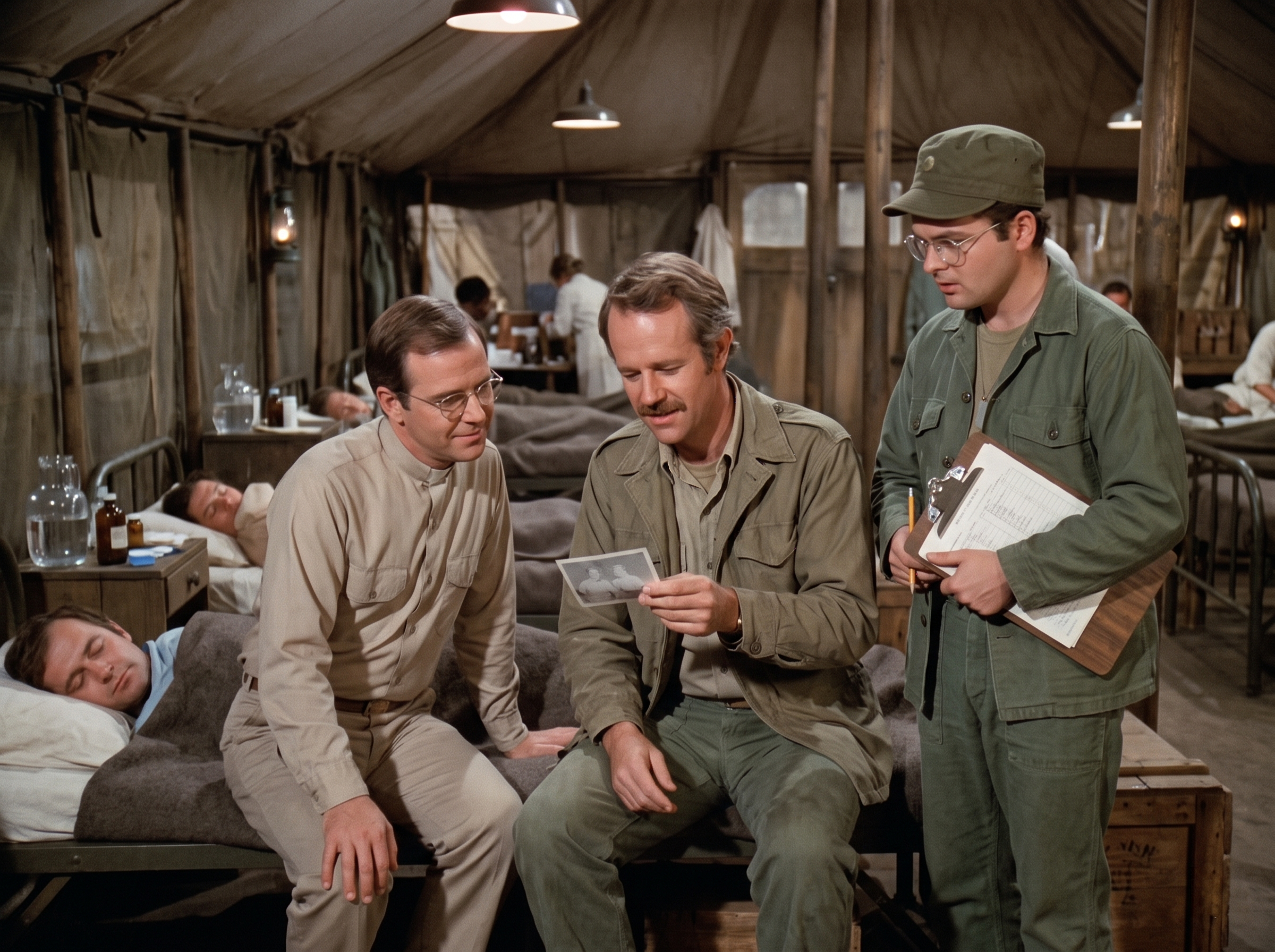
The quiet in the Post-Op ward was a rare and fragile thing, usually bought and paid for with forty-eight hours of pure, unadulterated exhaustion.
Outside the tent, the Korean wind was howling across the motor pool, kicking up dust that settled over everything in the 4077th. But inside, under the warm, practical glow of the overhead lamps, there was a temporary truce.
The air smelled faintly of iodine, damp wool blankets, and the stale coffee brewing over in the mess tent. A few feet away, a young private was finally sleeping peacefully, his chest rising and falling in a steady, reassuring rhythm.
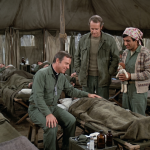
Captain B.J. Hunnicutt sat casually on the edge of an empty cot, his long frame folded up in tired relief. He wore his standard green fatigue jacket over a rumpled t-shirt, his dog tags resting against his chest.
His muscles ached, his eyes burned from lack of sleep, and his boots felt like they were made of lead. But in his hands, he held the only cure that actually worked in a place like this.
Mail call had come and gone hours ago, but B.J. hadn’t had a single second to open his letter until now.
He held a small, slightly creased black-and-white photograph. As he looked at it, the exhaustion seemed to melt off his face, replaced by a smile that radiated a gentle, quiet homesickness.
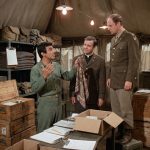
Father Mulcahy, who had been making his quiet rounds among the resting boys, spotted the captain and drifted over. He leaned down compassionately, resting his hands lightly on his knees, his face breaking into a sincere, soft-spoken smile of pure joy.
At the edge of the cot stood Corporal Radar O’Reilly. He had marched into Post-Op with a clipboard full of supply requisitions that urgently needed a doctor’s signature.
But seeing the captain and the priest huddled over the photograph, Radar had completely forgotten about his paperwork. He stood politely at attention, holding his clipboard and a yellow pencil, looking down at the picture with wide-eyed, innocent concern.
For a long moment, nobody spoke. The silence in the ward was heavy and thick.
B.J. kept his eyes glued to the photograph. It was a simple shot of Peg and his little girl, Erin, sitting on the front steps of their house in Mill Valley.
But as he stared at the image, the crushing weight of five thousand miles suddenly dropped squarely onto his shoulders. The dusty floors of the 4077th vanished.
B.J.’s soft smile slowly faltered, his eyes glazing over as the impossible distance between Korea and California swallowed him whole. He stopped moving, stopped speaking, and seemed to fall right into the tiny paper square.
The canvas walls seemed to close in, leaving Father Mulcahy and Radar standing in the heavy, fragile silence of a man whose entire heart was trapped on the other side of the world.
Radar shifted his weight from one foot to the other, his boots making a soft scuffing sound against the dirt floor.
He didn’t like it when the doctors got that faraway, heavy look in their eyes. It made the war feel entirely too big.
“She’s… she’s getting awful big, Captain Hunnicutt,” Radar said softly, his voice breaking the heavy silence with an earnest, boyish sweetness.
B.J. blinked, pulling himself back across the Pacific Ocean. He looked up at Radar, the deep sadness in his eyes giving way to a returning, grounded warmth.
“Yeah, she is, Radar,” B.J. chuckled softly, his voice thick with emotion. “Peg says she’s practically running now. Says she chased the neighbor’s cat halfway down the block last Tuesday.”
Father Mulcahy leaned in just a fraction closer, his eyes crinkling at the corners. His presence was like a warm blanket in the drafty tent.
“It is a truly beautiful picture, B.J.,” Mulcahy murmured gently. “Peg looks absolutely radiant. And little Erin… well, she clearly has her mother’s smile.”
“Thank God for that, Father,” B.J. smiled, a dry, self-deprecating humor returning to his voice. “If she had my mustache, the poor kid wouldn’t stand a chance in kindergarten.”
Radar smiled, adjusting his glasses. He looked down at the photo again, his face a picture of pure, unfiltered curiosity.
“We had a porch just like that back in Ottumwa,” Radar noted, pointing a slightly dirty finger at the background of the picture. “Course, ours had a broken step where my Uncle Ed fell through during a thunderstorm. But it’s real nice, Captain. Looks like a good place to drink grape Nehi.”
“It’s the best place in the world, Radar,” B.J. said quietly.
He rubbed his thumb gently over the edge of the photograph. He could almost smell the California air. He could almost hear the sound of the screen door slamming shut.
Mulcahy placed a reassuring hand on B.J.’s shoulder. The priest understood the profound danger of memories in a combat zone, how they could either keep a man alive or break his spirit entirely.
“You know, Captain,” Mulcahy said, his voice dropping to a comforting, pastoral whisper. “I see a lot of boys come through this tent. They carry lucky coins, rabbit’s feet, sometimes even a four-leaf clover.”
The priest gestured gracefully toward the photograph.
“But I have always believed that these small rectangles of paper are the greatest medicine we have. They are the anchor. They remind us of the grace and the love that are waiting for us when this terrible madness finally ends.”
B.J. looked up at the priest. The quiet wisdom in Mulcahy’s eyes was exactly what he needed to hear. It took the bitter sting out of the homesickness and left only the sweet warmth of gratitude.
He wasn’t just a tired surgeon in a dirty green tent. He was a husband. He was a father. And that meant he had a profound reason to keep going, to keep fixing the broken boys who came through those double doors.
B.J. looked back down at the sleeping soldier on the cot next to him. The young kid looked no older than Radar.
“You’re right, Father,” B.J. breathed out, his shoulders finally dropping the last of their tension. “It’s a pretty good anchor.”
Radar, realizing that the emotional weather in the room had cleared, suddenly remembered the wooden clipboard clutched tightly against his chest.
“Uh, speaking of anchors, Captain,” Radar stammered politely, holding out the paperwork. “Colonel Potter says if I don’t get your signature on these plasma requisitions, he’s gonna anchor me to a jeep bumper.”
B.J. laughed, a genuine, hearty sound that felt good in his chest. He reached into his pocket, pulled out a pen, and quickly scrawled his name across the bottom of the form.
“There you go, Radar. Tell the Colonel the army is safe for another day.”
“Yes, sir. Thank you, sir.” Radar smiled brightly, giving a tiny, informal salute before turning and shuffling quickly out of the Post-Op tent, the screen door slapping shut behind him.
Mulcahy gave B.J.’s shoulder one last, tender squeeze before standing up straight.
“I should let you get some rest, B.J.,” the priest smiled kindly. “Try to get some actual sleep, won’t you? The cots are uncomfortable, but they beat the floor.”
“I’ll try, Father. Thanks.”
As Mulcahy moved gracefully down the aisle to check on the next patient, B.J. was left alone again in the quiet hum of the ward.
He looked at the photograph one last time, memorizing the curve of Peg’s smile and the bright spark in Erin’s eyes.
With a deep, cleansing breath, he carefully tucked the photograph into the breast pocket of his green fatigue jacket, placing it exactly over his heart. The war was still waiting right outside the canvas, but for today, the 4077th felt just a little bit closer to home.
Some days, the only thing holding the world together was a piece of paper from five thousand miles away.