The Mystery of the Monday Morning Mystery Meat
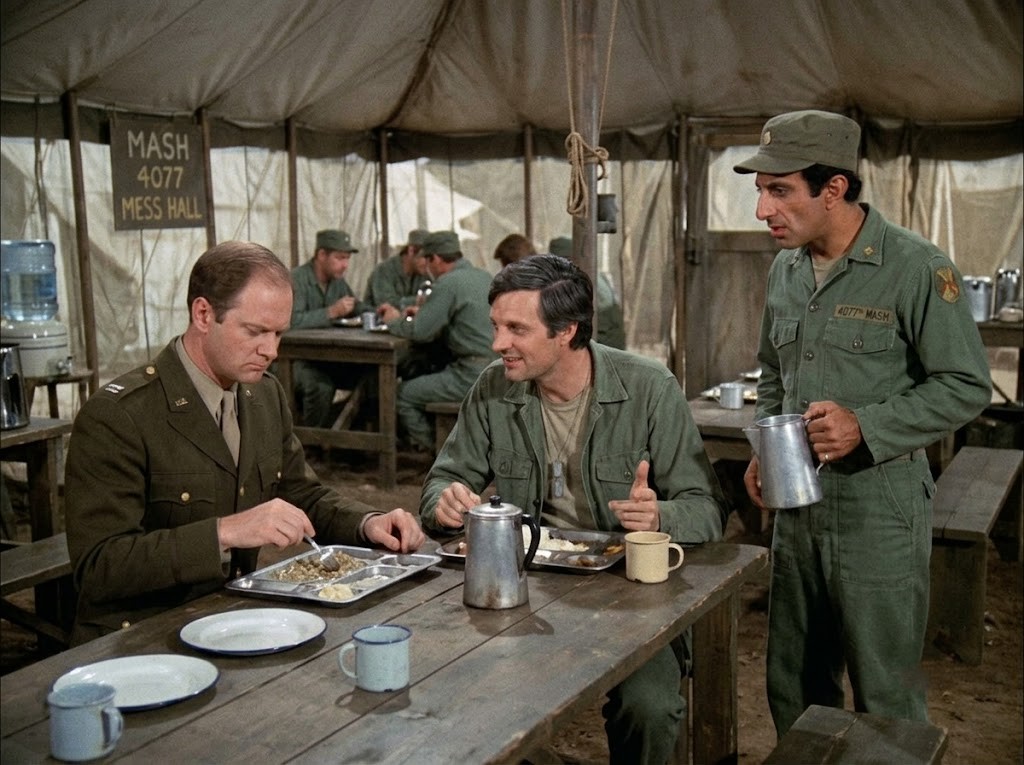
The Mess Hall tent at the 4077th was rarely a place of culinary delight, but on this particular humid morning, it felt especially oppressive. The smell of scorched coffee and something vaguely resembling overcooked liver hung heavy in the air, clinging to the canvas walls like a bad memory.
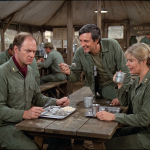
Major Charles Emerson Winchester III sat at his usual table, his posture as rigid as the starched collar of his dress uniform. He stared down at his steel tray with an expression of profound, aristocratic distaste, his spoon hovering over the gray, gelatinous heap of protein as if contemplating whether to perform an autopsy on it.
Across from him, Hawkeye Pierce leaned in, his own breakfast looking equally questionable, but his eyes were bright with a familiar, mischievous energy. He watched Charles’s struggle with a grin that bordered on predatory, clearly waiting for the inevitable explosion of refined indignation.
“It’s a daring culinary experiment, Charles,” Hawkeye remarked, gesturing with his spoon. “It’s a study in monochromatic textures. I believe it’s called ‘Surrender in a Skillet.'”
Klinger, currently serving as the mess hall steward, approached their table with a dented metal pot of coffee in hand, his expression weary but ever-presently alert. He stopped beside them, noting the standoff between the Major and his meal, his shoulders sagging just a fraction under the weight of the morning’s responsibilities.
Charles looked up at Klinger, his brow furrowed, his voice dripping with icy precision. “Klinger, I demand to know exactly what this… amorphous slab of misery is supposed to be, and furthermore, I insist on knowing who authorized its creation so that I may lodge a formal complaint with the Hague.”
Klinger sighed, casting a long, suffering look toward the ceiling of the tent, then shifted the pot in his grip, his eyes meeting the Major’s with a look of exhausted defiance. “It’s whatever was left in the back of the freezer, Major. We’re out of rations, we’re out of supplies, and frankly, we’re out of options. If you want a gourmet meal, I suggest you take it up with the supply sergeant who decided our truck was a nice place for a nap.”
Hawkeye’s smile faded, replaced by a sudden, sharp glint of realization as he looked at the tray, then back at Klinger’s defeated posture. The quiet hum of the tent seemed to drop away, leaving only the sound of a distant truck engine idling in the mud outside.
“Wait a minute,” Hawkeye said, his voice dropping, his playfulness replaced by an uncomfortable, sinking sensation in his gut. “Klinger, if you’re scraping the bottom of the freezer and the supply truck is MIA, then what are the nurses and the boys in recovery going to be eating for lunch?”
Klinger didn’t answer immediately; he just tightened his grip on the coffee pot, his knuckles turning white, and looked at them with a silent, devastating realization that hit the table harder than any insult Winchester could have imagined.
The silence that followed was absolute, heavier than the stifling heat of the tent. Charles looked from the gray heap on his tray to Klinger’s grim, tired face, the sarcasm completely draining out of him, replaced by a sudden, heavy gravity.
“The supply convoy didn’t make it, did it?” Hawkeye asked, his voice low, the humor entirely gone.
Klinger shook his head slowly, looking down at his feet. “Roads are washed out three miles back. The last of the real food went to the recovery ward an hour ago. This,” he gestured to the pot of coffee and the remaining trays, “is just what’s left over. I was hoping to make it look like something before anyone noticed.”
Charles sat back, the spoon clattering against the metal tray with a sound that seemed abnormally loud in the quiet mess hall. He looked at the mess hall sign hanging nearby, then back at the simple, shared misery of their situation, his refined features softening into something uncharacteristically human.
He didn’t complain again. Instead, he carefully placed his spoon down, wiped his mouth with a napkin, and looked at Klinger with a look of unexpected solidarity. “Well,” Charles said quietly, “in that case, I suppose we shall have to make do. A man of my background has survived on much less during the darker days of the war.”
Hawkeye looked at Charles, then at Klinger, and gave a small, weary nod. He pushed his own tray toward the middle of the table, making room. “Grab a chair, Klinger. If this is the last of the ‘chef’s special,’ we might as well sit together and pretend it’s a five-course meal at the Waldorf.”
Klinger hesitated, blinking in surprise, before slowly pulling up a wooden bench. The three of them sat there in the middle of the crowded tent, surrounded by the clatter of other soldiers doing the exact same thing—sharing the little they had, complaining about the quality, but finding comfort in the simple fact that they were all in it together.
It wasn’t a feast, and it was certainly far from the comforts of home, but as the morning light filtered through the canvas, there was a strange kind of peace in that wooden mess hall. They traded weak jokes about the coffee and quiet stories about home, the earlier tension dissolving into the kind of camaraderie that only existed within the borders of the 4077th.
They were tired, they were hungry, and the war was still waiting for them just outside the tent flap, but for a few minutes, they were just friends sharing a table. In the grand, exhausting, and heartbreaking tapestry of their lives in Korea, it was these small, quiet moments of shared humanity that kept them going, one day, one meal, and one friendship at a time.
As they finished the lukewarm coffee, there was no more need for complaints or pretenses, only the unspoken understanding that tomorrow would bring its own challenges, but for today, they were still standing.
It wasn’t much, but in the 4077th, it was everything.