The Architecture of Quiet Afternoons
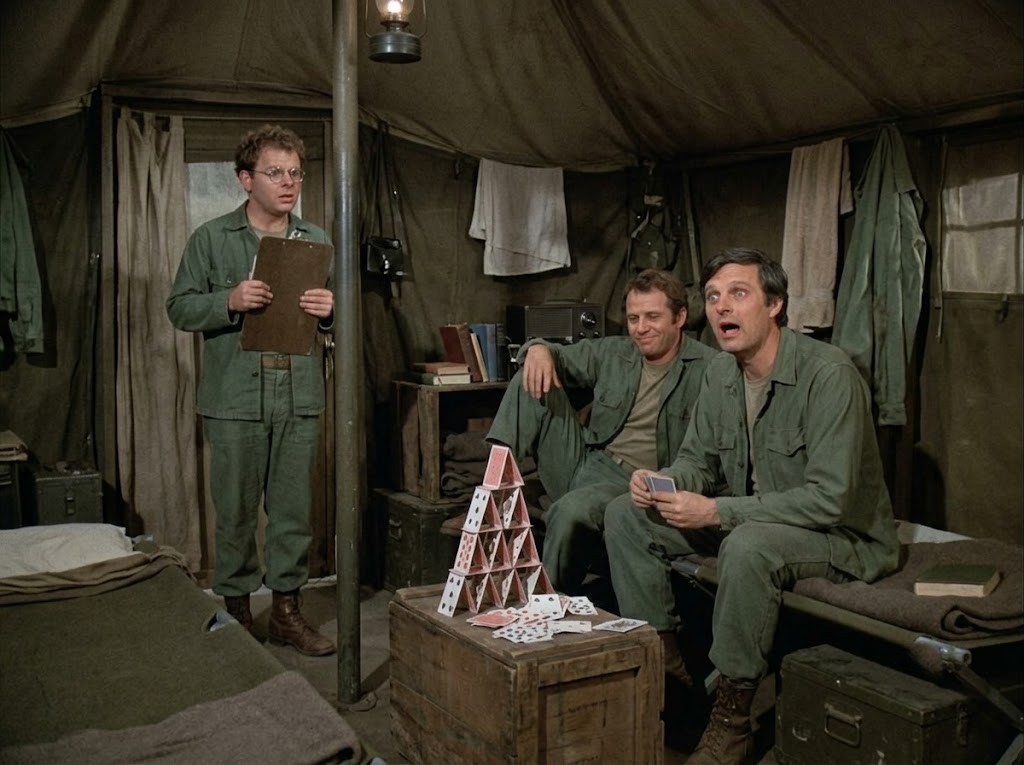
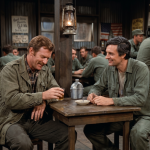
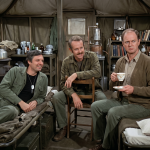
The Swamp always smelled of stale coffee, damp canvas, and the sharp, antiseptic sting of rubbing alcohol that never quite washed off their hands.
Outside, the Korean wind rattled the tent flaps, a constant reminder of the world they had been pulled into, but inside, time had a habit of standing still between the deluges of wounded.
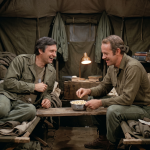
Hawkeye Pierce sat on the edge of his cot, his fingers delicately balancing a two of spades at the apex of a three-tiered house of cards. His eyes were wide, a manic sort of focus replacing the usual exhaustion that lined his face.
Beside him, B.J. Hunnicutt leaned back against his own bunk, a quiet, knowing smirk playing on his lips as he watched his tentmate’s hyper-fixation. B.J. held his own hand of cards loosely, entirely content to let Hawkeye play the architect of their temporary distraction.
The silence in the tent was heavy but comfortable, the kind of quiet that only grows between people who have seen the worst of humanity together and survived another shift.
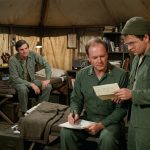
Then, the screen door clicked open, and Radar O’Reilly stepped inside, holding a clipboard tightly against his olive-drab chest.
Radar didn’t say a word, his glasses reflecting the dim light of the lantern hanging from the central pole, but his face carried an expression of pure, unadulterated dread that instantly shifted the air in the room.
Hawkeye froze, his hand hovering an inch away from the delicate structure of cards.
“Radar,” Hawkeye whispered, not daring to move his head, his voice a mix of playful warning and sudden, genuine tension. “If you breathe too hard, if you even think about a chopper coming over that hill, this entire masterpiece collapses, and I will be forced to perform open-heart surgery on your clipboard.”
B.J. chuckled softly, but his eyes darted to Radar’s face, searching the young corporal’s expressions for the signs they all feared—the twitch of the shoulder, the tilted head that meant incoming choppers were still miles away but entirely real.
Instead, Radar just stood there, his jaw slightly slack, staring at the cards and then at Hawkeye with a look that seemed to stretch far beyond the small wooden crate serving as their table.
“Sirs,” Radar said, his voice unusually small, cracking just enough to make B.J. straighten up on his cot. “The Colonel just got a call from Seoul.”
The humor evaporated from Hawkeye’s eyes, though his hand remained frozen in place, a stark contrast to the sudden tightening of his jaw.
“Don’t do it, Radar,” Hawkeye said, his voice dropping its theatrical edge, replaced by the raw, tired tone of a man who hadn’t slept more than four hours at a time in six months. “Don’t tell me the peace talks broke down again. Don’t tell me we have another convoy coming from the front.”
Radar swallowed hard, shifting his weight from one mud-caked boot to the other, his eyes finally moving from the house of cards up to Hawkeye’s face.
“No, sir,” Radar whispered. “It’s not a convoy. It’s… it’s about a letter that came through the main pouch. From Mill Valley, California.”
B.J.’s smile vanished instantly. The loose cards in his hand suddenly felt like lead. He looked at Radar, his posture rigid, the thoughts of his wife Peg and his little girl Erin flashing across his mind with the force of an artillery shell.
“Radar,” B.J. said, his voice remarkably steady despite the sudden paleness of his cheeks. “What about Mill Valley?”
The tent was so quiet you could hear the faint hum of the generator across the compound, the slow drip of water somewhere near the laundry truck, and the heavy, rhythmic breathing of three men waiting for a verdict.
“Your daughter, Captain Hunnicutt,” Radar said, a tiny, genuine smile finally breaking through his nervous expression. “She took her first steps yesterday. Mrs. Hunnicutt sent a telegram through the Red Cross liaison because she knew the regular mail was delayed. She wanted you to know right away.”
The breath exploded out of Hawkeye in a loud, dramatic gasp of pure relief, his mouth falling open in a comical look of mock indignation.
“You little midwestern heartbreaker!” Hawkeye yelled, his hands flying up in the air in celebration, entirely forgetting his previous caution.
The sudden movement sent a gust of air rushing across the wooden crate. The delicate house of cards shivered, buckled, and then cascaded down into a flat, scattered pile of red and black symbols on the rough wood.
But nobody looked at the cards.
B.J. let out a breathless laugh, a sound that carried the weight of a thousand miles and a year of missed milestones, leaning his head back against the canvas wall as a massive, tearful grin spread across his face.
“She’s walking,” B.J. whispered to the ceiling, his voice thick with a warmth that seemed to heat the entire chilly tent. “Peg says she’s walking, Hawk.”
“Of course she is,” Hawkeye said, leaning over to slap B.J. on the knee, his own eyes bright with a deep, fierce loyalty. “She’s a Hunnicutt. Probably walking straight toward a telephone to tell her dad to get his ugly mug back home.”
Radar stood by the door, his clipboard still clutched like a shield, but his chest swelled with the quiet pride of a boy who had successfully delivered a piece of home to the people he cared about most.
By evening, the artillery would rumble again in the distance, and the tents would fill with the harsh realities of the 4077th, but for those few minutes in the Swamp, the war didn’t stand a chance against a little girl’s first steps.
In a place where everything felt temporary, we built our survival out of the moments that promised us tomorrow.