A Splash of Pink in a Sea of Khaki
The war was often measured not just in miles or casualties, but in the endless, exhausting counting of wooden crates.
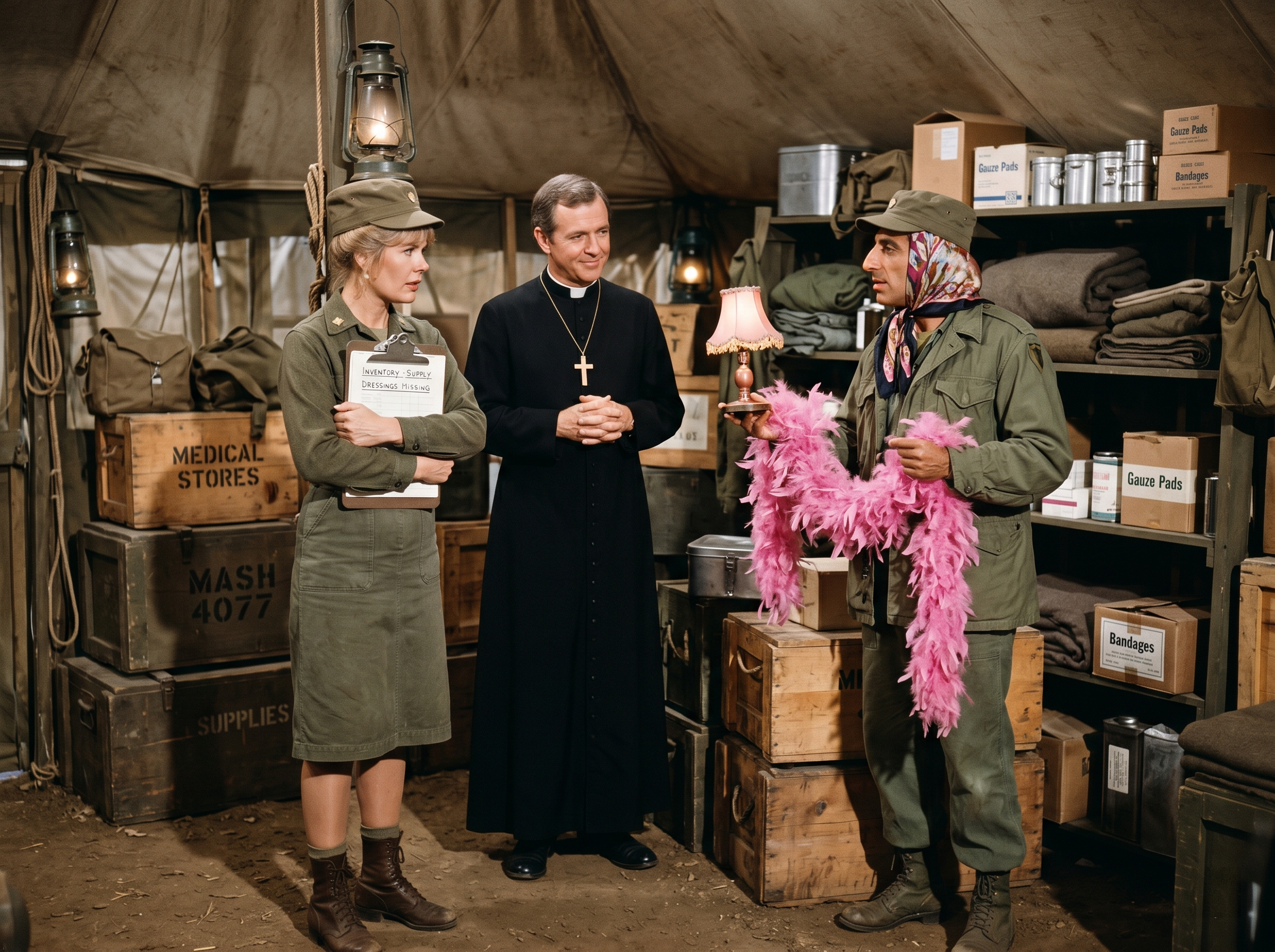
Inside the 4077th supply tent, the air always smelled of damp canvas, dry dust, and the sharp, metallic tang of iodine. It was a space built on absolute necessity, packed to the sloped ceiling with olive-drab bags, folded wool blankets, and heavy wooden boxes boldly stenciled with “MEDICAL STORES” and “MASH 4077.”
It was late, and the camp was wrapped in a rare, temporary quiet.
A single kerosene lantern cast a soft, dim glow over the dusty floorboards, throwing warm, long shadows against the walls.
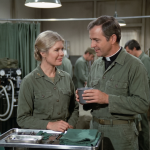
Major Margaret Houlihan stood in the center of the clutter, holding her clipboard like a shield. She was exhausted, though she would never admit it, running on cold coffee and sheer, stubborn willpower.
Her posture was perfect, her uniform crisp despite the dirt of the Korean peninsula. She was trying to bring a sense of military order to a place that constantly defied it.
Beside her, Father Mulcahy stood quietly, his hands gently folded together.
The chaplain had offered to help her with the inventory, hoping to locate a few spare blankets for the local orphanage. He was a calming presence in the dusty room, a quiet anchor of peace amidst the towering stacks of gauze pads and bandages.
But peace, at the 4077th, was always short-lived.
Across from them stood Corporal Maxwell Klinger.
He was dressed in his standard, worn-in fatigues, but his head was wrapped securely in a brightly patterned silk scarf, tied neatly under his chin. That, however, was not what had stopped the inventory dead in its tracks.
Draped dramatically across Klinger’s hands was a massive, violently pink feather boa.
Balanced carefully in his palm was a small, ornate boudoir lamp with a fringed shade. It was a theatrical, utterly absurd object, completely alien to the grim reality of a mobile army surgical hospital.
Margaret stared at him.
Her arms were stiff, pressing the clipboard tightly to her chest. Her face was locked in a perfect mask of controlled frustration and profound, skeptical disbelief.
Klinger held the items up with a look of sly, unmistakable hope. His comedic timing was perfect, his expression radiating a strange, dignified pride in his bizarre treasure.
Father Mulcahy simply observed them both. A soft, slightly confused smile played on his lips, his gentle eyes crinkling at the corners as he watched the standoff unfold.
“Corporal,” Margaret finally said, her voice dropping to a dangerously low, tight whisper.
“Major,” Klinger replied, not blinking, his tone polite and painfully innocent.
“I have been counting rolls of surgical tape for three hours,” Margaret said, her knuckles turning white around her pen. “I have counted crates of penicillin, boxes of plasma, and enough tongue depressors to build a bridge to Tokyo.”
She took a slow, measured step forward.
“So, you will explain to me, right now, how a pink feather boa and a parlor lamp ended up in a crate distinctly marked ‘WINTER THERMAL GEAR’.”
Klinger adjusted the lamp in his hand, standing just a little taller, preparing his defense. The tension in the dusty tent was thick enough to cut with a scalpel, and Margaret’s patience was officially running on fumes.
“Well, Major,” Klinger began, his voice smooth and remarkably steady. “It’s a known fact that army logistics are deeply flawed. A simple clerical error in Seoul, a misread requisition form…”
“A clerical error,” Margaret repeated, her voice dripping with absolute ice.
“Exactly,” Klinger nodded, shifting the bright pink feathers slightly. “I asked for standard-issue thermal neckwear and a heavy-duty portable heat source. Clearly, the supply clerk in supply depot three has a very loose interpretation of army regulations.”
Margaret’s jaw tightened. She looked at the delicate fringed lamp, completely useless without a proper electrical outlet, and the boa, which looked like an explosion in a flamingo factory.
“You ordered this,” she said, her tone leaving no room for argument. “You used army transit, during a war, to ship theatrical props from a catalog.”
“I would never misuse army resources, Major,” Klinger said, placing a hand over his heart, nearly dropping the lamp. “But since they are already here, it would be a tragic waste of taxpayer dollars to throw them away. Think of the morale.”
“The morale,” Margaret echoed, closing her eyes for a brief second.
She was so tired. Her feet ached, her back was stiff, and the endless sea of olive green and khaki was enough to slowly drive anyone mad. She wanted to yell. She wanted to write him up, confine him to quarters, and burn the ridiculous feathers in the mess tent stove.
Before she could open her mouth to deliver a blistering reprimand, a quiet voice broke the tension.
“It is… a rather cheerful shade of pink, Margaret,” Father Mulcahy said softly.
Margaret turned to look at the priest. Mulcahy hadn’t moved, his hands still folded peacefully in front of his black cassock. He was looking at the boa with a genuine, innocent appreciation.
“Father, please,” Margaret sighed, some of the harshness leaving her voice. “It’s a violation of uniform code, hygiene standards, and basic common sense.”
“Perhaps,” Mulcahy agreed mildly. “But the Lord works in mysterious ways. And sometimes, in a place as dark as this, a little bit of… unexpected color can be a small mercy.”
He reached out and gently touched the fringe of the little lamp.
“It reminds me of the lamps in my grandmother’s parlor in Philadelphia,” the chaplain mused, a distant, warm look in his eyes. “It made the whole room feel safe. A very comforting light.”
Margaret looked back at Klinger.
Beneath the theatrical posture and the ridiculous silk headscarf, she saw the dark circles under his eyes. She saw the dust on his boots and the frayed edges of his fatigue jacket. She knew he had spent the entire morning unloading wounded soldiers from the choppers, his hands covered in the same mud and blood as the rest of them.
He wasn’t trying to undermine her authority. He was just trying to survive. He was trying to find one small, silly thing to hold onto in a world that had lost its mind.
The deep, heavy fatigue in Margaret’s chest shifted, transforming into something quieter. Something like understanding.
She looked at the pink boa again. It really was aggressively pink. In the dim, dusty light of the canvas tent, surrounded by crates of bandages and bitter medicine, it was the most ridiculous thing she had ever seen.
And it was, undeniably, beautiful.
Margaret took a deep breath. She adjusted her grip on her clipboard, her face returning to a mask of professional stoicism.
“Corporal,” she said, her voice crisp but stripped of its previous anger.
“Yes, Major?” Klinger asked, bracing himself.
“I am currently looking at a requisition of…” she paused, clicking her pen and staring down at her inventory sheet. “One bundle of highly experimental, pink-dyed thermal bandaging, and one… specialized, low-wattage surgical examination light.”
Klinger blinked, his sly hope blossoming into a wide, brilliant smile. “That sounds exactly right to me, Major. Very experimental.”
“However,” Margaret continued, pointing her pen directly at his chest. “If I see those experimental bandages draped around your neck in the mess tent, or if that surgical light ends up in Colonel Potter’s office, I will personally see that you are scrubbing bedpans until the next century. Am I understood?”
“Loud and clear, Major,” Klinger said, executing a sharp, albeit strange, salute while still holding the lamp and the boa. “The army thanks you for your dedication to medical innovation.”
“Get out of my supply tent, Klinger,” she said, finally allowing a tiny, almost imperceptible smirk to touch the corner of her mouth.
“Yes, ma’am. Bless you, Father,” Klinger beamed, turning on his heel. He practically floated out of the tent, the bright pink feathers trailing behind him like a comet against the drab canvas walls.
The heavy flap fell shut, and the tent was quiet once more.
Margaret stood silently for a moment, listening to the crunch of Klinger’s boots fading into the compound. She looked down at her clipboard, shaking her head slowly.
“You know he’s going to wear that to the next movie night, Father,” she said softly, not looking up.
“I certainly hope so, Margaret,” Father Mulcahy smiled, turning back to the wooden crates of blankets. “I certainly hope so.”
They went back to counting, surrounded by the smell of dust and iodine, but the dim light of the lantern suddenly felt just a little bit warmer.
In a world painted in endless shades of war, sometimes survival just meant holding onto the brightest, most ridiculous thing you could find.