The Quiet Sanctuary of Rosie’s Bar
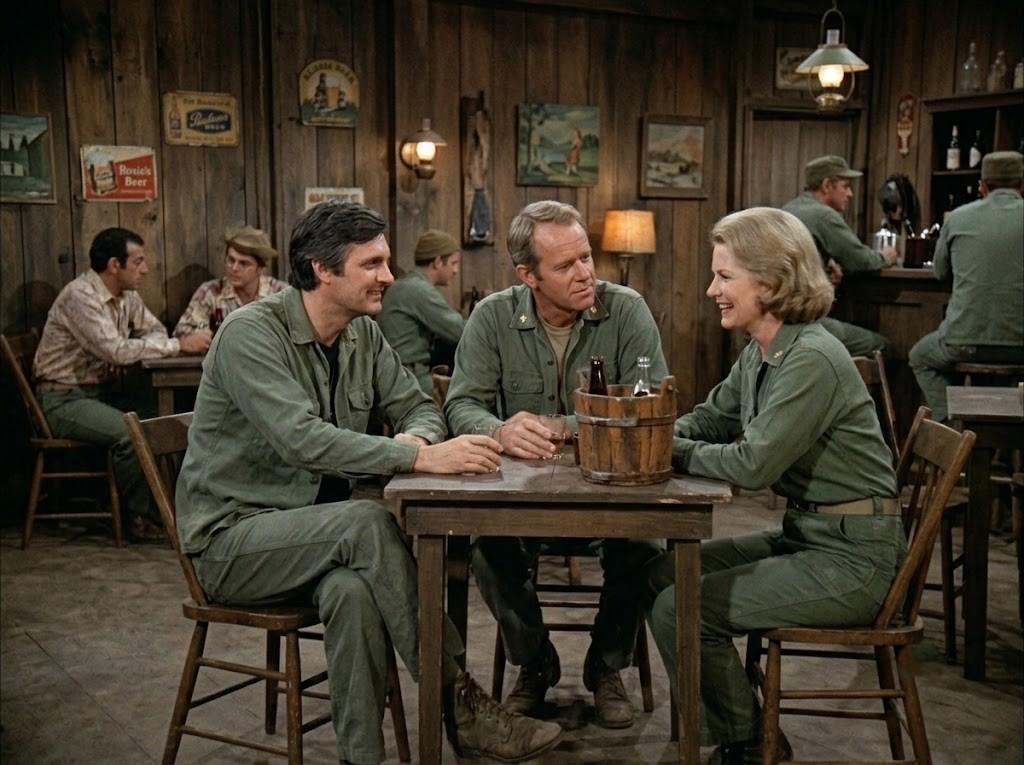
The smell of ether never really leaves your skin, no matter how hard you scrub with that yellow GI soap. After a grueling thirty-six-hour session in the operating room, it clings to your clothes, your hair, and the back of your throat like an uninvited guest.
But inside the dim, wood-paneled walls of Rosie’s Bar, if you leaned close enough to a cold glass of local beer, you could almost pretend you were somewhere else.
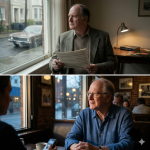
Hawkeye Pierce leaned back in his creaking wooden chair, slouching with the practiced ease of a man who spent half his life trying to escape his own boots. His eyes were heavy with a fatigue that went straight to the marrow, but a small, quiet smile played on his lips. Across from him, Margaret Houlihan was laughing—a genuine, unforced sound that didn’t happen nearly often enough back at the compound.
Between them sat B.J. Hunnicutt, his gaze shifting between the two of them with a steady, grounding warmth. A small wooden bucket containing a few stray bottles sat in the center of their scarred table, a humble centerpiece for an impromptu truce.
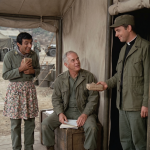
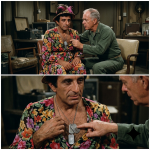
In the background, the soft murmur of the camp’s regulars offered a comforting wall of sound. Klinger was tucked away at a corner table, temporarily trading his theatrical dresses for a loud, floral shirt, speaking in hushed, earnest tones to a fellow soldier. At the bar, a couple of exhausted infantrymen stared silently into their glasses, letting the dim lanterns wash over their tired shoulders.
For a few precious minutes, the war felt like it was miles away, blocked out by the thick wooden door of Rosie’s sanctuary.
“I’m telling you, Margaret, it’s a medical breakthrough,” Hawkeye insisted, his voice dropping into that familiar, rhythmic banter he used to keep the dark thoughts at bay. “If we replace the plasma bags with Rosie’s finest brew, the patients won’t care about the shrapnel, and the surgeons will finally get some decent conversation.”
Margaret shook her head, her blonde hair catching the amber glow of the hanging lantern. “Pierce, you are completely irrepressible. If Colonel Potter caught you putting brewery stock in the supply tent, he’d have you scraping spark plugs from here to Seoul.”
“Ah, but the morale, Major!” B.J. chimed in, leaning forward and resting his hands on the table. “Think of the morale. A little foam, a pretzel or two, and suddenly the 4077th is the most popular resort in the Republic of Korea.”
Margaret chuckled, the strict, military posture she wore like armor completely vanishing. For a fleeting second, she wasn’t the hard-nosed Head Nurse fighting for protocol in a chaotic wilderness. She was just a woman sharing a laugh with the only people who truly understood what the last two days had cost.
Hawkeye watched her smile, his own expression softening into something deeply affectionate. These were the moments that kept the gears turning—the fragile, beautiful fragments of humanity salvaged from the mud.
Then, B.J. reached into his fatigue jacket and pulled out a small, crumpled piece of paper, his thumb gently tracing the edge. It was a drawing from Peg and Erin, sent three weeks ago, now worn thin from being folded and unfolded a hundred times.
The laughter at the table died down, replaced by a sudden, heavy stillness. The silence wasn’t cold; it was the kind of quiet that happens when three people realize exactly how much they are holding inside, and how close they are to breaking.
Margaret looked at the drawing in B.J.’s hand, her smile fading into a gentle, bittersweet expression. “How old is she now, Beej?” she asked softly, her voice devoid of any military crispness.
“She’s walking,” B.J. said, his voice thick with a mixture of pride and a homesickness so sharp it looked like physical pain. “Peg says she’s trying to talk to the neighbors’ dog. Every time I get a letter, I feel like I’m reading a book about someone else’s life. Like I’m checking out a story from a library, waiting for the day I get to go inside it.”
Hawkeye took a slow sip of his drink, his eyes fixed on the wooden grain of the table. The quick wit that usually served as his shield seemed to fail him for a moment. He thought of Crabapple Cove, the smell of the Atlantic surf, and his father sitting by the telephone, waiting for a ring that only came every few months.
“She’ll know you the minute you walk through that door, B.J.,” Margaret said, reaching out to briefly touch his sleeve. It was a rare, uncharacteristic gesture of pure comfort. “Children have a way of remembering the things that matter. Even across an ocean.”
B.J. looked up, offering her a grateful, tired smile. “Thanks, Margaret. I appreciate that. I really do.”
Hawkeye cleared his throat, sensing the air getting a little too heavy for comfort. He pointed a finger at the wooden bucket on the table. “You know, if we don’t finish these, Rosie is going to charge us rent for the ice. And frankly, my financial portfolio is currently tied up entirely in scrip and IOUs from Klinger.”
The tension broke, dissolving into a collective, quiet chuckle. Margaret leaned her chin on her hand, looking at Hawkeye with an expression that was part amusement and part deep, unspoken respect.
“You never stop, do you, Pierce?” she murmured. “Even when you’re so tired your knees are shaking, you just keep talking.”
“If I stop talking, Margaret, the silence gets too loud,” Hawkeye said honestly, his eyes meeting hers. There was no mockery in his voice now, just the raw, stripped-back truth of a surgeon who spent his days fighting a clock that never stopped ticking. “Besides, if I’m quiet, Hunnicutt over here starts thinking about California, and then he gets that look in his eye like he wants to build a raft out of tongue depressors and paddle across the Pacific.”
“It’s a valid escape plan,” B.J. defended himself, a spark of mischief returning to his eyes. “I’ve already figured out the sail. Klinger offered to donate one of his evening gowns. The yellow chiffon has excellent wind resistance.”
Margaret laughed out loud this time, a bright, clear sound that seemed to chase away the shadows lurking in the corners of the bar. “God help me, I don’t know how I ended up assigned to a unit run by a pair of lunatics.”
“Destiny, Major,” Hawkeye said, raising his glass in a small, solitary toast. “Pure, unadulterated, bureaucratic destiny. The Army looked at the two most disorganized doctors in the Western Hemisphere and said, ‘Let’s pair them with the finest nurse in the military and see if they can survive each other.'”
“And are we surviving?” she asked, her eyes searching both of their faces.
B.J. looked around the table—at Margaret’s relaxed shoulders, at Hawkeye’s tired but resilient smile, and at the worn drawing of his daughter resting safely near his heart. He raised his glass to join Hawkeye’s.
“We’re doing better than surviving, Margaret,” B.J. said softly. “We’re keeping each other human.”
Margaret hesitated for a fraction of a second, then picked up her own glass, tapping it gently against theirs. The clear, sharp ring of the glass echoed over the low rumble of the tavern, a tiny, defiant declaration of friendship in the middle of a forgotten peninsula.
Outside, the Korean night was cold, and tomorrow the helicopters would undoubtedly return, bringing with them the noise, the blood, and the endless struggle to mend what had been broken. The tents would be drafty, the food would be gray, and the war would go on.
But tonight, inside the warm, beer-scented walls of Rosie’s, three tired souls sat together at a small wooden table, holding onto each other, holding onto home, and sharing a laugh that the mud could never touch.
Sometimes, the best medicine the 4077th ever had wasn’t found in the pharmacy tent, but in a quiet corner of Rosie’s Bar.