The Quiet After the Storm
The hardest part of the war was never the noise. It was the silence that followed.
The heavy, canvas doors of the O.R. had finally stopped swinging. The endless stream of stretchers had slowed to a halt, leaving the room feeling vast, hollow, and smelling faintly of iodine and exhaustion.
The generator outside hummed its familiar, rhythmic tune. It was the only sound in the room, save for the sharp, rhythmic clink of metal against metal.
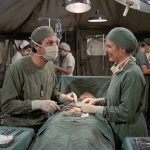
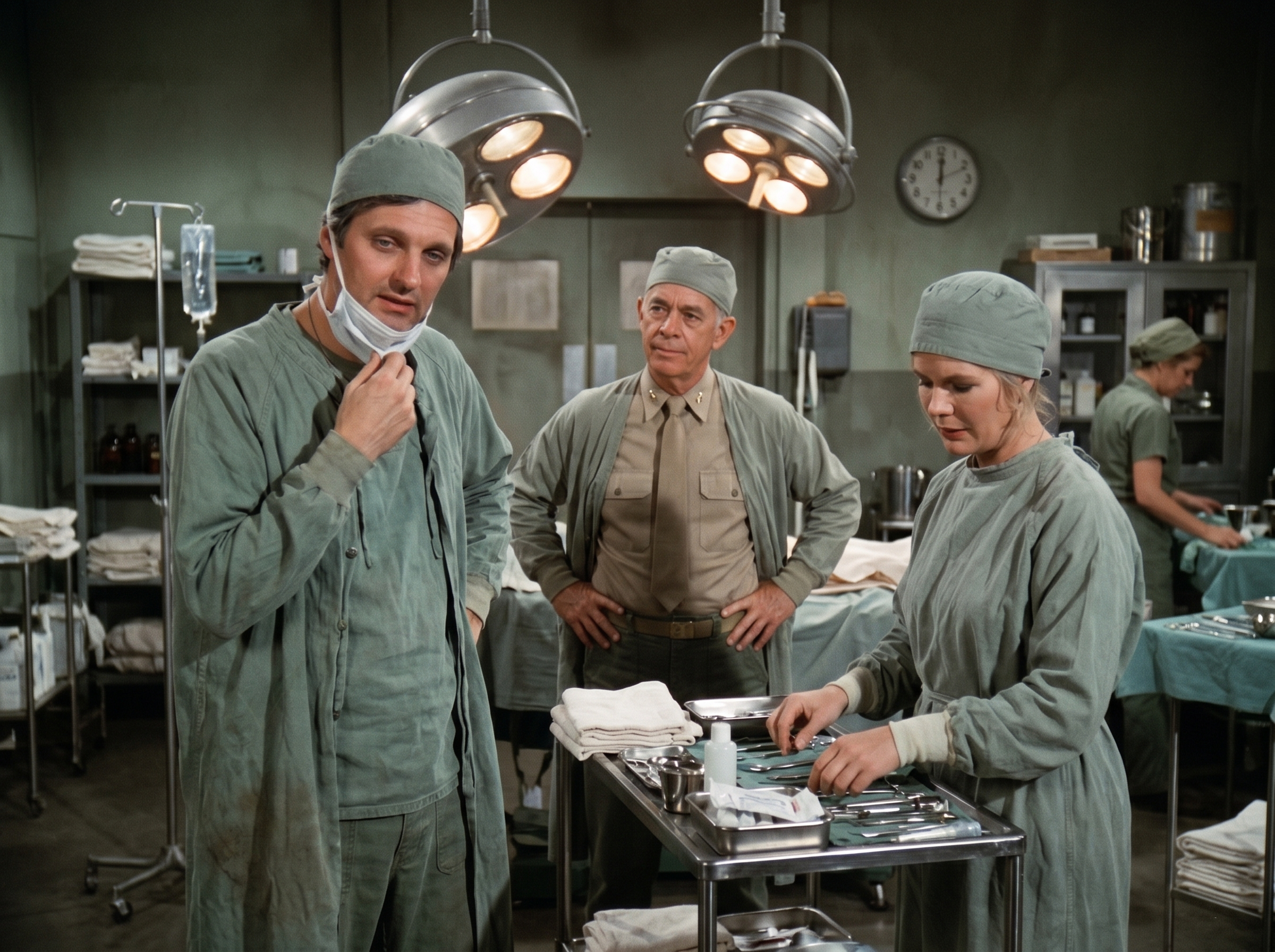
Hawkeye Pierce stood near the center operating table, his shoulders slumped in a posture of profound, bone-deep fatigue.
He reached up with heavy arms, his fingers catching the elastic of his surgical mask. He pulled it down, letting it snap softly against his neck.
For a long moment, he just stared at the empty space where a nineteen-year-old kid had been lying just minutes before. The kid had made it. But it had been close. Too close.
Hawkeye’s eyes, usually dancing with some inappropriate joke or rebellious spark, were dark and quietly wounded. The comedy he wore like armor had been stripped away by fourteen straight hours of meatball surgery.
He leaned back, his spine curving into a relaxed, defeated slouch. He didn’t have the energy to move toward the scrub room. He barely had the energy to breathe.
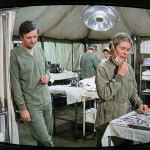
A few feet away, Major Margaret Houlihan was organizing a medical tray.
Her movements were crisp, professional, and methodical. Forceps, clamps, scalpels. She lined them up with military precision, the sterile stainless steel catching the muted glare of the overhead lamps.
But her face told a different story. The usual strict, unyielding mask of the Head Nurse had softened.
Her composed features subtly revealed how deeply the day’s effort had moved her. She had stood opposite Hawkeye for six of those fourteen hours, anticipating his hands, matching his frantic pace, fighting the grim reaper to a standstill over a canvas cot.
She knew how close Hawkeye had come to losing the boy on the table. And she knew how much it would have destroyed him if he had.
Behind them both, Colonel Sherman Potter stood slightly back from the surgical lamps, giving them space.
He rested his hands on his hips, his posture compact, stable, and deeply reassuring. He looked like an old, sturdy oak tree that had weathered a thousand storms and was fully prepared to weather a thousand more.
Potter surveyed his people. His eyes carried the gentle pride and seasoned authority of a father watching his children survive a nightmare.
“Well,” Hawkeye finally whispered, his voice cracking against the dry air. He didn’t look up. “I think that’s the last of them. Unless the Army decides to start dropping wounded directly through the roof.”
He tried to force a small, signature smirk, but it didn’t reach his eyes.
“I was going to suggest we all go out dancing,” Hawkeye continued, his voice trembling just a fraction of an inch. “But I seem to have misplaced my dancing shoes. And my legs. And my will to live.”
The joke hung in the air, fragile and paper-thin. It was a clear, desperate attempt to build a bridge away from the trauma of the last few hours.
Hawkeye gripped the edge of the surgical table, his knuckles turning white. The silence stretched out, heavy and suffocating, waiting to see if the chief surgeon was finally going to break.
The clinking of the medical instruments abruptly stopped.
Margaret carefully set down a retractor. She didn’t bark an order. She didn’t remind him of regulations.
Instead, she turned her head slightly, her blonde hair catching the harsh light. She looked at Hawkeye’s slumped shoulders, recognizing the familiar, heavy burden he was trying to carry all by himself.
“You didn’t misplace anything, Captain,” Margaret said softly. Her voice lacked its usual sharp edge, replaced by a quiet, steady warmth. “Your hands were exactly where they needed to be.”
Hawkeye slowly lifted his head, genuinely surprised.
He met her gaze. Margaret held it, her eyes reflecting a profound, unspoken respect. It was a rare moment of complete vulnerability between them, stripped of the brass, the ranks, and the endless bickering.
She was telling him, without saying the words, that she had seen the miracle he pulled off today. She was telling him it was okay to let the armor fall.
Hawkeye let out a long, shaky breath, the tension in his jaw finally unwinding.
“She’s right, Pierce,” Colonel Potter’s voice rumbled from the shadows, rich and grounding.
Potter took a slow step forward into the light. He kept his hands resting on his hips, projecting that calm, old-cavalry strength that held the entire 4077th together.
“That boy came in here with one foot on the train and the conductor punching his ticket,” Potter said gently. “You pulled him right off the steps. You both did.”
Potter looked at Margaret, offering her a nod of deep appreciation. She lowered her eyes for a moment, absorbing the praise, her professional exterior guarding a very tender, human heart.
“I thought I lost the bleeder, Colonel,” Hawkeye confessed. It was a rare admission of fear. He rubbed his face, smearing a line of exhaustion across his cheek. “For about thirty seconds there, I was operating on pure blind panic.”
“Panic is just adrenaline with a bad reputation,” Potter replied smoothly. “What matters is what you do with it. And what you did today, Hawkeye, was damn fine medicine. The finest.”
The words settled over the room like a warm blanket.
The suffocating weight of the previous fourteen hours didn’t vanish entirely—it never did in this place—but it shifted. It became lighter. It became something they were carrying together, instead of alone.
Hawkeye stood up a little straighter. The slouch remained, but the defeat was gone.
“Well,” Hawkeye sighed, a genuine, albeit exhausted, smile finally touching the corners of his mouth. “If you’re going to throw compliments around like that, Colonel, you’re going to ruin my carefully cultivated reputation as a miserable malcontent.”
Margaret picked up her towel, wiping down the edge of her tray.
“Don’t worry, Captain,” Margaret said, the faintest trace of a smirk appearing on her face. “I’m sure you’ll do something incredibly obnoxious by morning to remind us all who you really are.”
“I have several obnoxious things planned, Major,” Hawkeye fired back, his wit returning, soft and familiar. “I just have to sleep for three days before I have the energy to execute them.”
Potter chuckled, a warm, resonant sound that chased the remaining ghosts out of the O.R.
“Go get some sleep, both of you,” Potter ordered gently. “The war has kindly agreed to take the next six hours off. I suggest you take advantage of it.”
Margaret gave the room one last, sweeping look, making sure her domain was perfectly in order. She nodded to Potter, gave Hawkeye a brief, soft look of solidarity, and walked toward the scrub room, her posture strong and dignified.
Hawkeye lingered for a second longer. He looked at the surgical lamps, then at Potter.
“Thanks, Sherman,” Hawkeye said quietly.
“Anytime, Hawkeye,” Potter smiled. “Now get out of here before I put you on latrine duty.”
Hawkeye pushed open the canvas doors, stepping out into the brisk, fading light of the Korean evening.
The air smelled of dust and distant pine trees. From somewhere across the compound, he could hear the faint, comforting sound of B.J. Hunnicutt laughing, and Radar O’Reilly yelling something about a jeep.
Hawkeye closed his eyes, letting the cool breeze wash over his tired face.
They were thousands of miles from home, trapped in a nightmare that made no sense. But standing there, listening to the heartbeat of the camp, Hawkeye knew one undeniable truth.
He wasn’t alone.
They were a family. A strange, exhausted, magnificent family, stitched together by war and held together by grace. And for tonight, at least, that was enough.
In a place built on heartbreak, the greatest medicine they ever prescribed was simply each other.