The Toledo Furnace and the Boston Chill
The Korean cold is a living, breathing thing.
It doesn’t just chill a person; it disrespects them. It sneaks through the seams of heavy canvas, burrows into the soles of combat boots, and settles deep into the bones until you forget what July ever felt like.
For Major Charles Emerson Winchester III, a man who firmly believed winter should only be experienced through a frosted, double-paned window in Beacon Hill with a snifter of warm brandy in hand, the drafty tents of the 4077th were an endless, personal insult.
Which is exactly how he found himself standing in the cluttered, dimly lit supply tent, swallowing what little pride the November wind hadn’t already stripped away.
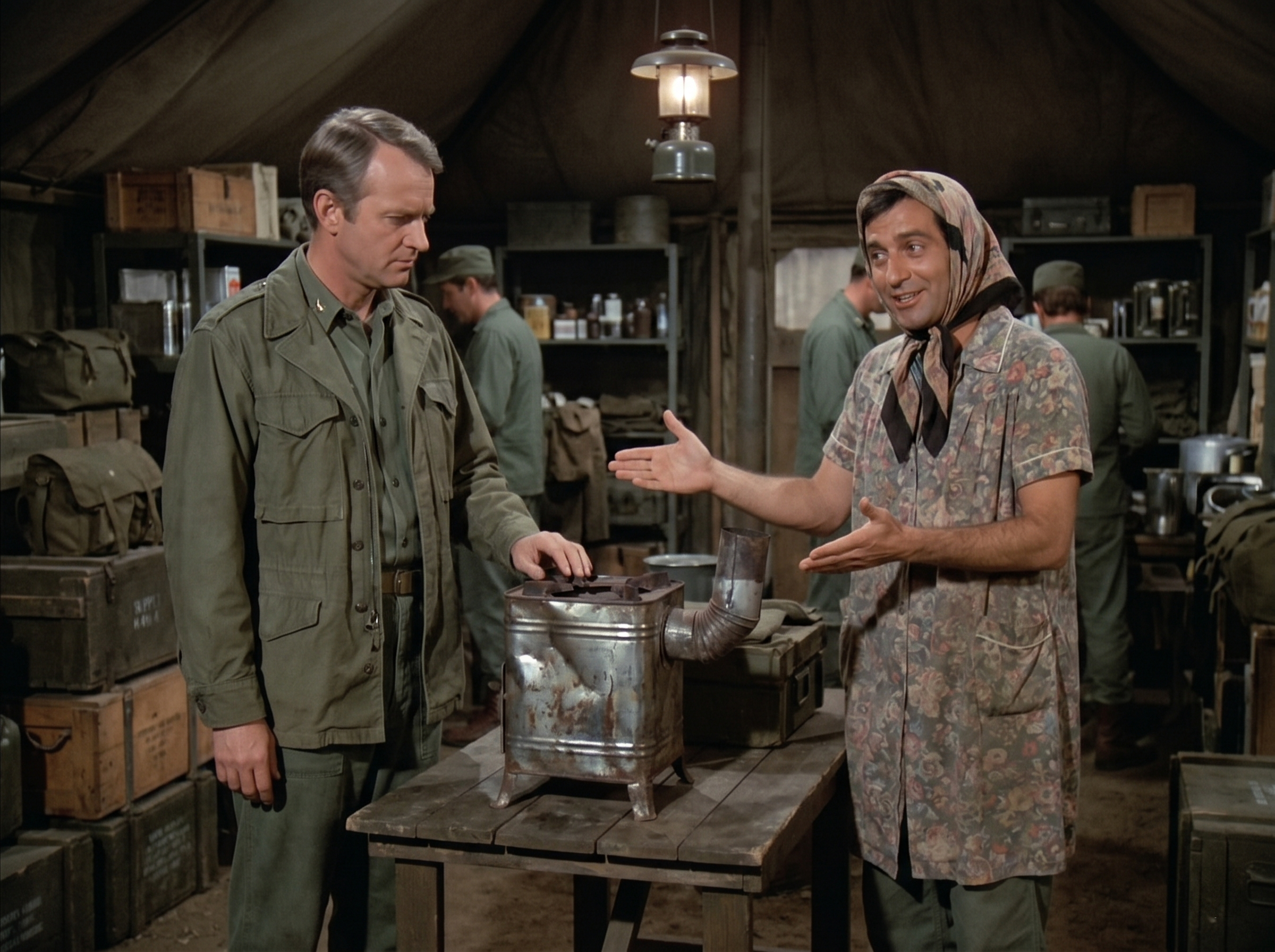
The tent smelled of damp canvas, old wool, and mothballs, illuminated by the soft, warm glow of a single practical lantern hanging from the center pole.
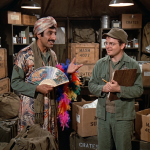
Across the rough wooden table stood Corporal Maxwell Klinger.
He was dressed, rather incongruously for the freezing temperature, in a matching floral babushka and short-sleeved housecoat.
Standing amidst the towering wooden crates and drab olive-green canvas bags, Klinger looked less like a military quartermaster and more like a proud European grandmother ready to haggle at a Sunday market.
But he wasn’t offering fresh bread. He was offering salvation.
Sitting between them on the wooden planks was a heavily dented, pathetic-looking tin box.
It had a corrugated metal pipe jutting awkwardly out of the side and looked as though it had recently been run over by a supply truck. Twice.
“I present to you, Major,” Klinger said, his hands sweeping expansively toward the battered metal with unmistakable comic timing. “The Toledo Torpedo. A masterpiece of improvised thermal engineering.”
Charles stared at the contraption.
Maintaining his upright posture, he rested his hand near the rusted grate, his face a perfect mask of dry, Bostonian disdain.
“Corporal,” Charles deadpanned, his voice dripping with condescension. “This is not a stove. This is a discarded coffee tin that has simply lost the will to live.”
“Ah, but it has character, Major!” Klinger countered, a sly, salesman’s hope gleaming in his eyes. “And more importantly, it holds fire. For the right price, it can turn the Swamp into the French Riviera.”
Charles sighed, a visible puff of white breath escaping his lips into the dim light. “And what exactly constitutes ‘the right price’ in this bazaar of the bizarre?”
Klinger leaned forward, dropping his voice to a conspiratorial whisper. “I hear you received a care package yesterday. Real silk pillowcases. And a tin of beluga caviar.”
Charles stiffened instantly, pulling his olive drab field jacket tighter around his shoulders.
“You are hallucinating, you floral fiend,” Charles snapped. “I would sooner freeze into a solid block of aristocratic ice than trade my family’s caviar for a mutilated tin can.”
He turned on his heel, his pride refusing to be battered any further. He took two firm steps toward the canvas exit.
But just as his hand touched the tent flap, a violent gust of wind tore through the compound, rattling the wooden tent poles and sending a brutal, icy shiver straight down Charles’s spine.
“Suit yourself, Major,” Klinger called out softly behind him, adjusting his headscarf. “But it’s supposed to drop to five below tonight. And I hear hypothermia is terrible for the complexion.”
Charles froze, his hand trembling on the cold canvas flap, trapped halfway between his towering dignity and the biting, undeniable cold.
The wind howled again outside, a high, lonely sound that seemed to mock the thin fabric of Charles’s uniform.
Slowly, agonizingly, the rigid aristocratic posture deflated.
Charles turned back around, his face tight with a spectacular display of reluctance. He walked slowly back to the wooden table, glaring at the dented monstrosity sitting between them.
“The caviar is entirely out of the question,” Charles said, his voice dropping to a tight, defeated whisper. “It is a Winchester family tradition, and I will not have it desecrated in a mud puddle.”
Klinger didn’t smile, but his eyes softened just a fraction.
He knew when a man was beaten, and underneath the dresses and the hustle, Klinger knew the difference between a good trade and outright cruelty.
Out here in the mud, nobody really wanted to see a fellow man freeze in his sleep. Not even a pompous one.
“Alright, Major,” Klinger said, his theatrical bravado dropping away to reveal a surprising, quiet dignity. “Keep your fish eggs. What are you offering?”
Charles reached deep into the pocket of his jacket. He pulled out a slightly crushed, blue tin of imported Scottish shortbread cookies.
He placed them on the table next to the dented stove, patting the tin with a quiet, lingering sadness.
“My Aunt Cecilia sent these,” Charles murmured. “They are authentic. They are exceptionally buttery. And they are the last tangible connection I have to civilized society.”
Klinger looked at the tin, then up at Charles’s face.
In the warm, dim light of the hanging lantern, Klinger could see the deep, purplish bags under the surgeon’s eyes. He saw the sheer exhaustion. He recognized the deep-bone chill that twelve-hour shifts in the freezing O.R. brought on.
For a brief moment, the sly salesman vanished completely.
Klinger was just a tired guy from Toledo, looking at a tired guy from Boston, both of them stuck in a freezing tent seven thousand miles from anywhere they wanted to be.
“Shortbread,” Klinger said softly. “My Uncle Mustafa used to make a mean shortbread. Put way too much rosewater in it, but it was good.”
Klinger reached out and slid the blue tin toward his side of the table.
“It’s a deal, Major.”
Charles looked at him, genuinely taken aback by the sudden lack of theatrics. “Just like that? No further haggling? No demands for my classical records or my phonograph?”
“Just like that,” Klinger said warmly.
He reached out and gave the dented stove a gentle pat. “She’s ugly, Major. I won’t lie to you. But she drafts well. Keep the vent pointed toward the door, and she’ll keep you warm.”
Charles gingerly picked up the heavy, battered tin contraption by its corrugated pipe. It was ridiculous. It was utterly hideous.
But as his bare hands grasped the cold metal, he felt a strange, unexpected wave of relief wash over him.
“Corporal,” Charles said, his voice losing a bit of its usual sharp edge. “I… I appreciate this. Despite its appalling aesthetic.”
Klinger smiled, flashing that familiar, irrepressible grin. “Stay warm, Major. And hey—if you ever need matching floral curtains for the Swamp, my spring collection is coming in next week.”
Charles allowed himself a very small, very dry smirk. “Let us not push our luck, Klinger.”
He turned and walked out of the supply tent, carrying the heavy, dented stove against his chest as if it were a priceless antique.
Back in the Swamp, Hawkeye and B.J. stared in stunned silence from their cots as Charles set the battered tin can down in the center of the wooden floorboards.
He didn’t explain the trade. He didn’t complain about the dirt.
He just struck a match, lit a small piece of kindling, and watched as the ugly little stove sputtered, smoked, and then finally began to glow with a steady orange light.
Within minutes, a small, radiant heat began to push back the freezing air of the tent.
Charles sat on his cot, pulling his wool blanket up to his chin, staring quietly at the glowing, dented metal.
It wasn’t a roaring fireplace in a Beacon Hill study. It wasn’t elegant, and it certainly wasn’t refined.
But as the warmth spread through the damp canvas, Charles realized something profound about this miserable, beautiful, terrible place.
Survival out here didn’t come wrapped in elegant packages.
It came in dented tin cans, bartered for in the shadows, handed over with quiet grace by a man wearing a floral dress.
And in the dead of a Korean winter, that was all the warmth a man really needed.
We came for the laughs, but we stayed for the moments when a freezing tent felt just a little bit like home.