The Toledo Illusion and the Clipboard Fortress
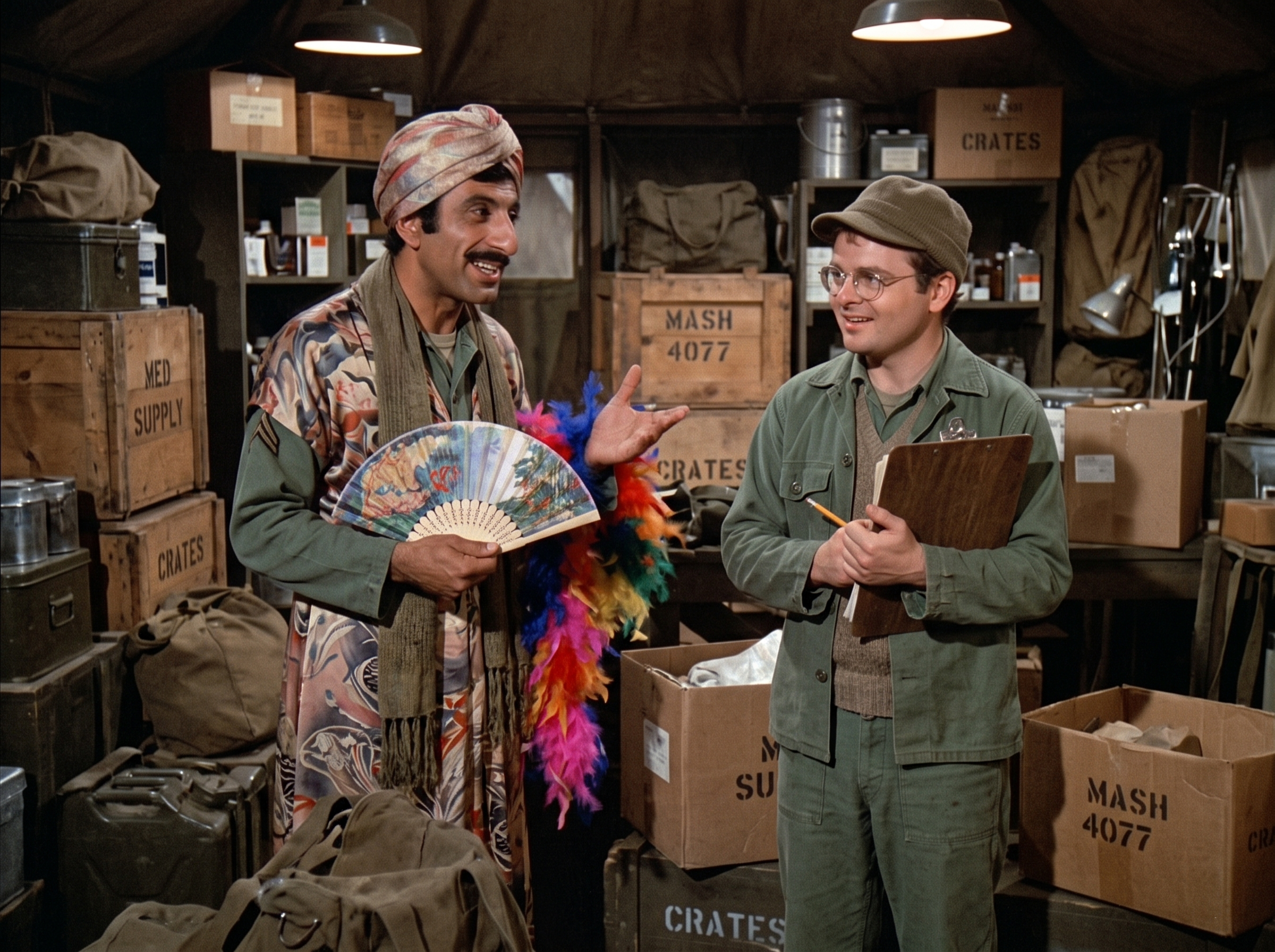
The supply tent of the 4077th always smelled like a peculiar mixture of damp canvas, iodine, and endless waiting.
It was a dim, cavernous space, stacked high with roughly hewn wooden crates, heavy brown canvas bags, and dull metal medical containers that seemed to stretch into the shadows. The practical, warm light of a single caged bulb hung from the central tent pole, casting long, tired shadows across the dirt floor.
It was a quiet afternoon, the kind of rare, suspended hour where the distant rumble of artillery felt like a bad rumor rather than an immediate threat.
Behind a fortress of stacked gauze boxes stood Corporal Walter “Radar” O’Reilly.
He was tightly clutching his trusty wooden clipboard against his chest, treating it less like an inventory ledger and more like a protective shield. His round glasses caught the weak light, and his face wore that familiar, earnest, nervous smile of absolute innocent misunderstanding.
Across from him, leaning over a crate of surplus bandages with the grace of a seasoned stage actor, was Corporal Maxwell Q. Klinger.
But Klinger was not currently dressed for the parade ground, nor was he fully in one of his famous Section 8 ensembles. He wore his standard, lived-in olive drab, the fabric soft and worn from too many washes in the Korean mud.
However, in his hands, he held a piece of pure, unfiltered theatrical magic.
It was a deeply impractical, outrageously bright crimson velvet opera cloak, complete with a tarnished silver clasp and a heavily embroidered collar. It looked completely alien in the dreary, olive-drab world of the mobile army surgical hospital.
Klinger gestured grandly with his free hand, sweeping it through the dusty air. His face was alight with an expressive, sly hope, the unmistakable look of a man who firmly believed he was about to close the greatest deal of his military career.
“Just look at it, O’Reilly,” Klinger purred, his voice dropping an octave into a smooth, radio-announcer register. “Feel the fabric. That is authentic, imported European velvet. Worn by the great baritones of the Toledo civic theater.”
Radar blinked, his smile wavering slightly. He didn’t reach out to touch the fabric. He just held his clipboard a fraction of an inch tighter.
“It’s very red, Klinger,” Radar said softly, his voice carrying the honest confusion of an Iowa farm boy confronted with big-city hustle. “But what am I supposed to do with it? The motor pool doesn’t need a curtain.”
“It’s not a curtain, you uncultured cherub,” Klinger sighed, though his affectionate tone betrayed no real frustration. “It is an investment. A masterpiece of camouflage.”
Radar looked at the bright red fabric, then back to Klinger, his eyebrows pulling together in a gentle frown. “Camouflage? Against what? A fire engine?”
Klinger leaned in closer, dropping his voice to a conspiratorial whisper. “Against the dreary, soul-crushing monotony of this war, my boy. Imagine Colonel Potter’s face when he sees you draped in the majesty of the theater.”
Radar shook his head quickly. “Oh, no. The Colonel likes me in regulation khaki, Klinger. He says I blend in with the filing cabinets.”
Klinger dramatically placed a hand over his heart, acting wounded. But the sly glint in his eye never faded.
He had a goal. The nights were getting bitterly cold, the kind of bone-chilling frost that seeped through the canvas walls of his tent and made his toes ache. He knew, through the deeply embedded camp grapevine, that a fresh shipment of heavy, wool-lined aviator socks and a single tin of real, honest-to-God roasted coffee beans had somehow found their way into Radar’s domain.
Klinger needed those socks. And he desperately wanted that coffee.
“Alright, let’s talk business, O’Reilly,” Klinger said, shifting his weight. He laid the velvet cloak reverently over a crate of plasma. “I am willing to part with this priceless artifact. I will let you have it, for your own personal morale.”
Radar looked down at his clipboard, tracing a line on the paper with a chewed pencil. “I appreciate the thought, Klinger. I really do.”
“I only ask for a modest trade,” Klinger continued, ignoring the protest, his hands framing the air as if painting a picture. “A mere administrative oversight. Two pairs of those heavy winter socks, and that stray tin of coffee. You get the cloak of a king. I get slightly warmer feet.”
Radar bit his lower lip. His eyes darted nervously between the meticulously organized columns on his ledger and the grand, hopeful face of his friend.
The silence in the dusty tent stretched tight, filled only by the quiet hum of the wind outside. Klinger held his breath, leaning over the wooden crate, waiting for the young corporal’s innocent resolve to finally break.
Radar slowly lowered the clipboard, letting it rest on the top of the supply crate.
He looked at the crimson velvet cloak, the dust motes dancing in the warm light above it. Then, he looked up at Klinger.
“I can’t do it, Klinger,” Radar said softly. His nervous smile faded into an expression of genuine, quiet regret.
Klinger’s grand theatrical posture deflated. The sly hope drained from his face, replaced by a sudden, heavy exhaustion. He suddenly looked like what he truly was: a very tired, very cold young man thousands of miles away from home.
“O’Reilly, please,” Klinger said, his voice losing the radio-announcer polish. It was just Maxwell Klinger now, sounding rough and worn. “My tent is like an icebox. The wind comes right through the canvas. I’ve been sleeping in my boots, and I can’t feel my left pinky toe.”
He picked up the velvet cloak, the heavy fabric sagging in his hands. The illusion of the great Toledo hustle was entirely gone.
“I just thought maybe…” Klinger muttered, looking down at the dirt floor. “I thought maybe I could trade my way into a little warmth. It was a good pitch, wasn’t it?”
Radar watched him closely. For all his innocent misunderstanding of the world, Radar O’Reilly possessed an incredible, almost supernatural intuition for the people he cared about.
He had seen Klinger shivering in the mess tent that morning. He had noticed how Klinger was holding his coffee cup with both hands, trying to draw the heat into his knuckles. Radar might not have understood the appeal of an opera cloak, but he understood suffering perfectly.
“It was a really good pitch, Klinger,” Radar said gently. “It’s a beautiful… whatever it is. But I can’t trade you for it.”
Klinger sighed, turning to walk away, the red velvet dragging slightly against a canvas bag. “Yeah. I know. Regulations.”
“No, that’s not it,” Radar said, his voice stopping Klinger in his tracks.
Radar flipped his clipboard over, revealing a blank sheet of paper on the back. He picked up his pencil and tapped it thoughtfully against his chin.
“I can’t trade you for the cloak,” Radar explained, his tone completely earnest and matter-of-fact. “Because there’s no column on Form 409-B for ‘Theatrical Garments, Velvet, Red’. If I take it, the whole quarterly inventory will be thrown off. The quartermaster in Seoul would have a fit.”
Klinger turned back around, a confused frown creasing his forehead. “So?”
“So,” Radar continued, reaching under his desk to a small, unmarked wooden crate that was deliberately hidden behind a stack of bedpans. “I can’t accept your trade.”
Radar pulled open the lid of the hidden crate. Inside, wrapped in brown paper, were several pairs of thick, heavy wool aviator socks. Resting on top of them was a dented, but sealed, green tin of real coffee beans.
“However,” Radar said, his innocent expression never changing, “I was just doing a recount of the damaged goods sector. And it seems that a box of winter socks was severely compromised by… uh… field mice.”
Klinger stared at him, his mouth slightly open. “Field mice?”
“Terrible infestation,” Radar nodded seriously, pushing his glasses up his nose. “Chewed right through the inventory tags. And that coffee tin has a dent in it. According to section 4, paragraph B, heavily dented rations must be discarded to prevent contamination.”
Radar gathered two thick pairs of the wool socks and the dented tin of coffee. He walked around the crates and held them out to Klinger.
“I was just about to throw these in the incinerator,” Radar said, his voice entirely steady. “But I’m pretty busy today. If you could take them off my hands and dispose of them for me, it would be a real favor to the camp.”
Klinger stood frozen in the warm, dusty light. He looked from the warm wool socks in Radar’s hands to the young corporal’s gentle, steady face.
The sly hustler from Toledo was suddenly at a loss for words. He realized, with a sudden tightness in his throat, that he had never needed to put on a show in the first place. He didn’t need to barter or scheme to find warmth in this place.
He just needed to ask his family.
Slowly, Klinger reached out and took the items. The wool felt incredibly soft, and the heavy weight of the coffee tin was a promise of a few minutes of real comfort.
“Radar…” Klinger started, his voice thick with unexpressed emotion. He cleared his throat, trying to regain a shred of his usual dignity. “I… I will ensure these damaged goods are properly handled. You have my word.”
“Thanks, Klinger,” Radar smiled, that nervous, earnest energy returning. “I appreciate it.”
Klinger carefully tucked the supplies under his arm. He looked down at the bright red velvet cloak still clutched in his other hand.
“Are you sure you don’t want the cloak?” Klinger asked softly. “Just as a gift. No trade.”
Radar shook his head, retreating behind his fortress of medical supplies. He picked up his clipboard again, holding it securely against his chest.
“You keep it, Klinger,” Radar said. “Winter is coming. You might need an extra blanket. Besides, I think it looks better on you anyway.”
Klinger smiled, a small, genuine expression that reached all the way to his tired eyes. He threw the velvet cloak dramatically over one shoulder, letting the tarnish silver clasp catch the dim light of the hanging bulb.
“You’re a good man, O’Reilly,” Klinger said quietly.
“Just doing the inventory, Klinger,” Radar replied, already chewing on his pencil again.
Klinger turned and walked out of the supply tent, stepping back out into the cold, biting wind of the compound. But as he walked toward his tent, the bitter air didn’t seem to cut quite as deep. He held the thick wool socks close to his chest, carrying a quiet, undeniable warmth that had nothing to do with the supplies.
It was the warmth of knowing that, even in the middle of a war, someone was looking out for him.
In the cold dust of a forgotten war, the greatest comfort didn’t come from the supply crates, but from the quiet kindness of the people who stood beside them.