THE UNWRITTEN LETTER
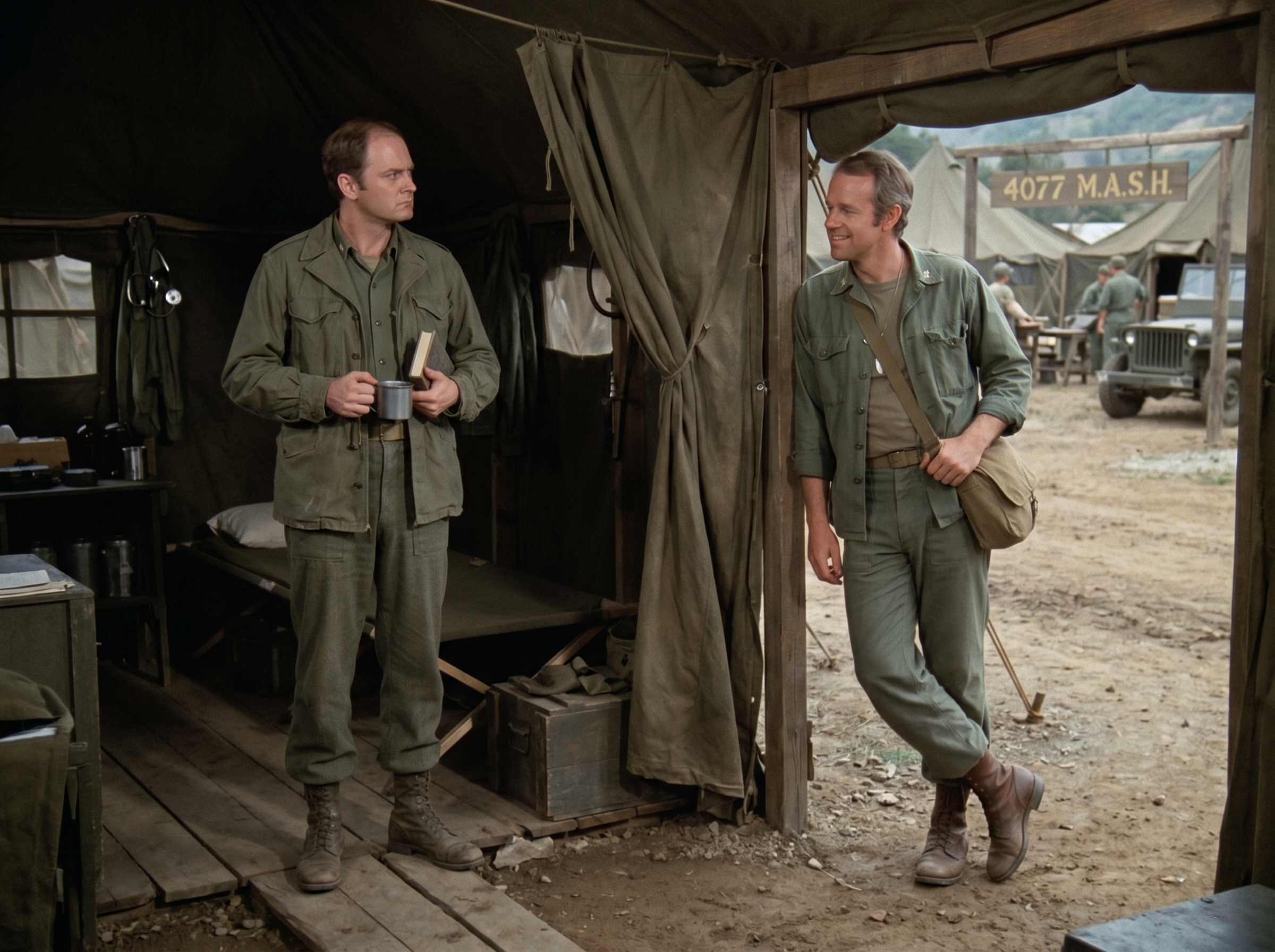
Charles Winchester III stood perfectly still, a lone sentinel of high culture amidst the encroaching dust of Uijeongbu. The tent was his fortress, though his fortress was made of canvas and had a dirt floor. It smelled of iodine, cheap tobacco, and the persistent, heavy exhaustion that hung over the entire 4077th like a morning fog. Charles had achieved a rare, delicate truce with the universe: five precious minutes of uninterrupted peace.
He was inside, safe from the casual slurs of Klinger and the relentless pragmatism of Colonel Potter. His Scarlatti tome was open in one hand, a perfect antidote to the chaotic medical journals that usually occupied his mind. In the other hand, he held a tin mug of coffee—real coffee, smuggled from Tokyo, hot enough to remind him he was alive. A single, perfectly positioned candle cast a refined, civilized glow across the pages. Life was, briefly, bearable.
And then, B.J. Hunnicutt arrived. B.J. was not content to simply walk in; he leaned, casual and easy against the doorframe, a physical embodiment of the relentless mediocrity Charles despised. His arms were folded over his M-1951 jacket, hands on hips, scuffed boots planted on the dry earth. A small, ironic smile played on his lips, the kind of smile that Charles knew meant B.J. had just seen something amusing, or was about to say something tedious. He didn’t move an inch inside, but his presence was a total invasion.
Charles slowly, deliberately lowered his book. He didn’t say a word. Instead, he utilized the most devastating weapon in his considerable arsenal: the slow, elegant raising of a single, perfectly sculpted eyebrow. The look conveyed centuries of Bostonian disapproval and a silent demand for solitude. B.J. just smiled wider, matching Charles’s icy stare with a cheerful, unshakable tolerance.
“Well?” Charles finally snapped, his voice a contained frost. “Have you completed your sociological study of the Boston intelligentsia under duress, or is there some other pedestrian reason you are leaning in my private quarters?” “Just finished the study,” B.J. said smoothly. “Conclusion: The subject has coffee, good lighting, and the posture of a man receiving bad news from the IRS.”
Charles snorted, a brief, refined sound of dismissiveness. “Then run along, Hunnicutt. Surely there are some local farm animals that require your profound medical oversight.” B.J. didn’t budge. He uncrossed his arms, the grin softening into something more thoughtful. His eyes, usually full of quiet irony, had a strange, careful focus. He took a single step inside the tent, a deliberate violation of the understood boundary. “I wasn’t looking for Scarlatti, Charles,” B.J. said quietly, his tone shifting. “I was looking for this.” B.J. reached into the heavy canvas satchel over his shoulder.
Charles watched him with wary disgust. B.J. pulled his hand out, holding not medical tools or a prank prop, but a small object wrapped in a torn cloth. Charles’s eyebrow stayed up, but the frost was melting into curiosity. B.J. moved further into the tent, crossing the wooden plank floor, and approached the rough wooden crate that Charles was using as a nightstand. With an unexpected gentleness, B.J. placed the object on the crate, directly between Charles’s copy of medical protocols and the book he had just closed. It was a single, worn piece of paper, folded and stained with dirt, but with clear, simple handwriting visible. “It’s not to me,” B.J. said softly, looking not at Charles, but at the letter. “And it’s not to Peg.“
Charles stood frozen. The coffee in his mug had gone lukewarm. His refined music tome, the Scarlatti he had so coveted just minutes ago, suddenly felt like an antique curiosity, useless and pretentious. He stared at the small, folded letter resting on the dusty crate. His raised eyebrow slowly lowered, replaced by a deep furrow of concern.
“What is this?” Charles asked, his voice losing its customary sharp edge. B.J. finally looked at him. The irony was gone from his face. His expression was one of profound, quiet human sadness, a look that Charles rarely saw him direct anywhere but at a wounded patient. “He was a local kid, Charles,” B.J. said, the memory visibly burdening him. “We operated on him two nights ago. Gunshot wound, abdomen. A farmer from near Busan, just caught in the crossfire.“
B.J. paused, the words heavy in the silent tent. “We lost him. You and me. He was barely nineteen.” Charles swallowed. He remembered. They had fought for that boy for hours. They had used all the refined skills of Boston and California, but simple biology had won. “And…?” Charles asked, though he knew the answer.
“I found it tucked inside his shirt pocket when I was cleaning him up for transport,” B.J. continued, looking back at the letter. “Unmailed. It was addressed to his wife and his mother. I had some friends in the language department translate it for me.” Charles found himself reaching for the worn paper, careful not to smear the stains. He didn’t read it immediately. The mere presence of it, resting on the crate where he’d just finished celebrating his solitude, changed the air in the tent.
He slowly refolded it and set it down next to the discarded Scarlatti book. “It wasn’t about the war,” B.J. said quietly. “It was just… normal stuff. How he was cold. How he was hungry. How he missed the smell of the tilled soil on their farm in the spring.” B.J. leaned against the edge of the cot, hands clasped, the image of weary resilience. “He wanted them to know he was okay. He didn’t know he was writing his final words.“
Charles let out a long, slow breath. The refined veneer, the class defense, cracked. The shared fatigue, the relentless exposure to loss that bound everyone in the 4077th, rose to the surface. He wasn’t a Winchester from Boston, and B.J. wasn’t a liberal from California. They were just two tired men, sharing the final thoughts of a plain man they had failed to save. Charles reached out and lifted the Scarlatti book from the crate, setting it aside, making the letter the central object.
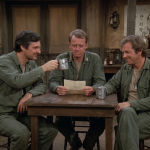
He then took a clean tin mug from the rack—his reserve, meant for only the most distinguished guests—and placed it on the crate. He carefully poured the rest of his precious Tokyo-smuggled coffee into it. It wasn’t much, but it was real coffee. Charles picked up the mug and, with an unprecedented humility, offered it to B.J.
“Here,” Charles said simply. B.J. straightened up and accepted the mug, a small look of surprise crossing his face, followed by a warm, genuine smile of appreciation. He didn’t say thank you; they didn’t need words. The offering was the connection. They didn’t talk about the letter or the boy. They just sat in the dim light of the tent, two doctors sharing the brief peace, connected by shared burdens and a small, quiet act of communion.
Outside, the 4077th continued its noisy, chaotic dance. Radar was yelling at someone, Klinger was arguing with Margaret, and the Jeeps were still running. But inside, there was only silence and a sense of understanding that transcended their usual differences. They sat side-by-side on the cot, the letter from a farm boy resting between them and the closed music tome. It was a small, meaningful connection, a simple act of human solidarity that, for a few moments, made the entire war feel less absolute. The dust still coated everything, but in that shared silence, it felt just a little lighter.
In the end, it isn’t the class we come from, but the connection we share in the quiet moments that truly defines our humanity.