The Quiet Watch in the Early Hours
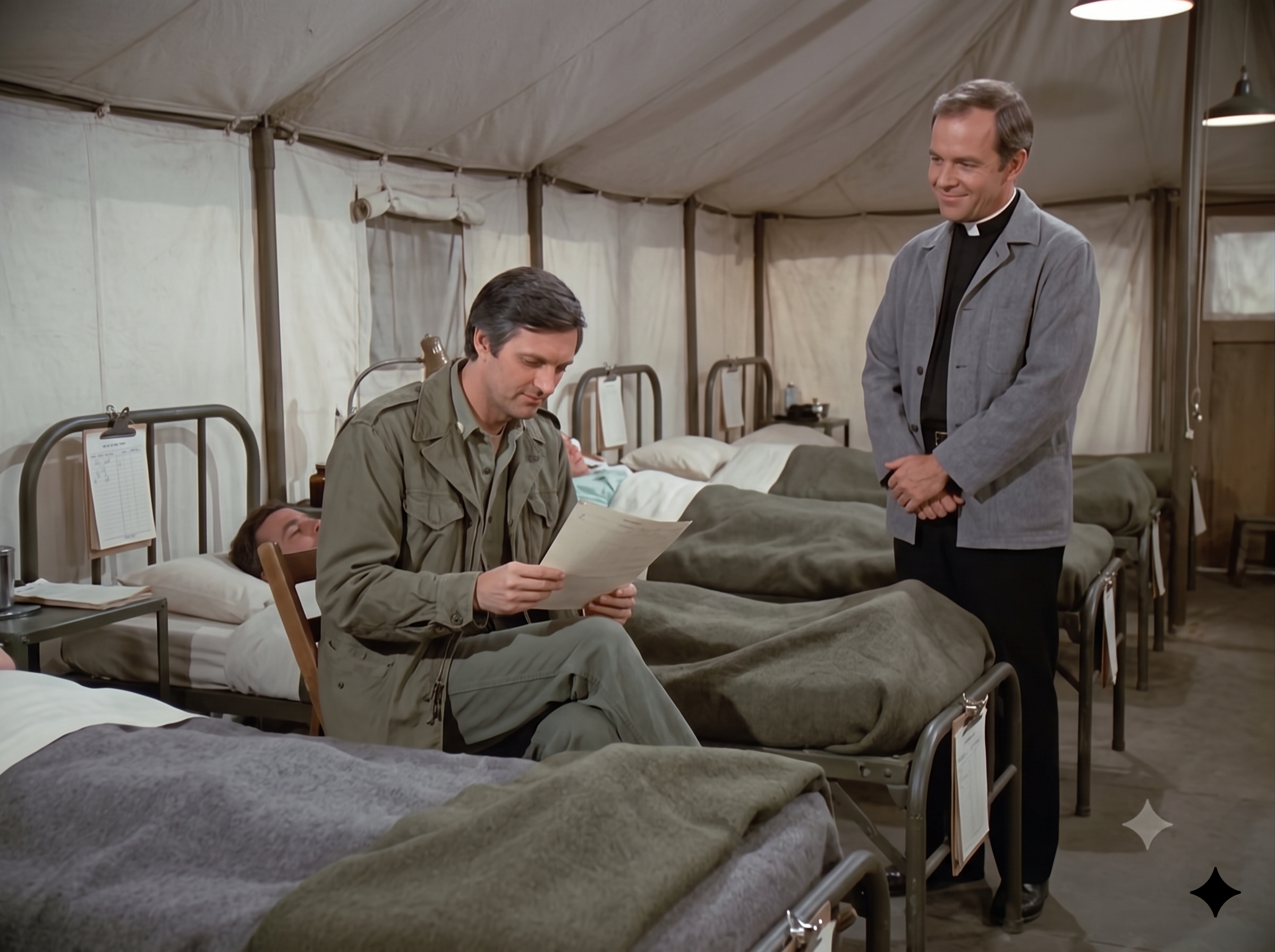
There were exactly two distinct versions of the 4077th Mobile Army Surgical Hospital.
The first was the one they all complained about at the mess tent. It was loud, chaotic, and terrifying. It was the roar of incoming choppers shaking the canvas walls, the frantic shouting in the compound, and the blinding, blood-soaked frenzy of the operating room.
But there was a second version of the 4077th, one that only existed in the dead of night. It was the hushed, fragile stillness of the Post-Op Ward at three in the morning.
In this version of the camp, the war felt like it was paused. The only sounds were the steady, rhythmic hum of the camp generators outside and the soft, uneven breathing of twenty exhausted young men trying to heal in the dark.
The lighting in the tent was turned down low. A few scattered lamps cast a warm, practical glow across the rows of cots, painting the worn canvas walls with long, quiet shadows. It was a space of muted greens, soft grays, and pale white bandages.
Benjamin Franklin Pierce sat perfectly still beside one of the beds in the center of the ward.
He wasn’t wearing his usual armor of manic energy. The Groucho Marx mask was entirely gone. He was just a deeply tired man in faded green scrubs, hunched on a small wooden stool, leaning gently toward the cot.
In his hands, he held a metal medical clipboard. He didn’t grip it with the frantic speed of a surgeon barking orders. He held it gently, resting it on his knee, tracing the edge of the paper with his thumb as if the chart itself were something delicate.
His face was a portrait of thoughtful concern. The lines around his eyes, usually crinkled in a sarcastic smirk, were deep with quiet, profound compassion. He was watching the young private in the bed with the intense, protective focus of a father watching a child fighting a fever.
A few feet away, Father John Mulcahy slipped silently through the tent flaps.
The chaplain moved through Post-Op the same way he moved through life—with a gentle, unassuming grace that never demanded attention. He wore his standard olive drab sweater over his clerical collar, the wool frayed at the cuffs from months of nervous habit.
Mulcahy stopped slightly to the side of Hawkeye’s stool. He folded his hands together near his waist, settling into a comfortable, familiar posture.
A soft, hopeful smile touched the corners of the priest’s mouth. He didn’t interrupt. He simply stood there, serving as a silent, warm sentinel for both the wounded boy and the exhausted surgeon.
“You’ve been sitting in that exact spot since we scrubbed out, Hawkeye,” Mulcahy finally whispered, his voice barely louder than the hum of the generator.
Hawkeye didn’t look up from the sleeping boy. “I’m waiting for the floor show to start, Padre. I hear the kid in bed four does a great impression of a sleeping person.”
The joke was entirely hollow, lacking any of its usual bite. It was just a reflex, a soft deflection to fill the heavy air.
“His vitals are stable,” Mulcahy noted gently, leaning in just a fraction to look at the boy’s pale, peaceful face. “You did a wonderful job in there. Margaret said it was one of the most difficult arterial repairs she’s ever seen you do.”
Hawkeye finally dragged his eyes away from the boy and looked down at the medical chart in his lap. His shoulders slumped.
“I patched a leak, Father. That’s all,” Hawkeye said, his voice dropping into a rough, weary whisper. “I sewed up a tear in a nineteen-year-old kid’s chest. But I didn’t fix the real problem.”
Mulcahy frowned softly, his smile fading into a look of deep, empathetic listening. “And what problem is that?”
Hawkeye tapped the metal clip of the chart. The exhaustion was suddenly rolling off him in waves, exposing the raw, tender nerve he usually kept hidden behind a martini glass.
“The fact that in a few hours, the anesthesia is going to completely wear off,” Hawkeye said, his voice tightening with a sudden, sharp ache. “He’s going to open his eyes, look up at this dingy green canvas ceiling, and remember exactly where he is. He’s going to remember the mud, and the noise, and the fact that people are actively trying to kill him.”
Hawkeye looked up at Mulcahy, his eyes bright with an unresolved, desperate kind of grief.
“Tell me, Padre,” Hawkeye whispered, the silence of the tent pressing in around them. “When he wakes up terrified… what exactly am I supposed to write on this medical chart to make that reality okay?”
The question hung in the warm, heavy air of the Post-Op tent, blending with the smell of canvas, iodine, and damp wool.
Father Mulcahy did not offer a quick platitude. He didn’t quote scripture or offer a practiced theological defense of suffering. Over his time at the 4077th, he had learned that men like Hawkeye Pierce didn’t need sermons; they needed anchors.
Mulcahy took a small step closer, his hands still gently folded together. The soft, ambient light of the nearby lamp caught the silver of his cross, casting a tiny reflection against his sweater.
“You don’t write anything on the chart, Hawkeye,” Mulcahy replied, his voice remarkably steady and deeply kind. “And you don’t try to make it okay. Because it isn’t okay.”
Hawkeye stared at the priest, slightly taken aback by the blunt honesty.
“But you are missing something vital,” Mulcahy continued, a warm, reassuring smile returning to his face. “When he wakes up and remembers where he is… he is also going to see you sitting right beside him.”
Hawkeye looked back down at the muted green blanket covering the boy. He swallowed hard, his grip on the clipboard loosening just a fraction.
“I’m just the mechanic, Father,” Hawkeye murmured, though the defense sounded incredibly weak, even to his own ears.
“Nonsense,” Mulcahy said softly, affectionately. “You are the very first face he will see that isn’t asking him to march, or shoot, or hide. You are the one who stayed awake for three hours just to make sure his breathing didn’t change. That isn’t mechanics, my friend. That is grace.”
Before Hawkeye could muster a witty rebuttal to deflect the compliment, a sudden rustle of fabric broke the quiet.
The boy on the cot shifted. His head rolled slightly on the flat, firm pillow. A dry, ragged groan escaped his lips, and his eyelids began to flutter against the dim light of the tent.
Instantly, the heavy, existential dread vanished from Hawkeye’s posture.
The medical chart was smoothly placed onto the edge of the cot. Hawkeye leaned forward, his entire being focusing with absolute, razor-sharp clarity on the patient. But there was no panic in his movement, only a deep, practiced tenderness.
“Hey,” Hawkeye said. His voice was a low, soothing rumble, entirely different from the loud, brassy tone he used in the Swamp. It was a voice designed to wrap around a frightened kid like a heavy, warm blanket. “Take it easy, pal. You’re safe.”
The young private blinked heavily, his eyes darting around the shadows of the canvas roof before finally locking onto Hawkeye’s face. Panic began to flare in the boy’s chest. He tried to lift his hand, his breathing suddenly shallow and rapid.
“Where… where’s my rifle?” the boy gasped, his voice cracking with dry terror. “The ridge… they were right behind us…”
Hawkeye immediately reached out. He placed one hand firmly but gently over the boy’s trembling fingers, pressing them softly back down against the mattress.
“Forget the ridge,” Hawkeye said smoothly, locking eyes with the kid. “The ridge is old news. You’ve just been promoted to the most exclusive resort in all of South Korea. I’m Dr. Pierce. I’ll be your cruise director for this evening.”
The boy stared at him, the panic slowly giving way to profound confusion. “A doctor…?”
“The best one this side of the Pacific,” Hawkeye assured him, offering a small, incredibly gentle smile. “Though, to be fair, the competition mostly consists of a guy who talks to a stuffed bear and a man who considers a tongue depressor high fashion. But you’re in good hands.”
The private took a slow, rattling breath. The reality of the hospital tent finally seemed to register. The terror in his eyes slowly melted into an overwhelming, exhausting relief.
“I’m alive?” the kid whispered, as if he couldn’t quite believe the words.
“You’re very alive,” Hawkeye confirmed, his thumb gently tracing the back of the boy’s hand in a repetitive, comforting rhythm. “You’re safe. You’re warm. And you’re going home. All you have to do right now is close your eyes and let me do the worrying. I’m a professional worrier. I have a degree in it.”
The boy managed a tiny, fragile half-smile. His heavy eyelids drooped. The tension bled out of his young face, and within seconds, the rhythmic, steady breathing of deep sleep returned.
Hawkeye stayed leaning forward for a long moment, keeping his hand gently resting on the boy’s arm, making absolutely sure the sleep was genuine.
Standing just to the side, Father Mulcahy watched the entire exchange.
The priest’s smile had grown, radiating a quiet, immense pride. He watched the way the weary surgeon held the boy’s hand, recognizing it for what it truly was: a profound act of love in a place designed for destruction.
Slowly, Hawkeye pulled his hand back. He picked up the medical chart again, taking a pen from his pocket. He jotted down a quick note about the boy’s brief waking period, his handwriting terrible but his diagnosis perfect.
Hawkeye let out a long, quiet exhale. He looked up at Mulcahy, the tension finally gone from his shoulders.
“Well,” Hawkeye whispered, a tiny, genuine smirk finding its way back to his face. “I suppose room service isn’t a total disaster tonight.”
Mulcahy chuckled softly, the sound barely a breath in the quiet tent. He reached out and gave Hawkeye’s shoulder a brief, affectionate squeeze.
“I think your bedside manner is improving, Doctor,” Mulcahy whispered warmly. “Though I’m not sure the American Medical Association would approve of the cruise director analogy.”
“The AMA doesn’t know a good time when they see one,” Hawkeye replied softly.
He leaned back on his rickety wooden stool, getting comfortable. He didn’t move to leave. He just crossed his legs, resting the chart back on his knee, settling in to watch over his sleeping patient for the rest of the night.
Father Mulcahy stood beside him for a few moments longer, perfectly content in the shared, comforting silence of the ward.
They were thousands of miles from home, surrounded by mud, fatigue, and the endless absurdity of war, but in the quiet shadows of the Post-Op tent, they had built something beautiful together. They had built a family.
In a place where the world was constantly falling apart, the truest heroes were simply the ones who stayed awake in the dark to hold the pieces together.