A Simple Request, an Extra Blanket, and the Things We Hold Onto: A 4077th Tale
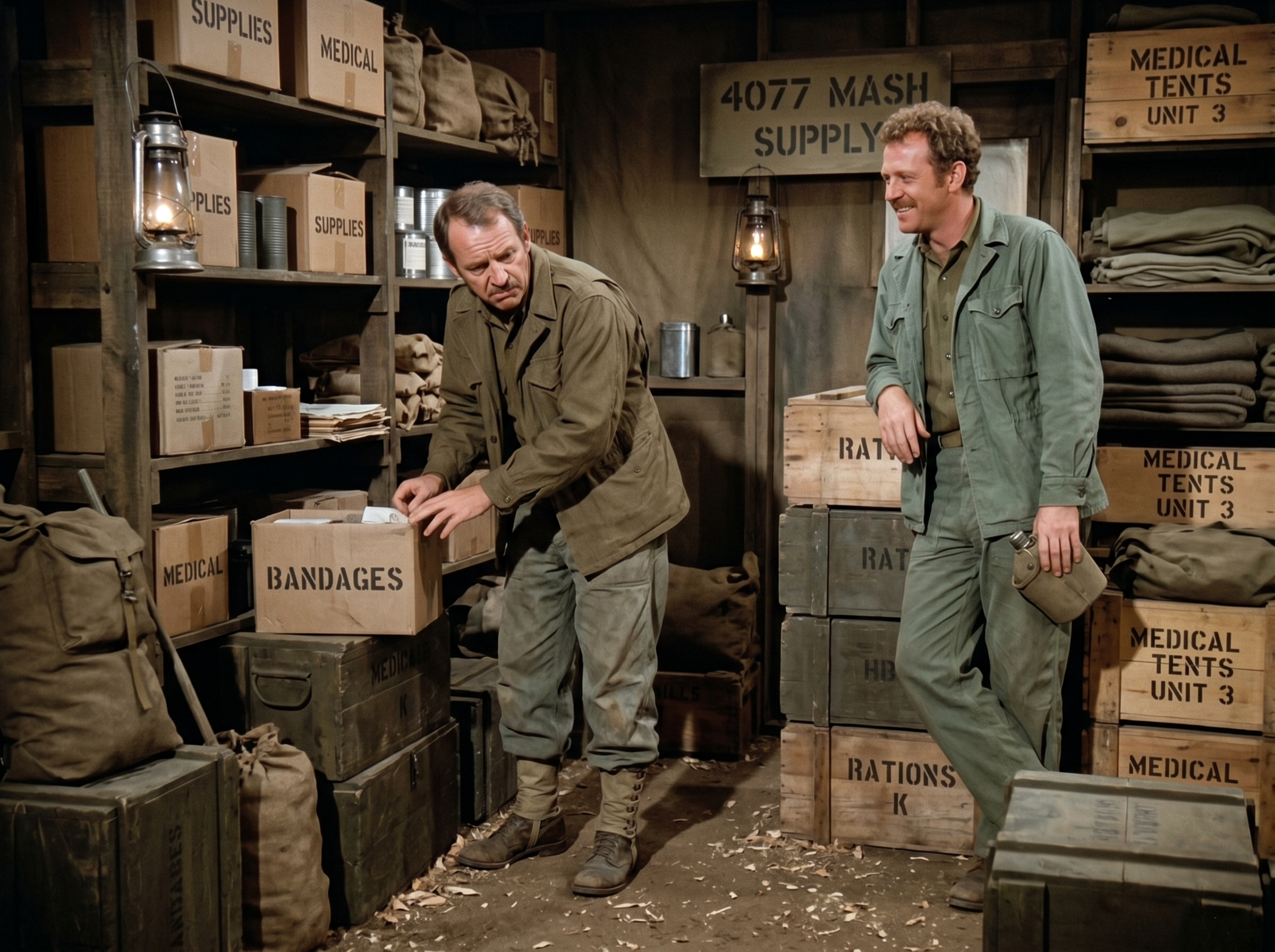
The dust in the supply tent always tasted like lost dreams and old army blankets.
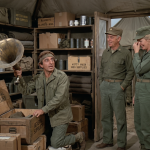
It hung in the dim, yellow glow of the lanterns, a fine powder that settled on the crates of bandages, the stacks of ‘Medical Tents Unit 3’, and the spirits of anyone unlucky enough to pull an inventory shift.
On this particular evening, it wasn’t an unlucky soldier with a clipboard, but the doctors who had been running on fumes for four days straight.
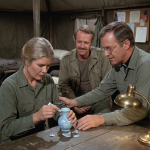
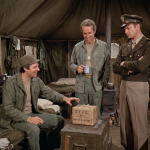
Colonel Potter stood hunched over a partially opened crate labeled BANDAGES, his weathered face set in a frown that spoke of a calculation not balancing.
His hand was hovering just above the contents, his attention fixed on a single piece of paper, possibly a manifest or perhaps just a reminder of a promise he was trying to keep.
His brow was furrowed, the lines deep enough to hold all the worries of a weary command. He knew every discrepancy meant something or someone was suffering, and he carried that knowledge like a physical weight.
Beside him, casual in a way that always seemed like a minor miracle after the chaos, B.J. Hunnicutt leaned his elbow on a stack of RATIONS K crates.
He wasn’t actively counting, but his easy posture offered a necessary counterpoint to Potter’s tension.
His green jacket hung open, and he held a canteen loosely, as if his next drink were guaranteed, a luxury he rarely felt in the swamp or the O.R. but one he maintained for appearances.
“You look like you’re about to wrestle that bandages box,” B.J. observed, his voice low, matching the quiet of the supply tent. “It won’t win.”
“It’s not the bandages, Hunnicutt,” Potter grunted, without looking up. “It’s the blankets. We are officially short. Again. Radar says the requisition went in three weeks ago. It’s like sending requests to a black hole.”
B.J. shifted slightly, his gaze following Potter’s to the ‘Supplies’ and ‘Medical’ crates lining the shelves. “Well, at least the bandages won’t run away. The blankets tend to… wander. To the local orphanage, sometimes. Or just disappear into thin air.”
“I know where they *tend* to wander,” Potter snapped, but without the heat of genuine anger. “And normally, I would just… turn a blind eye, as they say. But not with a cold front coming and three more wounded expected before midnight.”
“Are they coming by chopper?” B.J. asked, his own easy demeanor tightening slightly at the thought of more intake.
“Ground ambulance. Delayed by washed-out roads.” Potter finally straightened, looking B.J. in the eye. “And one of ’em isn’t a soldier, son. It’s a six-year-old Korean girl from the village. Her father brought her in. Shrapnel from a stray artillery round.”
The air in the tent seemed to still. The humor B.J. had been holding dissolved instantly. This was the raw nerve of life at the 4077th, the truth that no joke could soften.
“A little girl,” B.J. repeated, his voice barely above a whisper.
Potter nodded, his expression grim. “And right now, I don’t have enough blankets to keep all the recovering cases warm, let alone a small child with no body fat to speak of.” He gestured again, with a frustration that was purely for show, but the urgency beneath it was real.
“So when I find out that Corporal O’Reilly has somehow managed to put aside two *extra* blankets,” Potter continued, his voice rising just a fraction, “when he knows damned well the situation, and says they are ‘spoken for’… that’s when I get a little… perturbed.”
A faint smile touched B.J.’s lips, even as his heart heavy with the thought of the little girl. “Radar. He always has an angle. Are they spoken for by, let’s see, Major Houlihan? A special request for the nurses’ tent?”
“He claims they are a pre-payment,” Potter replied, the absurdity of the situation starting to bleed through his worry. “A ‘reserve supply’. For when things get ‘really bad’.”
“He’s a visionary,” B.J. mused.
“He’s an unauthorized quartermaster,” Potter corrected. “And I have ordered him to produce them immediately for the intake. He refuses. Claims they are on loan and he can’t get them back until after dark.”
B.J. knew a stall when he heard one. Radar was protective, yes, but he wasn’t usually insubordinate. If he was digging in his heels this hard, there had to be more to the story.
“Wait a minute,” B.J. said. “Let me guess. He’s hiding them.”
“He’s *protecting* them,” a small voice corrected from the tent flap.
Neither of the doctors had noticed Corporal Walter Eugene ‘Radar’ O’Reilly entering. He stood there, his glasses reflecting the lantern light, clutching his ever-present clipboard against his chest, looking like a guilty schoolboy caught in the cookie jar. He had arrived just in time to hear the tail end of their conversation.
Potter turned on him, his fatherly tone now a sharp command. “Corporal. You were ordered to retrieve those blankets. Not to engage in philosophical debate.”
“Colonel, sir,” Radar began, his voice surprisingly steady, though his hands on the clipboard were white-knuckled. “I can’t. They’re… they’re currently in use.”
B.J. raised an eyebrow. “In use? By whom, Radar? Are you and Klinger having an extra-curricular sleepover?”
“No, Captain!” Radar sounded genuinely horrified by the suggestion. “It’s not… it’s not for us.”
Potter’s eyes narrowed. The tension in the tent had spiked. This was no longer about administrative headaches. It was about trust, and about the quiet rebellion of a soldier who usually put duty above all else.
“Then who, Corporal? Tell me. Now.” Potter demanded, his voice dropping into that quiet, dangerous range that made everyone stand a little taller.
Radar hesitated for a heartbeat, looking from Potter to B.J., seemingly searching for an out, for a way to protect his secret without disobeying a direct order. The gravity of the situation, the small girl’s impending arrival, must have been battling against a deep-seated commitment he had made.
Then, he finally deflated. His shoulders slumped.
“It’s Father Mulcahy, sir,” Radar confessed, his voice almost a whisper, looking down at his boots. “He’s the one who asked me to put them aside.”
The revelation was like a physical blow. Of all the people to be involved in a clandestine blanket hoard, the mild-mannered, dedicated chaplain was the last anyone would expect. The air in the supply tent seemed to disappear.
Potter and B.J. exchanged a look of pure, unadulterated astonishment. This was a whole new level of complication.
Potter stared at Radar, the silence stretching taut and painful in the crowded supply tent. The crates of medical supplies, the lantern light, the smell of canvas—it all seemed to amplify the weight of the moment. He had expected to hear about a negotiation for comic books or an illicit trade with some distant quartermaster, not the quiet, devout chaplain.
“Father Mulcahy,” Potter repeated, the name sounding foreign in this context, like finding a dove in a foxhole.
Radar could only nod, his eyes locked on his boots, the clipboard held tight against his chest. He looked like he wanted the dusty ground to swallow him whole.
“Our Father Mulcahy?” B.J. asked, his own disbelief coloring his tone. “The same man who offers comfort and a kind word when everyone else is shouting or crying? He’s… hoarding?” He couldn’t quite bring himself to use a harsher word.
“He’s not hoarding, Captain Hunnicutt,” Radar corrected, his voice finally finding some strength. “He’s not keeping them for himself. He doesn’t even use a full blanket on his own cot, sir. He gives them away. All of them.”
“Give ’em away? To whom? He has a whole congregation of recovering patients,” Potter challenged.
“No, sir. Not to the patients. That’s what he uses the *extra* extras for,” Radar explained, still not looking up. “These two… he uses these for the people the trucks don’t usually stop for. For the families who have lost everything and are just… trying to make it to tomorrow. He’s… he’s built this little reserve, sir. For emergency, emergency cases.”
The confession hung in the air, a humble answer that immediately changed the texture of the confrontation. It wasn’t about self-preservation or a clever deal. It was about a deeper, unspoken kind of triage—a moral triage where a blanket was more than warmth; it was a testament of care.
Potter stood very still, the hand that had been hovering above the bandage box slowly curling into a fist, not in anger, but in a profound sense of conflict. He, more than anyone, knew the terrible choices they had to make every day. His job was to prioritize the soldiers, the immediate casualties. Father Mulcahy, it seemed, had assumed the burden of prioritizing the forgotten.
“Emergency, emergency cases,” B.J. repeated, a different kind of quiet entering his voice. “Like, maybe, a six-year-old Korean girl from a village that just got caught in the crossfire?”
Radar looked up sharply, the lenses of his glasses flashing in the lamplight. He glanced from B.J. to Colonel Potter, his gaze finally understanding the urgency that had driven the initial request.
“Is… is that true, Colonel?” Radar asked, his voice trembling slightly. “A little girl? She’s coming?”
Potter nodded, his own expression softening with a tired resignation. “Yes, Radar. She is. And I needed those two blankets for her, to give her a chance to recover from the shock. Now, it seems, I have to choose.”
The supply tent, once a place of logistical headaches and quiet camaraderie, felt like it was closing in on them. They were facing the impossible arithmetic of compassion in a war zone. How do you choose which kindness matters most?
“She… she needs them,” Radar murmured, looking down again, his struggle evident. “Father Mulcahy, he doesn’t know about her yet. He only knows about a family he was trying to help… but he’d understand. He’d *want* her to have them.”
“Of course he would, son,” Potter replied, his fatherly tone returning, but tinged with a deep weariness. “And that’s precisely the problem. It doesn’t make the choice any easier. Do I use these blankets for her, a decision that feels right and good, or do I respect the reserve that has already been spoken for, for people who may have even less of a safety net?”
He sighed, the weight of command settling heavily on his shoulders. He looked at the surrounding crates—medical supplies, tents, rations. Everything was about fighting pain and suffering on a large scale. But here, in this quiet moment, the battle was over two old blankets and the dignity of a single small human being.
B.J. didn’t offer an easy answer. He stood, listening, allowing the complexity of the moment to breathe. He knew Potter was right. There was no easy, clean solution. Every option meant letting someone down.
Finally, Potter made a decision. He stepped away from the bandage crate and looked directly at Radar.
“Corporal,” he said, his voice steady, carrying both authority and a profound sense of human duty. “I understand what the Father was trying to do. It was a noble effort, and I expect nothing less from him.”
“But,” he continued, and the word hung heavy in the air, “right now, we have a life that is immediately before us. We have a child who needs care, and I have made a commitment to provide that care. We are the 4077th. Our first duty is to heal. That means we use every resource we have to do that.”
Potter’s tone was final, but it wasn’t harsh. It was the voice of a man who had made countless impossible calls and had learned that you sometimes have to just choose the good that is right in front of your eyes.
“Yes, sir,” Radar whispered, his voice catching slightly. “I understand, Colonel.”
“Get those blankets, Corporal,” Potter said, and then, his voice softening even further, “And Radar? Make sure they are the softest ones we have. Not the wool ones. The fleece.”
A flicker of a smile crossed Radar’s face. “The soft ones. Yes, sir.” He saluted, a little less nervously this time, and then turned to leave the tent.
“And Radar?” Potter called after him, as the corporal reached the flap.
“Sir?”
“When you bring ’em,” Potter said, “tell Father Mulcahy… tell him I want to see him. Not to reprimand him. To… to thank him. And maybe we can find a way to make sure that ’emergency reserve’ of his doesn’t get depleted so easily.”
Radar nodded, the grin spreading wide on his face. “Yes, sir! I’ll tell him, Colonel!” He slipped out of the tent, his mission clear.
Potter turned back to B.J., a deep exhale escaping him. The anger, the frustration, the conflict—all of it had transformed into a shared moment of profound understanding. He wasn’t the hard-nosed commander or the fatherly figure, just a man, like all of them, trying to make the best of a terrible situation.
“Well,” B.J. said, a wry, tired smile on his face, “so it seems Father Mulcahy is our unofficial minister of social work. Who knew?”
“I think we all did, son,” Potter replied, finally leaning back against the bandages crate with a sigh that seemed to last for a long, quiet minute. “We all did. He just does it better than the rest of us.”
B.J. chuckled softly, the sound of it a familiar comfort in the dimly lit tent. “Yeah. I guess he does.”
Potter reached up and adjusted the wick of the lantern, the flame steadying and making the shadows in the tent recede just a little more. He didn’t say anything else, but B.J. knew. They were the 4077th. They were a found family, an unlikely band of souls thrown together in a crazy place, and today, in a dusty supply tent, they had reminded themselves of what truly mattered. They had chosen to honor both their mission of healing and the quiet, essential acts of kindness that defined their humanity.
The sound of an approaching jeep, and then the distant wail of an ambulance, cut through the quiet. The night was starting again. The intake was about to begin. But for a few precious minutes, the doctors had found a moment of shared understanding, a warm, nostalgic comfort in the midst of it all. And in that moment, the dust of the 4077th supply tent didn’t taste like old army blankets or lost dreams. It tasted like hope, and like the unbreakable bonds of friendship.
They both straightened, ready to meet whatever the night had in store for them. They would heal the wounded, comfort the grieving, and laugh when they had to, because that was who they were. And they would make sure that, for one small girl and for all the forgotten souls who passed through their world, there would always be a blanket and a shared moment of quiet tenderness to remind them they were not alone.
In this corner of chaos, the hardest things we counted weren’t the bandages, but the moments of simple, unspoken grace.