The Unlikeliest Sound in Korea
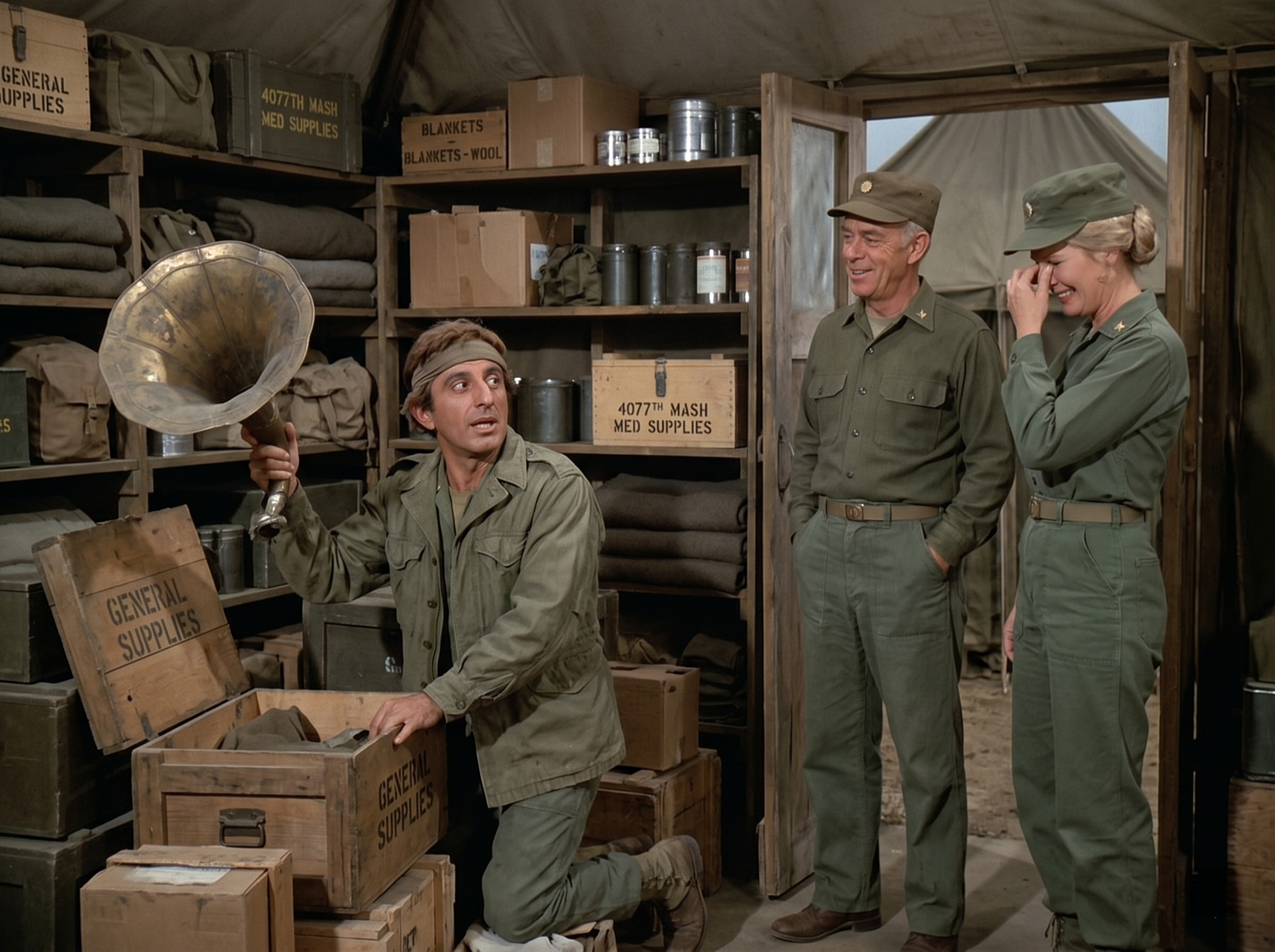
If there is a soundtrack to the 4077th, it is usually a symphony of exhaustion, rhythmic snores, and distant artillery.
Sometimes, though, against all odds, the best noises are the ones you never see coming.
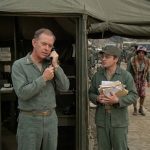
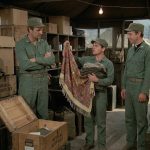
They all found themselves in the supply tent together, and it wasn’t to trade surgical wisdom.
There was a genuine chill in the air—the kind that signals a coming wet winter and makes every joint ache.
Corporal Radar O’Reilly had finally come through with the winter issue wool blankets, though it wasn’t an official request.
It was more of a *negotiated* understanding.
The shipment, contained in sturdy wooden crates labeled “GENERAL SUPPLIES,” had arrived only minutes earlier, and Radar was already in process of cataloging everything.
For Colonel Potter, it was simple logistics: men and women needing warmth before the frost got serious.
For Major Margaret Houlihan, it was ensuring discipline by maintaining adequate quarters.
But the delivery had arrived in pieces. Radar had requested Hawkeye and B.J. for manpower, but somehow, they only got the most energetic *and* distracting helper available.
Klinger, currently kneeling on the wooden floorboard, was deep in the crate, pulling out folded khaki wool.
He wasn’t in uniform. He was in his usual *non*-uniform, complete with the green utility cap, headband, and a look of deep, focused bewilderment.
His sleeves were rolled, showing forearms that had spent more time moving boxes than they ever would in a cocktail lounge.
“You are *very* welcome, Colonel,” Klinger was saying, holding up another neatly folded blanket, which he then tossed onto the stack.
“For what, specifically, Corporal?” Potter asked, his voice dry. “Your sudden interest in logistics or the sudden shortage of silk robes in Tokyo?”
Klinger didn’t miss a beat, reaching into the crate again. “I trade my expertise, Colonel! This wool,” he patted the blanket, “needs to feel valued. That’s *leadership*.”
He tossed the blanket, and his arm dropped back down into the crate’s bottom.
Something clattered—not the soft thud of wool on wood.
“What is *that*, Klinger?” Margaret asked, instantly sharp. She knew Klinger’s boxes.
“Probably a hidden compartment with high heels,” B.J. offered from near the stack.
“Or the fountain of youth, conveniently delivered in sections,” Hawkeye added. “Which, given this place, would just make us teenagers forever.”
Klinger didn’t answer. He was wrestling with something heavy and awkward.
“Help me up, you guys!” he strained.
Hawkeye and B.J. grabbed his arms, and with a grunt, Klinger was yanked upright.
As he stood, he was pulling out a massive, trumpet-like shape from the crate.
It was brass, tarnished but still gleaming where the dim light caught it. It was heavy and awkward in his grip.
A giant, ancient horn.
“What in the hell is *that*?” Potter demanded.
Hawkeye squinted. “Looks like my Aunt Martha’s eartrumpet. She lost her hearing during the Great Gatsby.”
B.J. leaned in closer. “No, Hawkeye. Look. It’s too big. And there’s a winding key.”
It wasn’t just a horn. It was attached to a complex mechanism.
Klinger looked at it with dawning recognition that turned into pure, simple delight.
“It’s a gramophone!” he declared, grinning. “A genuine, spring-loaded sound machine!”
“You requested blankets, Radar,” Potter said, his voice dropping an octave.
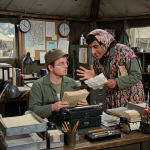
“Yes, sir! Blankets, sir! Just blankets! I promise!” Radar was already backing towards the doorway, his clipboard held up like a shield.
Potter turned on Klinger. “And where, Corporal, did you procure an *antique gramophone* when my medical staff is screaming for penicillin?”
“Don’t look at *me*, Colonel!” Klinger exclaimed, standing fully upright and holding the tarnished horn high, as if presenting a trophy. His mouth was open in theatrical protest. “I just move the boxes! Ask Radar! He knows people!”
Margaret looked horrified. Radar was still retreating, mumbling something about the processing clerk.
Klinger’s eyes were wide and earnest. He was the picture of innocent surprise, using the horn as his shield.
Potter didn’t move. He just stared at the brass monstrosity Klinger was still triumphantly displaying. The tension in the tent was palpable.
A whole crate of wool blankets, desperately needed by fatigued troops, had seemingly swapped half its cargo for an antique noise-maker.
The silence that followed Potter’s gaze was heavy. Klinger held the pose, a statue of supply-chain chaos.
The next sound would be Potter’s judgment.
Then B.J., standing near the main blanket stack, broke the spell.
“Well,” he drawled, his easy grin appearing, “at least the wounded can have music when their legs are amputated by an ear-horn.”
Margaret’s eyes widened, and Hawkeye gasped a quiet, stifled laugh. “Actually, Captain, I believe the proper medical term is an *eartrumpet*.”
Radar, seeing his opportunity, peeked around the tent opening again. “They are… they are vintage!”
Potter didn’t yell. He just took his cap off and ran a hand through his gray hair, letting out a long, slow sigh of pure, exhausted defeat.
“B.J.,” he began, still looking at Klinger and the gramophone. “How are the patients?”
The sudden shift in focus left everyone confused.
“They’re okay, Colonel. Stressed. Tired. But okay.”
“Tell me,” Potter continued, looking right at the tarnished brass horn Klinger held aloft. “If you could ask any one of them… what do they want more: another scratchy, government blanket, or five minutes where the only sound they hear isn’t related to pain or destruction?”
The tent went quiet. This wasn’t the expected response.
Radar lowered his clipboard. Hawkeye stopped joking. Margaret took her hand away from her face, her stern expression fading.
Potter walked closer to Klinger, who was still holding the horn high.
“Corporal,” Potter said, “did you think about that when you pulled this stunt?”
Klinger lowered the gramophone slightly, his face dropping all pretense of theater. He looked small. “No, sir. I didn’t. I just thought it was… funny. And old.”
Potter reached out and ran a thumb over the tarnished brass. “It *is* funny. And very old. It deserves to be treated with respect. Just like my patients.”
He looked around the small supply tent. The shelves were packed with medical goods, blankets, the everyday items of a medical unit at war.
“My unit is cold, exhausted, and sad,” Potter said softly. “This is not medicine. But sometimes… sometimes a distraction is exactly what is ordered.”
Klinger stood frozen, looking at his commander. “You’re not sending me to the front for this?”
“No,” Potter said, a faint smile ghosting his face. “In fact, I have an assignment for you.”
He turned to look at the rest of them.
“This supply tent is about to become an unauthorized entertainment center,” he announced. “We have twenty minutes before evening reports. Klinger, you get this thing working.”
Klinger didn’t hesitate. He scrambled to find the winding crank.
“Radar!” Potter bellowed.
“Sir?”
“Find some records. Anything. I don’t care if it’s the Korean military band playing ‘The Stars and Stripes Forever’ backward. We are about to hear the oldest sound in the world.”
The tension broke. The panic was replaced by an odd, unified focus.
Radar scurried off. B.J. and Hawkeye started clearing a small workspace on a stack of wool blankets. Margaret was even caught directing Klinger to be careful with the tarnish.
Within minutes, the gramophone was set up. Radar returned with a handful of dusty 78rpm shellac records he had apparently liberated from Father Mulcahy’s stash.
Klinger wound the crank, his brow furrowed with concentration. The mechanism groaned. The heavy, spring-loaded machine felt alive.
A record was selected—some obscure bit of classical music that nobody recognized.
The steel needle was lowered.
*Crackle. Pop.*
Then, the unlikeliest sound filled the quiet tent.
The scratchy, muffled swell of an orchestra. The gramophone, its huge brass horn projecting the sound forward, was a portal to another time.
It wasn’t stereo. It wasn’t loud. It wasn’t clear.
It was perfect.
The music was a waltz, grand and sweeping, but rendered fragile and distant by the vintage technology. It seemed to hang in the air, a whisper of civilization against the backdrop of war.
Klinger stopped cranking and just stood back, a look of genuine wonder on his face.
Potter closed his eyes for a moment, listening. When he opened them, the weariness was still there, but so was a brief, unmistakable trace of nostalgia.
“I haven’t heard this piece since 1932,” he murmured. “My wife and I danced to it.”
Margaret was also standing very still, her hands clasped in front of her. The sternness of the officer had vanished, replaced by a soft, wistful look. She wasn’t just in uniform; she was a woman listening to a distant melody.
B.J. and Hawkeye leaned against a crate. “Makes you miss the old radio programs,” Hawkeye said quietly. “Where you only had to use your imagination to picture the singer’s eyebrows.”
For twenty minutes, time in the supply tent slowed down. The gramophone provided the soundtrack as they all just stood and listened, lost in their own separate worlds of memory and peace.
It was a small event, born from a supply mix-up and some mischievous intent, but it became something important.
They were a tired medical crew, a nervous company clerk, an eccentric clerk, and their fatherly commander, all briefly unified not by a shared task, but by a shared memory of a better world.
When the final scratchy notes faded and the needle lifted with a quiet *thwump*, nobody spoke.
The silence that returned was different now—not heavy, but peaceful.
Potter finally cleared his throat. “Well. It works. For now. Back to work, everyone.”
As they began to disperse, the music still lingering, Klinger was gently wiping dust off the massive horn.
Potter paused at the door, catching Klinger’s eye. “Good procurement, Corporal.”
Klinger didn’t say anything, but the grin on his face, seen through the supply tent opening, was wider and brighter than any dress he had ever worn. He had brought music to a place that had almost forgotten what it was.
They found warmth in wool and civilization in sound, proving that in Korea, sometimes the best supplies are the ones you didn’t know you were missing.