A Map Home: Crayon and Compassion at the 4077th
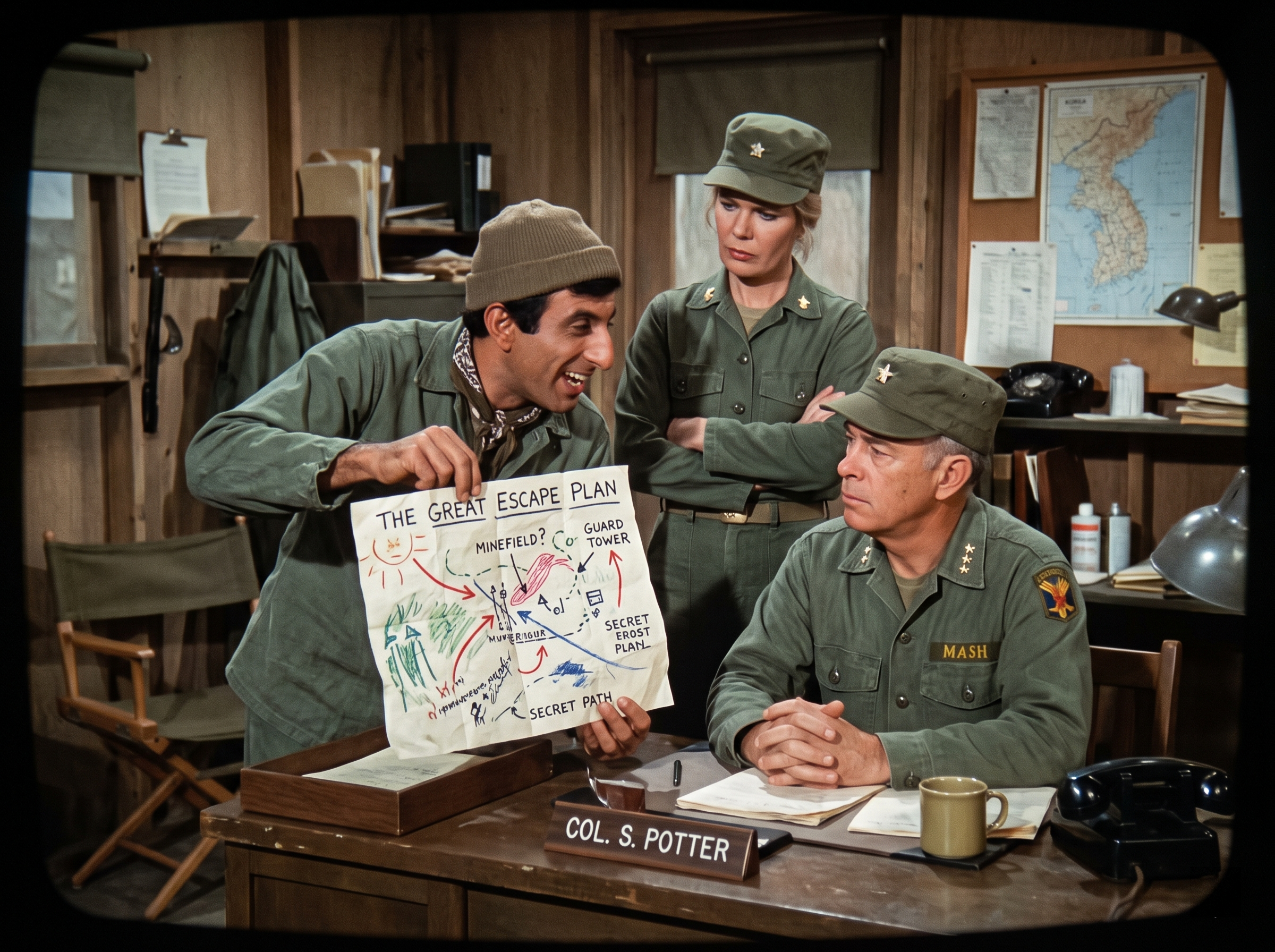
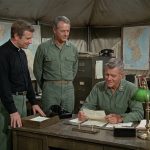
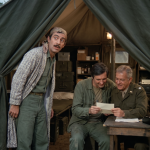
The artillery was finally quiet, a heavy silence that felt more exhausting than the noise. In the dimly lit heart of Colonel Potter’s office, the weight of the war pressed in on the three figures gathered around the desk. This was the Swamp of the bureaucracy, where morale was often stitched together with threads of humor as fragile as the 1950s film grain visible on the old television broadcast this image recalls.
Colonel Potter sat behind his desk, his shoulders squared as always, a rock of stability. Yet, his face was a masterpiece of patient exasperation. He looked not at the war map of Korea on the wall, but at Corporal Klinger. Potter’s hands were folded, a steady father waiting for the theatrical storm to pass. He knew Klinger, and he knew this moment was about something more than just a Section 8 attempt.
Klinger, center stage as always, leaned dramatically over the desk. He was not in a dress this time; just his standard fatigue blouse, the familiar knit cap, and a neckerchief. But his presentation was vintage Klinger. In his hands, he held the culmination of his war effort: “THE GREAT ESCAPE PLAN.” It was a crumpled sheet of paper covered in crayon. Arrows, dotted lines, and crude drawings of guard towers battled for space. To Klinger, this was cartographic gold.
Directly behind Klinger, Major Margaret Houlihan stood like a sentinel of discipline. Her posture was taut, arms crossed tightly over her chest. Her uniform was perfect, her glare sharpened to a fine professional edge. She was staring at the crayon scribbles with a look that defined composed disdain. To Margaret, this was rank insubordination, a joke during a crisis. She was poised, waiting for the Colonel to explode so she could add her own devastating critique.
Klinger, unaware of the tension she broadcast, tapped a thick red arrow on the map with theatrical pride. “Colonel, I’ve mapped the optimal route! We skip the minefield here—if it is a minefield, Radar’s not sure—slide past the guard tower by pretending to look for a lost soccer ball, and then we are home free!“
Potter didn’t move. He closed his eyes for just a second, absorbing the “minefield?” question mark. Margaret’s posture grew even stiffer, her disapproval radiating from the image. The silence stretching between them in that cramped, warm office was more loaded than any shell. The moment hung there, balanced perfectly on the razor’s edge between a court-martial and a needed laugh.
Klinger, taking the silence for awe, beamed, expecting praise for his initiative.
The silence finally broke, but not with an explosion.
Colonel Potter opened his eyes. He didn’t yell. He didn’t sigh. He simply looked from the crayon-scrawled “Escape Plan” up to Klinger’s earnest, hopeful face, and then over at Margaret’s tightly coiled frustration. The humor in this situation was dry enough to parch the throat.
“’The Great Escape Plan,‘ huh, Klinger?” Potter asked, his voice low, steady, and devoid of the expected thunder. “Complete with a ‘Secret Path’?”
Klinger snapped to attention, misinterpreting the lack of anger as validation. “Yes, sir! The path of least resistance! It takes us right to Tokyo, or maybe a nice little farm near Toledo, depending on which way the wind blows!”
“Major Houlihan?” Potter asked, not moving his gaze from Klinger.
Margaret bristled. She had her rebuke prepared, a five-minute lecture on duty, decorum, and the gross misuse of military crayons. But something in Potter’s eyes stopped her. It was that look he got when he saw the tiredness in his people, a look that cut through rank.
“Colonel,” Margaret began, her voice crisp but slightly softened, “the maps provided by Headquarters are standard issue and fully functional. This… this rendering is clearly a violation of protocol and, frankly, a tactical nightmare.” She gestured curtly to the crude drawing of the “Guard Tower.” “I mean, look at that foundation!”
“Major,” Potter said, “the map Headquarters sends us tells us where to fight. This map… this map tells us what we’re missing.” He gently slid the crumpled paper away from Klinger and towards himself.
He studied the crayon. “He’s even included the minefield with a question mark. That’s more honesty than I usually get from Seoul.”
Klinger’s theatricality wavered, replaced by genuine surprise. Potter touched the arrow pointing to the “Secret Path.“
“Toledo, you say?” Potter mused, the nostalgia creeping into his own voice, a dry wit standard for the 4077th. “Does this secret path lead past a good diner? I could use a decent piece of pie.”
The tension in Margaret’s shoulders visibly dropped a centimeter. She knew what Potter was doing. He was de-escalating. He was taking Klinger’s absurdity and turning it into a moment of shared, tired humanity.
Klinger, sensing the shift, lost his dramatic flourish. His posture softened. “Sir… it’s tough, you know? Sometimes you just gotta imagine the path out. Just for a minute.”
Potter nodded, folded the map, and carefully tucked it under his blotter. “We all imagine the path out, Corporal. Yours just happens to be a red crayon arrow. I’ll keep this safe. When we finally get that secret path open, I’ll need a guide.”
He looked up, meeting Klinger’s eyes with a quiet fatherly warmth. “Dismissed, Corporal. And for heaven’s sake, keep this copy away from intelligence. They might try to implement it.”
Klinger saluted, his typical resilience restored. “Thank you, Colonel. A pleasure to serve with a true cartographer.” He turned and exited the office, leaving an echoing laugh in his wake.
Margaret remained. The professional mask was back, but the edge was gone. “Colonel… that man is impossible.”
Potter smiled, a tired but affectionate expression that settled into his wrinkles. “Yes, he is, Major. And sometimes, impossible is exactly what we need. His ‘Great Escape’ map just reminded me that we’re all trying to find our way home.”
He picked up the black field phone on his desk, the spell broken, back to business. “Now, about that missing shipment of penicillin…”
The moment passed, dissolving back into the bureaucratic, gritty, bittersweet reality of the 4077th, yet the warmth of that small, shared human connection remained, etched forever in the grain of the film and the memory of found family.
In that small office, surrounded by chaos, they found the most vital map of all: the one to each other.