The Silence Between the Stitches
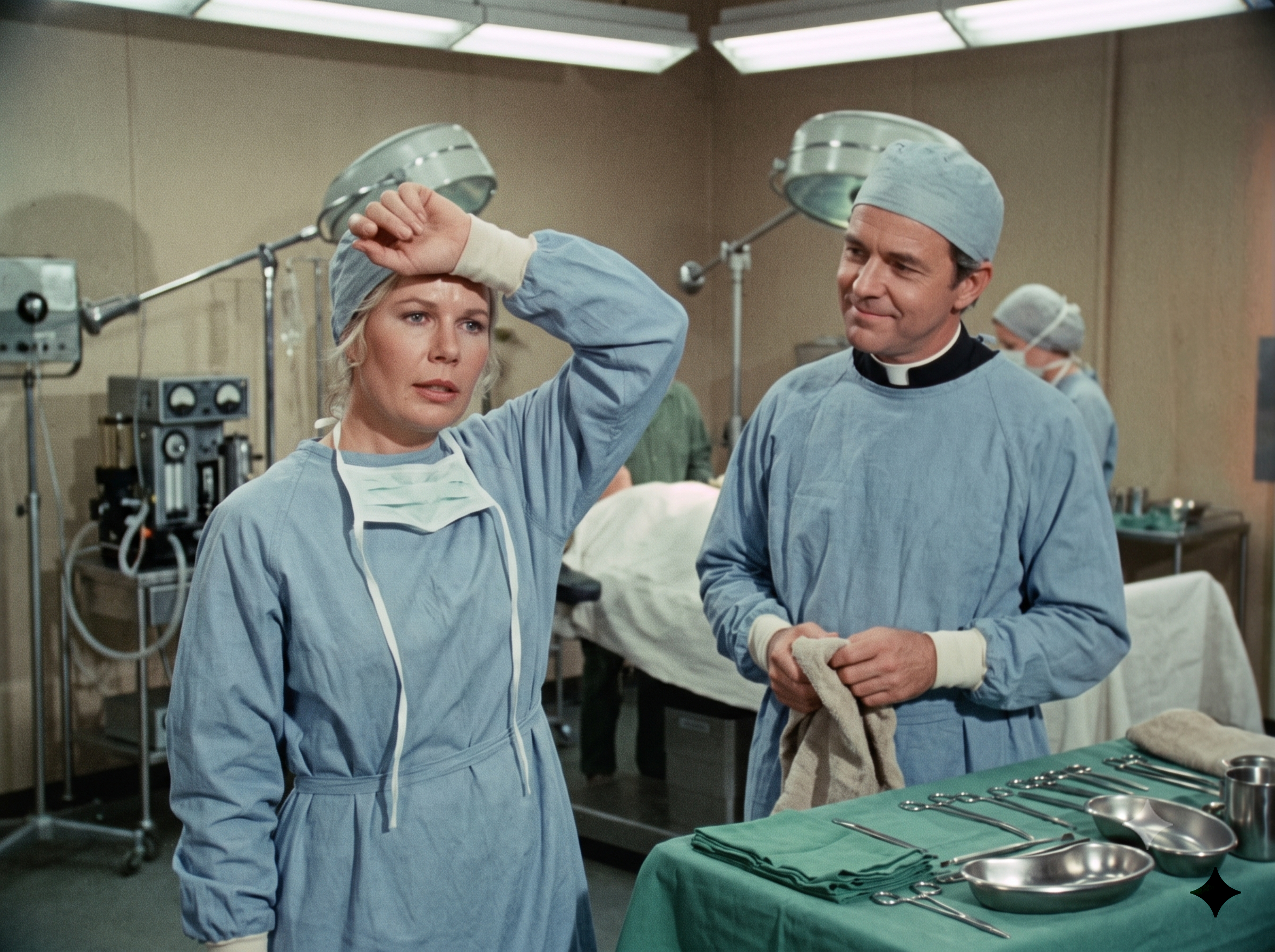
The air inside the OR was thick, tasting of metallic sweat and stale coffee. We had been at it for ten hours, and the steady hum of the generators outside had long ago faded into a maddening, rhythmic pulse behind my eyes. I leaned against the back wall for a second, my scrub cap feeling like a lead weight, and looked over at Margaret. She didn’t know I was watching. She had pulled her mask down to her chin, her forearm pressed firmly against her forehead as if she were trying to physically wipe away the last four hours of carnage.
For a moment, she looked less like the Major I knew and more like someone just trying to remember what it felt like to be home. Then, the door creaked open, and Father Mulcahy stepped in. He wasn’t there for a procedure; he was there because he was always there when the pressure threatened to crush us. He carried a small, folded towel in his hands, his face set in that gentle, practiced calm that usually made me want to cry.
He stood near the instrument table, watching Margaret with a look of profound, quiet empathy. He knew better than to offer a platitude. He just waited, his presence acting like an anchor in a room that felt like it was drifting away from sanity. Margaret finally lowered her arm, her eyes meeting his. She looked shattered, her composure fraying at the edges in a way she never allowed on the ward.
“It’s not enough, Father,” she whispered, her voice cracking like dry parchment. “I just… I feel like I’m running out of bandages for the world.”
Mulcahy didn’t look away. He moved a step closer, his expression shifting from comfort to something more solemn, something that suggested he had been holding his own secrets of despair all afternoon. The tension in the room suddenly spiked. It wasn’t just about the surgery anymore; it was about every single life we’d touched today, and the cold, terrifying reality that we were fighting a flood with a thimble.
Father Mulcahy looked down at the towel in his hands, then back at Margaret. He took a steadying breath, his eyes crinkling at the corners. “Major,” he said, his voice soft but surprisingly firm, “we don’t get to decide the scope of the flood. We only get to decide how we hold the thimble.”
He stepped toward her, not as a priest offering a sermon, but as a man who had seen just as much blood as any of us. He carefully handed her the towel. It wasn’t sterile, and it wasn’t official; it was just a clean, dry cloth he’d scavenged from the laundry tent. It was a small, absurdly human gesture in a place defined by inhumanity.
Margaret took it, her fingers trembling slightly as she wiped the perspiration from her neck. The sheer normalcy of the act—the simple kindness of a dry towel—seemed to pull her back from the ledge. She let out a long, shuddering breath, her shoulders finally dropping from their defensive hunch.
“I suppose,” she said, her voice regaining a hint of that familiar, sharp discipline, “that a dry towel is better than no towel at all.”
“Exactly,” Mulcahy replied, a small, knowing smile playing on his lips. “And for what it’s worth, Margaret, you saved two boys today who shouldn’t have seen the sunset. That’s not a small thing. That’s the only thing.”
The silence in the room shifted. It wasn’t the heavy, suffocating silence of fatigue anymore; it was the quiet, reflective peace of two people who had looked into the abyss and decided to stand their ground together. I watched them, still leaning against the wall, and felt a strange, aching warmth bloom in my chest.
In the 4077th, we weren’t just a unit; we were a family held together by duct tape, worn-out scrubs, and the frantic, beautiful necessity of looking after one another. We were all exhausted, all scared, and all desperately tired of the war. But seeing them there—the Major and the Chaplain, finding a moment of grace amidst the stainless steel—reminded me why we kept showing up.
We didn’t have much, and we rarely had peace. But we had each other, and most days, that was just enough to keep the light on. As Margaret finally nodded, a flicker of her true strength returning, I pushed myself off the wall and walked toward the scrub sink. There were more patients waiting, and the night was far from over. But for the first time in ten hours, the weight didn’t feel quite so heavy.
In a place where everything was temporary, the only thing that lasted was the kindness we shared between shifts.