The Weight of a Single Page at the 4077th
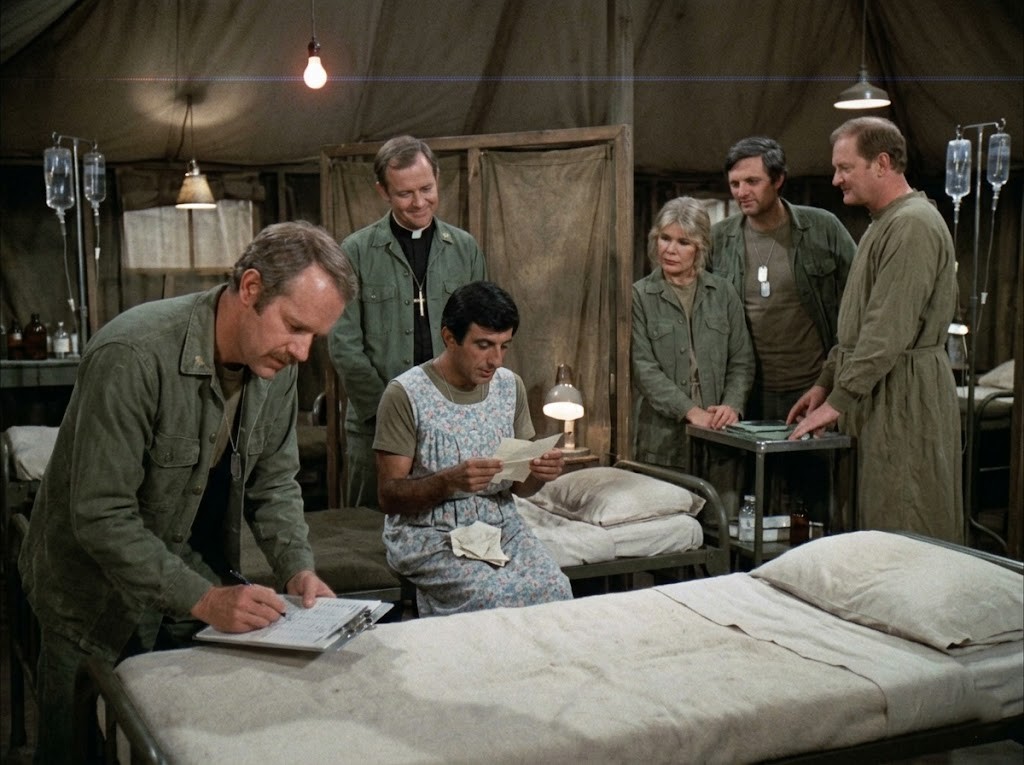
The smell of Korea never really left the post-op tent. It was a thick, unmistakable mixture of damp canvas, boiled laundry, industrial floor wax, and the metallic tang of old blood. But today, if you leaned in close enough to the small wooden stool near the middle cot, you could catch the faintest scent of lavender and cheap Ohio dimestore perfume.
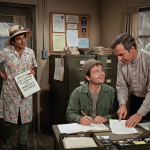
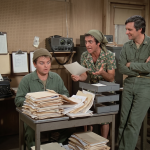
Corporal Max Klinger sat on the edge of the mattress, his large hands trembling slightly as they held a crumpled piece of blue stationery. He wasn’t wearing his standard-issue olive drabs. Instead, he sat under the dim glow of a bare hanging bulb dressed in a floral-print, ruffled apron over a drab t-shirt, looking like a cross between a Toledo housewife and a weary infantryman.
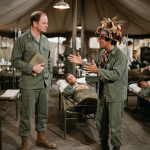
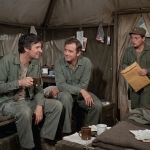
Around him, the rest of the unit stood in a quiet, protective semi-circle. It was one of those rare afternoons where the choppers weren’t flying, the artillery in the distance was just a low, dull thud, and the endless assembly line of broken bodies had finally slowed to a halt. The exhaustion was still there, etched deeply into the lines around everyone’s eyes, but for a few minutes, the war had stepped aside.
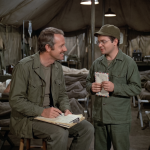
To Klinger’s left, Captain B.J. Hunnicutt stood hunched over a clipboard at the foot of the adjacent bed. He was making a show of charting a patient’s recovery, his pencil scratching methodically against the paper, but his eyes kept drifting upward. B.J. knew the look of a man waiting for bad news from home; he wore a milder version of it every time the mail jeep arrived from Seoul.
Behind Klinger, Father Mulcahy stood like a quiet sentinel, his silver crucifix catching the weak light. He had his hands clasped loosely in front of his olive jacket, a gentle, worried smile playing on his lips. He had already whispered a quick prayer for whatever was written on that paper, knowing that sometimes the words from home could wound a soldier deeper than a piece of shrapnel.
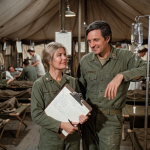
Across the cot, Major Margaret Houlihan stood next to Captain Hawkeye Pierce and Colonel Sherman Potter. Margaret’s posture was stiff, her hands resting near a small metal utility table, but the usual sternness in her eyes had softened into genuine concern. Next to her, Hawkeye leaned forward, his dog tags dangling outside his shirt, his usual rapid-fire wit uncharacteristically silenced by the look on Klinger’s face.
Klinger cleared his throat, his eyes darting across the handwritten lines. “It’s from Toledo,” he murmured, his voice cracking just enough to make Colonel Potter shift his weight. “From my Uncle Abdul. He says the grocery store… the one with the good pita bread and the imported olives… it caught fire last month.”
A collective breath seemed to escape the room, a small sigh of relief that it wasn’t news of a death. But Klinger didn’t look relieved. His thumbs stroked the edges of the paper as if trying to smooth out a tragedy.
“He says the whole block smelled like burnt cinnamon for a week,” Klinger continued, his voice dropping an octave. “But that’s not the worst part. He says my mother… she’s spent the last three weeks sitting on the porch, staring at the ashes, waiting for me to come home and rebuild the awning. She thinks I’m just down in Cincinnati on business.”
Hawkeye took a half-step forward, his mouth opening to deliver a joke to break the tension—something about Ohio being dangerous enough without fires—but the words died in his throat. He saw a tear hit the blue stationery, turning the ink into a blurry, dark bruise on the page.
The silence in the tent stretched out, heavy and suffocating. For all of Klinger’s elaborate schemes, his chiffon dresses, his fake fainting spells, and his endless petitions for a Section 8 discharge, everyone in the room knew the truth: the bravest thing about Max Klinger was how desperately he loved the people he left behind.
Colonel Potter stepped closer, the heels of his boots clicking softly against the floorboards. He placed a weathered, fatherly hand on the back of Klinger’s chair. “Fires happen, son,” Potter said, his voice a low, comforting rumble that had steadied men through two different World Wars. “Wood and brick can be put back together. The important thing is your mother is safe on that porch.”
“But she’s alone, Colonel,” Klinger whispered, looking up with a face entirely stripped of his usual theatrical bravado. “She doesn’t know about the mud. She doesn’t know about the triage. She thinks I’m selling suits. How am I supposed to fix a roof from five thousand miles away in a dress?”
B.J. finally set his clipboard down on the mattress. He walked over and stood beside Mulcahy, looking down at Klinger with a warm, empathetic expression. “You’re building a different kind of roof over here, Max,” B.J. said quietly. “Every time you fetch a unit of O-negative or drive the ambulance through a mortar field, you’re keeping the roof over somebody else’s kid. Your mother would be proud of that. Even if she thought you were doing it in a three-piece suit.”
Margaret nodded, her voice surprisingly tender. “He’s right, Corporal. There isn’t a person in this tent who hasn’t wanted to pack up and run back to the states to fix a broken pipe, or a broken heart, or a broken business. But we stay. And we help each other hold the walls up until the music stops.”
Klinger looked around the circle. He saw Margaret’s fierce loyalty, B.J.’s steady gaze, Father Mulcahy’s approving nod, and the quiet, fierce respect in Colonel Potter’s eyes.
Hawkeye finally found his voice, slipping his hands into his pockets and offering a small, lopsided grin. “Besides, Klinger, look at the bright side. If you were back in Toledo rebuilding the grocery store, you’d be wearing overalls. Overalls don’t do justice to your calves. That floral apron, on the other hand? It screams ‘interstate commerce’.”
A small, wet chuckle escaped Klinger’s nose. He wiped his face with the back of his sleeve, careful not to tear the letter. “You think the floral pattern works, Doc?”
“It’s a triumph of civilian fashion,” Hawkeye replied, his eyes crinkling at the corners. “The Sears Roebuck catalog is weeping tears of envy.”
Father Mulcahy stepped forward and gently touched Klinger’s shoulder. “If you like, Max, we can sit down after evening mess and write a letter back to Uncle Abdul. We can tell him that your ‘business trip’ is yielding great results, and that you’ll be bringing home enough stories to fill a lifetime.”
Klinger carefully folded the blue paper, tucking it into the pocket of his apron, right over his heart. The heavy weight that had settled over the post-op tent seemed to lift, replaced by the familiar, resilient warmth of the 4077th. They couldn’t put out the fires in Ohio, and they couldn’t stop the war in Korea, but for fifteen minutes in a drafty canvas tent, they could make sure a friend didn’t have to carry the smoke alone.
Colonel Potter tapped Klinger’s shoulder twice. “Alright, folks, the circus is over. B.J., finish those charts. Margaret, check the penicillin inventory. And Klinger?”
Klinger stood up, straightening his apron with a newfound touch of his usual dignity. “Yes, Colonel?”
“Go get some coffee. And put on something with sequins for dinner. It’s Tuesday.”
“Yes, sir,” Klinger said, a genuine smile finally breaking through his mustache.
As the group scattered back to their duties, the distant thud of the big guns started up again. But inside the tent, the walls held firm.
Because out here in the mud, home wasn’t a place on a map anymore—it was the people who held you together when the letters arrived.