The Knit That Binds Us
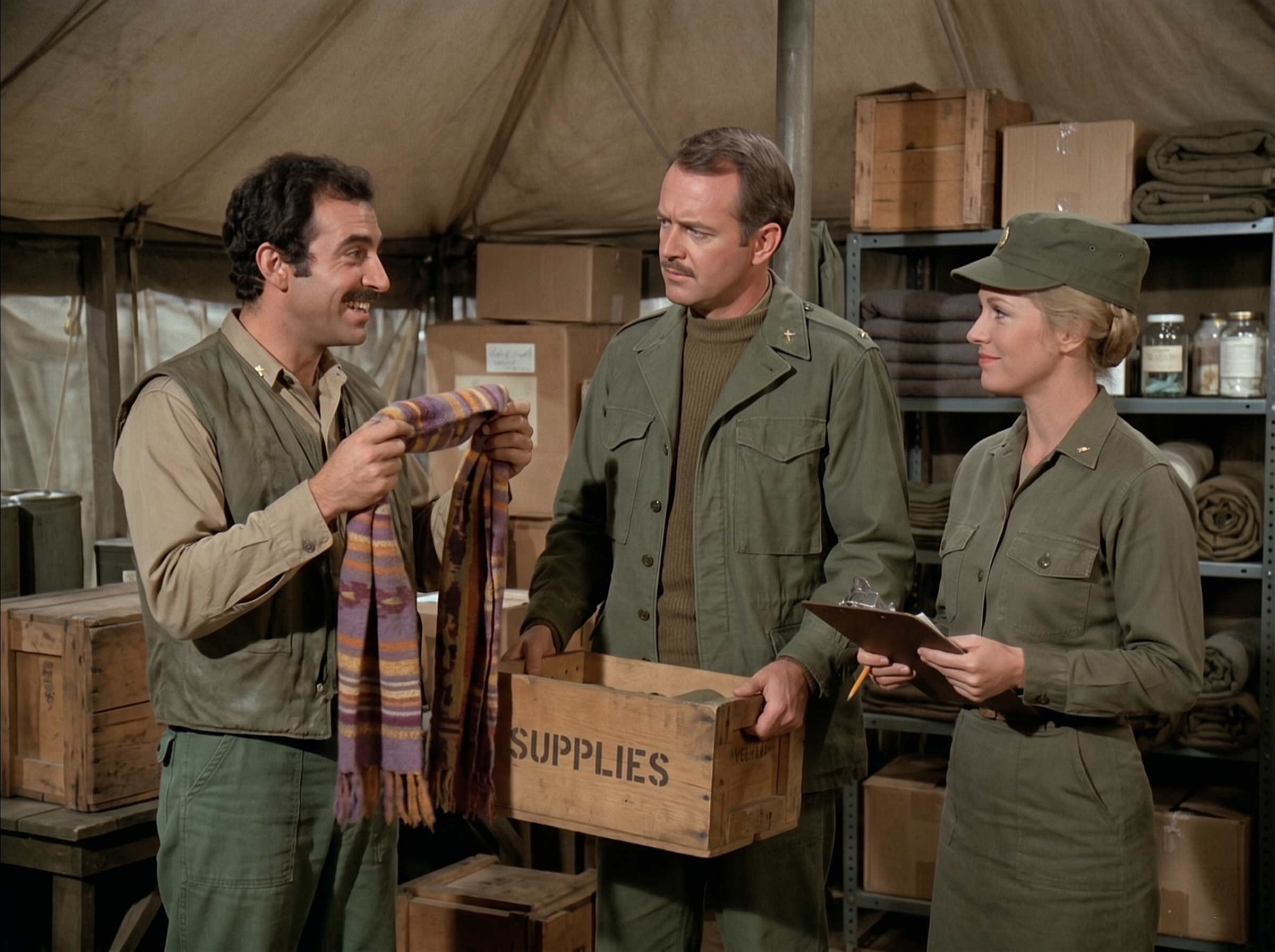
You know the smell of the supply tent at the 4077th. It wasn’t just dust and mildew. It was the scent of anticipation, of desperate hope arriving in wooden crates. It was Christmas morning and tax day all at once, depending on what the latest truck delivered.
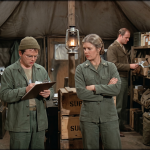
We were standing in that very tent, surrounded by the usual beige boxes and metal shelves stacked with things we needed yesterday. B.J. had just finished rummaging through a box marked “SUPPLIES” that Winchester was still holding, looking ready to drop it if it contained one more non-essential item.
Margaret stood beside him, clipboard in hand, already mentally tallying the inventory. “Another box of B-12 ampoules, Major,” she reported. Then she paused, looking at what B.J. was currently holding.
B.J. was beaming. His mustache twitched with a grin wider than the distance from here to Seoul. In his hands, he displayed a hand-knitted, multi-colored scarf.
“Well,” Winchester said, his voice flat with cultivated indifference, “someone’s grandmother finally figured out the complex, intricate weave pattern called ‘chaos.'”
B.J. didn’t even hear the jab. He was busy looking at the card that had been tucked into the wool. “It’s from a church group in California,” he said softly. “Look at this stitch work, Winchester. That is love.”
Winchester raised one elegant eyebrow. “It is *misguided* love, Captain. The colors alone violate the Geneva Convention.”
The scarf was, to put it mildly, a sensory assault. It had stripes of aggressive purple, faded orange, a sickly mustard yellow, and a pink that seemed to have lost its will to live. It was soft, yes, but its appearance was… well, a masterpiece of good intentions and bad design.
“I think it’s charming,” Margaret said, stepping closer. “It shows dedication.”
“Dedication to what, Major?” Charles scoffed. “Blindness?”
B.J. began winding the thing around his neck. It was thick, immediately making him sweat. He didn’t care.
“I’m wearing this in the O.R. tonight,” he declared. “The warmth from this scarf will radiate through my scrubs and directly into my patients.”
Just as he was securing the knot, a sound pierced the air. Not the usual rumbling of artillery, but a high, anguished, and distinctly recognizable cry. It was Radar.
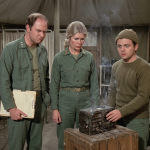
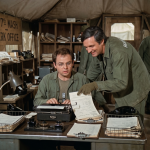
He burst into the tent, red-faced and hyperventilating. In his trembling hands, he held the unit’s only set of brass keys to the pharmacy cabinet. The keys were snapped. Completely sheared off at the shaft. The *only* set.
Radar slumped onto a low wooden crate, the picture of absolute disaster. He couldn’t speak, just pointed at the broken metal in his palms. We all froze. This was the supply tent. If the pharmacy keys were broken, there was no backup, no Master Sergeant to call. We were effectively locked out of our own medical lifeline.
Charles’s face, usually so composed, went pale. Margaret gripped her clipboard white-knuckled. B.J. slowly unwound the multi-colored monstrosity from his neck, looking down at Radar’s crumpled form. The silence was heavier than the tent canvas.
“Okay,” B.J. finally said, his voice quiet, steadying. “No one panic. Panicking is only for people who haven’t spent six months trying to repair a toaster with only a tongue depressor and optimistic thoughts.”
“But the key…” Radar managed to choke out, “the *only* key. I went to open the cabinet and… and…” He started sobbing quietly.
Charles actually put the heavy wooden supply crate down, very carefully, on a stack of blankets. He approached the broken keys. “Radar, you bumbling, vertically challenged creature. This is not how a supply sergeant operates.” But his voice lacked its usual bite. It was laced with panic.
“Major,” Margaret’s voice was tense, professional yet slightly strained. “What can we do? We have patients.”
They all looked at B.J. The man who saw hope in a box of gauze and love in a knitted disaster. He was staring, not at the broken key, but at the scarf draped across his arm.
He looked up, a wild, dangerous glint in his eye. “Radar,” he said, “how thick is that lock’s keyway?”
B.J. had a look on his face. It wasn’t his usual ‘prank Hawkeye’ look. This was his ‘I am about to do something so crazy it might actually save our lives’ look. He lifted the awful scarf, high, like a conquering banner, and stared right into Winchester’s eyes.
The silence stretching across that tent felt like a physical weight. Radar looked like he was about to faint. Margaret looked like she was about to start an official inquiry. Winchester just stared, a faint, condescending smile appearing.
“Captain,” Winchester said, with slow, agonizing deliberation, “if you are suggesting what I think you are suggesting, I believe the strain of this conflict has finally, completely, cracked your resolve. You intend to pick a lock using a *scarf*?”
B.J. didn’t answer right away. He was uncoiling a section of the knitted monstrosity, examining the thick, mustard-colored wool. “Not pick it, Winchester. Fill it.”
“Excuse me?” Margaret was incredulous. “You can’t just… stuff a lock with wool and call it a solution. We need antibiotics. We need morph—well, we need everything.”
B.J. was already working. He took one edge of the scarf and carefully started to unravel the mustard section. The wool was thick, hand-spun, and slightly coarse.
“The key is broken at the shaft,” B.J. mused, eyes narrowed, working his fingers. “The profile of the key is what we need. This wool is stiff. We don’t just fill it. We create a pressurized matrix.”
“A pressurized matrix of *what*, Captain? Incompetence?” Winchester threw his hands up. “This is preposterous! I will send a runner to Seoul immediately. We can have a new locksmith here by next Thursday!”
B.J. was busy now. “Radar, stop blubbering. Winchester, grab those needle-nose pliers from the toolbox by the shelf. No, the metal box. Yes, that one. Move it, Winchester, your refined sensibilities are slowing us down.”
He had unraveled about six feet of the thick yarn. He was carefully plaiting it, creating a multi-strand cord about the width of the key shaft.
Radar looked up, tears streaking his face. “B.J., you can’t. Colonel Potter is going to put me on a plane to Omaha.”
“And if this works, Radar, you’re going to Omaha for *vacation*,” B.J. promised, never looking up from his painstaking work. “Hold the snapped end of that key, Winchester. I need to copy the *profile*.”
B.J. was using the broken end of the key, dipping it in the unraveled wool, then using the pliers to gently shape the plait. He was trying to create a pressurized mold of the missing key profile using the stiff, colorful wool.
Winchester was forced into the role of a surgeon’s assistant, holding the broken key with the same delicate precision he used to play the cello. Margaret stood by, her jaw set, watching B.J.’s fingers fly. Even she seemed captivated by the desperation of the plan.
“What is the point?” Winchester muttered. “It won’t work. The lock is brass. This is wool.”
“Trust the wool, Charles,” B.J. murmured. “This came from a church group in California. If that doesn’t have the power to turn miracles into reality, I don’t know what does.”
B.J. finished. He had created a complex, multi-layered plug of compressed, molded yarn, mirroring the exact, sheared profile of the key head. He’d even used the pliers to compress the ‘teeth’ into the yarn.
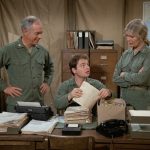
The group was dynamic. B.J., still wearing his green vest, was hunched over, focusing. Charles stood stiffly, holding the key. Margaret was leaning in, clipboard forgotten. We all held our breath. This was the moment.
B.J. gently guided the sculpted wool plug into the keyway of the pharmacy cabinet lock. It resisted. He pressed firmly. The wool compressed further. He felt the specific point where the ‘teeth’ of his matrix met the internal tumblers. He braced the plug, then took a simple screwdriver and inserted it *behind* the pressurized wool, into the plug’s key shaft opening.
“Okay,” B.J. whispered. “Pray.”
He turned the screwdriver. We all held our collective breaths. The silence was louder than the war outside.
Click.
The sound was tiny. A micro-event. But in that tent, it echoed like a cannon shot.
The latch released. The cabinet door swung open.
Radar let out a sound that was half sob, half laugh. Margaret visibly sagged with relief. Winchester’s jaw actually dropped. His refined silence was the loudest reaction of all. He stared at the open cabinet, then at B.J., then at the still-held wool mold, and finally back to B.J.
B.J. pulled the wool matrix out of the lock. It was compressed, blackened, and looked like a small, misshapen caterpillar. He handed the pliers back to Charles.
“Told you,” B.J. said, wiping his hands on his pants. “The knit that binds us.”
Winchester picked up the wooden supply box again, but he did so with far more humility. Margaret silently made a note on her clipboard. Radar was now happily counting vials, sniffing slightly.
B.J. walked back over, picked up the remains of the scarf—now shorter, missing a section of mustard yellow, and slightly unraveling. He wound it carefully, lovingly, around his neck.
It was still ugly. It was still absurd. But standing there in the beige dust of the supply tent, looking at B.J. with his mustache twitching in that self-satisfied grin, I realized it was the most beautiful thing I’d seen in Korea. The color clashing didn’t matter. What mattered was that a piece of wool from California, via a church group and a manic doctor’s imagination, had just helped keep a hospital running.
B.J. patted his scarf, satisfied. “It’s a little frayed,” he said, looking at Charles. “But I think I can make a case that it just got field-tested.”
Winchester rolled his eyes, but this time, he couldn’t quite maintain the arrogance. “Just… keep that thing away from the patients, Captain. They are suffering enough.” He actually cracked a tiny, almost invisible, smile as he carried the heavy box of supplies deeper into the tent.
In the supply tent, among the boxes of the ordinary, we often found the extraordinary warmth that kept us together.