A Desk, A Dress, and a Lifetime of Distance
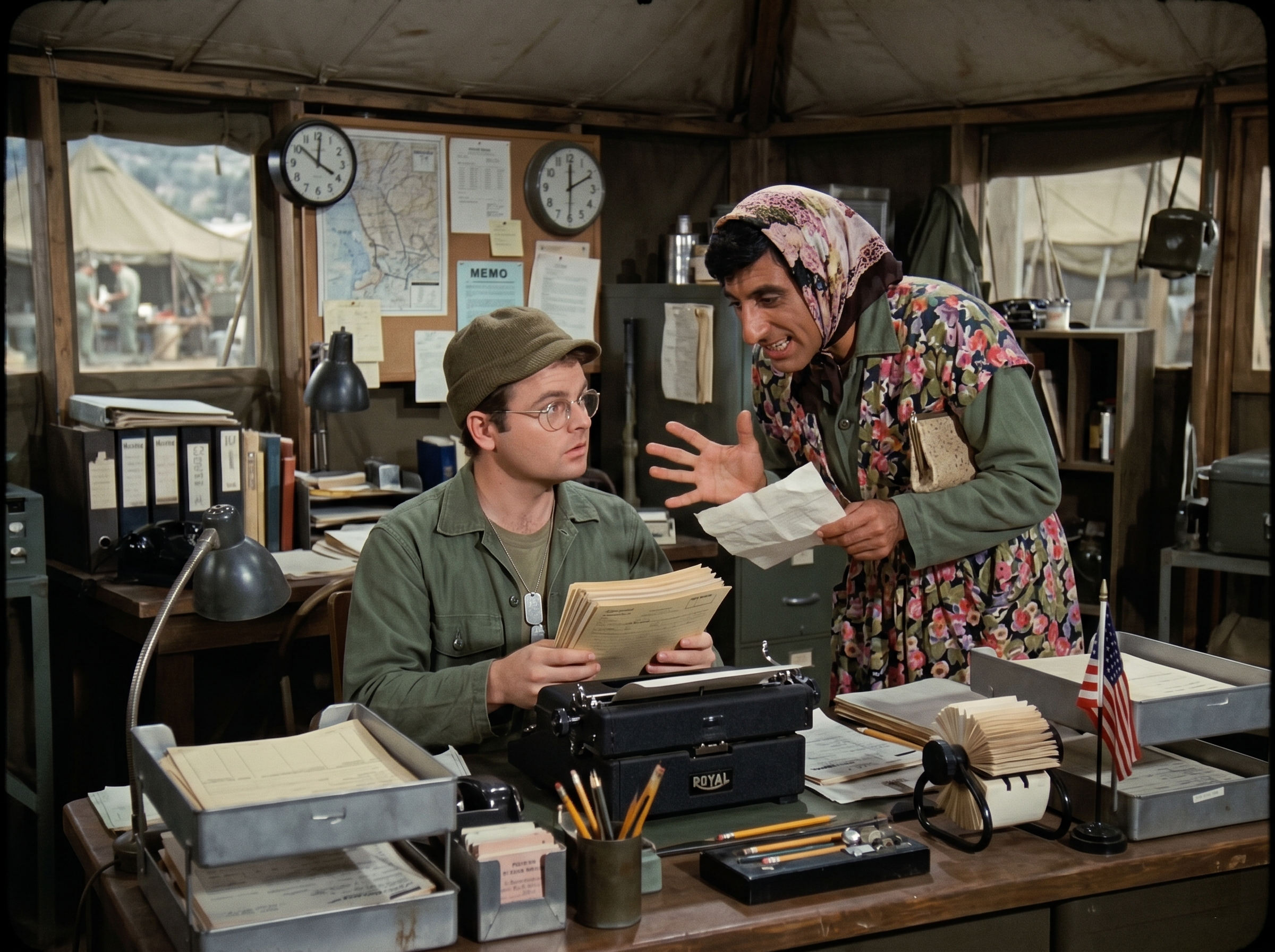
The clatter of Radar O’Reilly’s Royal typewriter was often the only heartbeat in the 4077th’s main office.
In that quiet tent, the war felt millions of miles away, yet it was precisely what filled the filing cabinets to bursting.
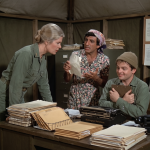
Radar sat like a nervous goalie, hands frozen over a fresh stack of personnel files, looking up at the most chaotic energy the unit possessed.
Klinger had just burst in, the usual whirl of taffeta and desperation, today accessorized with a floral babushka that clashing magnificently with a multi-colored housecoat over his fatigues.
He didn’t come to argue for a Section 8; he came with news that was clearly crushing him from the inside out.
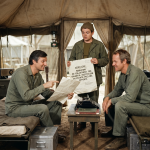
Klinger leaned over Radar’s neat desk, his hand fumbling, thrusting a crumpled letter under Radar’s nose while his other hand splayed in an intense, wordless gesture.
The letter looked like it had been read a thousand times in a foxhole or a foxhole-adjacent tent, then squeezed in anguish.
Radar didn’t breathe; he just looked at Klinger’s wide-eyed, frantic face, the visible sweat breaking through his pancake makeup.
Radar knew Klinger didn’t do *this* face for the brass; this face was reserved for his friends, for the times when the act was the only thing holding him together.
“Five years, Radar!” Klinger finally managed, his voice strained, raw with a feeling that bypassed his theatrical self.
“Five! That’s how long she’s been waiting! And she doesn’t understand, she *never* understands, because she doesn’t *want* to!”
Radar looked down at the paper, catching fragmented words like ‘mother,’ ‘marriage,’ ‘home,’ ‘now.’
The reality of the distance, the miles of silence, and the cruel logic of a world moving on without them, crashed into the quiet office.
Radar could handle any Colonel, any general, any supply form, but he couldn’t handle Klinger’s broken heart.
Klinger wasn’t asking to go home; he was asking why he couldn’t *be* there, where he was truly needed.
The office, with its multiple clocks and its neat stacks of bureaucracy, felt suddenly cold and insufficient.
Radar just sat there, the stack of files forgotten in his grip, his eyes searching Klinger’s, unable to offer a single word.
The silence grew heavy, a pressure waiting to burst. *How does a farm boy from Iowa tell a man from Toledo that he doesn’t have the answer?*
“Radar, please… just look at it. Tell me what I do,” Klinger whispered, the dramatic energy from his entry draining away, leaving him just a terrified man in an absurd floral dress.
Radar O’Reilly didn’t need to read the letter to understand its meaning. He saw the same message in every piece of mail that *didn’t* arrive, in every look shared across a bloody operating table.
Slowly, Radar put down the stack of personnel files, neatening them on the metal desk.
He carefully took the crumpled letter from Klinger’s hand, handling it like it was a delicate surgical instrument.
“Klinger,” Radar said, his voice quiet, steady, contrasting Klinger’s ragged panic.
Klinger leaned in closer, his floral babushka a chaotic frame around his desperate eyes. “What? What do I tell her? How do I make her see that I can’t just walk out? She thinks I’m *enjoying* this! The food! The mud!” He gestured wildly around the drab green tent.
Radar didn’t say what he was thinking: *No one enjoys this.*
Instead, he cleared a small space on the desk, pushing aside the stamp pads and pencil holders.
“Klinger, sit down,” Radar said, not as a command, but as an offering.
Klinger looked around, as if the concept of sitting was alien. He slowly sank into the chair on the other side of the desk, the crinoline of his skirt deflating.
Radar looked over at the empty Royal typewriter, the ribbon ready.
“You can’t change the war, Klinger. And you can’t be in Toledo. But you can make sure she *hears* you.”
Klinger stared. “Hears me? What, on a radio? I’ve tried that, Radar, the reception is garbage!”
“No,” Radar said, adjusting his glasses. “We’re going to write her. The *right* letter.”
The Royal typewriter clattered to life again, but this time, it was slow, deliberate.
“Klinger, tell me. Start with, ‘Dear Mother…'” Radar paused, waiting.
Klinger started, his words tumbling out fast, melodramatic, full of references to injustice and madness.
“Wait, wait,” Radar interrupted gently. “That’s too much… *Toledo* Klinger. Write the *other* Klinger. The one who misses her cooking. The one who just wants to come home.”
For the next twenty minutes, the only sound was Klinger dictating, then stopping, then correcting himself, while Radar carefully shaped the words on the paper.
The theatrics were gone. They were just two tired men, connecting over an outdated form of communication.
Through the windows of the tent, blurry figures went about their business—other soldiers, nurses, perhaps Hawkeye with an imaginary martini—unaware of the small victory happening inside.
They found words for the love, the fear, the impossible distance. They spoke of duty, even if it was just the duty to survive.
They didn’t create a medical miracle, but they created a human connection across thousands of miles.
When the letter was finished, Klinger didn’t need to ask if it was good. He saw it in the final neatly typed paragraphs.
He stood up, his posture a little straighter. He looked at the letter, then at Radar.
The frantic gesture from the image was gone. He slowly adjusted his floral babushka, then brushed an invisible piece of lint off his floral housecoat.
“Thanks, Radar. For all of it.”
Klinger didn’t wait for a response. He took the letter, folded it carefully, and slipped it into his dress pocket, like it was a secret weapon.
Radar didn’t say anything as Klinger left the tent. He just watched the floral dress recede, a bright splash of life in the sea of olive drab.
He adjusted his glasses one last time and looked at the Royal typewriter, then at the stack of personnel files.
The clocks still ticked different times, but the silence didn’t feel heavy anymore. The distance was still there, but so was the humanity that made it bearable.
Radar O’Reilly picked up the stack of files and started typing the next form.
Business as usual, in the heart of the 4077th.
And for that afternoon, the impossible distance felt just a little bit less.