A Simple Pot of Hope
The OR session had finally ended, leaving behind a silence so profound it felt heavy. Another 20-hour stint. Another endless procession of broken bodies and tired faces, stitched together by moonlight and caffeine. Now, the 4077th was slowly returning to life—the quiet, weary life of the aftermath.
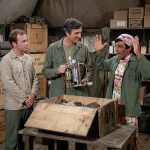
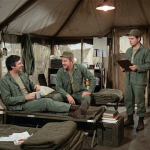
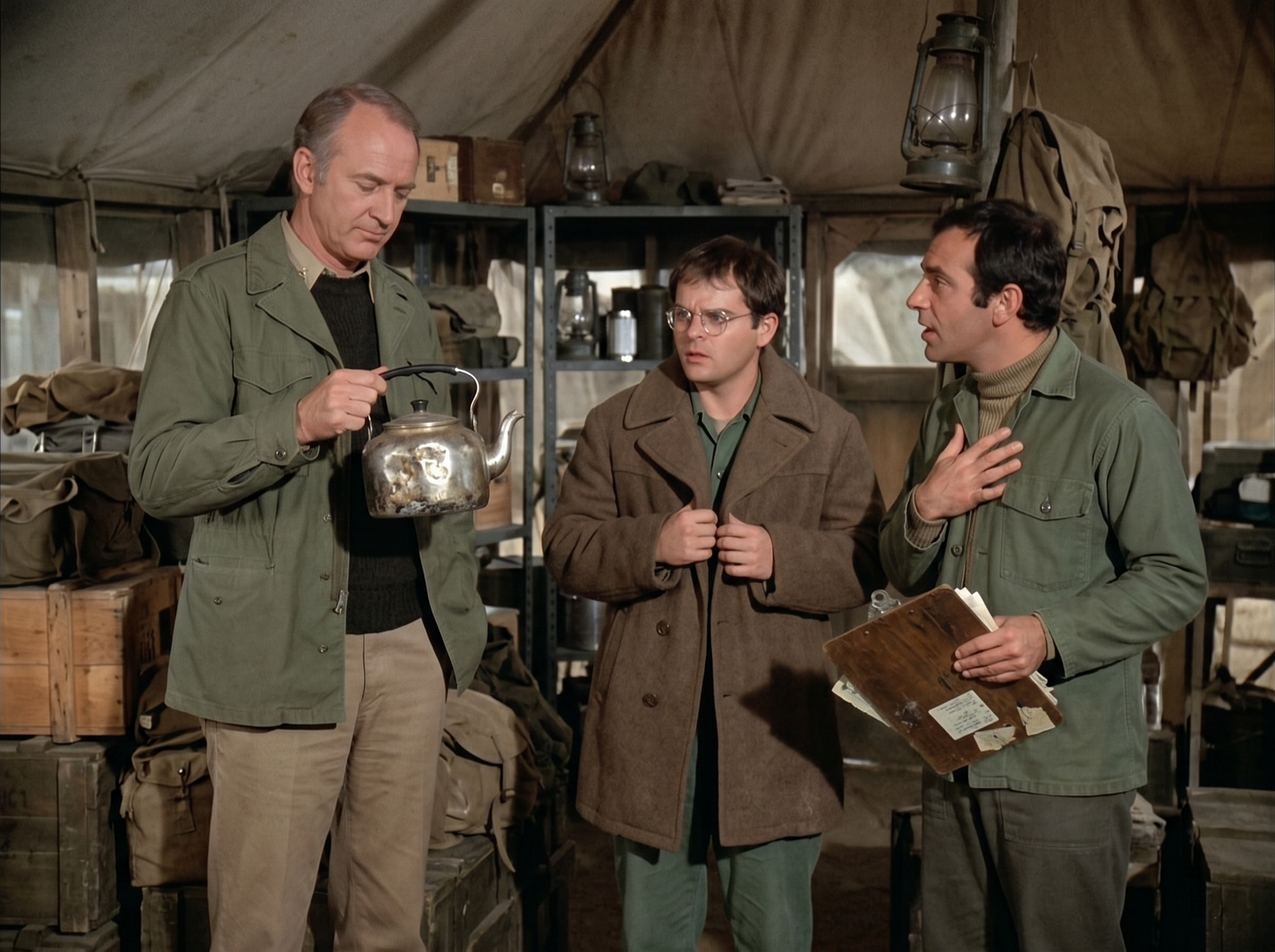
Inside the supply tent, the chill of a fading Korean night lingered, despite the warm glow from the potbellied stove. This wasn’t the bustling hub of requisition forms and complaints. Right now, it felt like a brief refuge, a place where three men could simply stand and *be* for a moment.
Colonel Potter, ever the pragmatic father figure, stood looking down intently at the object in his hand: an old, battered metal tea kettle. It wasn’t anything special. Just aluminum, dented and stained with the patina of countless brews. His face was etched with the weariness only a commanding officer knows, his brow furrowed as he gripped the handle.
“It’s empty,” Potter said, his voice flat with fatigue. “Tapped out. Dead as a doornail.” He didn’t look up at the other two men. His focus was entirely on the cold, empty kettle.
Next to him, Radar was huddled deep inside his oversized wool coat. Even on warm days, Radar seemed perpetually chilled, his nervous energy a stark contrast to his commander’s steady calm. He looked between Potter and B.J., his eyes behind the round spectacles wide and slightly worried.
“We’ve got instant coffee packets,” Radar offered, his voice barely a whisper. He knew instantly it was the wrong thing to say.
“Coffee packets, Radar?” Potter retorted, a hint of genuine disappointment coloring his tone. “That sludge isn’t fit for a radiator, let alone a man who hasn’t slept since last Tuesday.” He shifted the kettle to his other hand, looking lost.
It was more than just coffee. It was the principle. A hot drink meant the OR was over. It meant a momentary escape from the reality just outside the tent flap. The empty kettle was a final, frustrating insult to a grueling week.
B.J. Hunnicutt stood slightly back, his green field jacket open. He had a clipboard tucked under one arm, but it was just a prop right now. His other hand was pressed to his chest in a silent plea for reason.
“Colonel, let it go,” B.J. said gently, a soft, tired smile playing on his lips. “It’s just water. It’ll boil again. Tomorrow. Today, we rest.”
His dark sweater peeked out from under his jacket, another layer against the persistent cold. He was trying to be the steadying hand, the voice of sanity in a place that rarely made sense. He looked tired too, the circles under his eyes deepened by the dim light, but his focus was on easing the quiet frustration he saw in Potter.
But the Colonel wasn’t ready to let it go. His gaze hadn’t wavered. He held the kettle like it was a complex puzzle box he couldn’t decipher.
He stood there, seemingly paralyzed by the small, frustrating problem of a cold pot. The silence in the tent stretched uncomfortably. B.J. exchange a worried glance with Radar. It wasn’t like Potter to get stuck on something like this. It was just an empty kettle, right?
But then, as B.J. opened his mouth to say something else, anything to break the spell, Colonel Potter slowly raised the heavy, battered kettle… and aimed it directly at the nearest support beam of the tent, his knuckles white with frustration.
The action was swift, unexpected, and utterly out of character. B.J.’s stomach gave a sickening lurch. *No*, he thought, his own hand flying from his chest to cover his mouth in shock. Potter wasn’t an explosive man, but the pressure of the last week must have finally found its crack.
Radar let out a small gasp, completely frozen. The sight of the Colonel, his steady anchor, about to smash a piece of camp equipment against a post in raw frustration was almost too much for the young clerk to handle. He braced himself for the crash, for the loud *clang* that would shatter the tenuous peace they’d found.
But the sound never came.
Colonel Potter’s arm stopped mid-swing. The base of the aluminum kettle hovered inches from the wooden pole. His face, seconds ago a mask of simmering exhaustion and anger, suddenly crumpled. The lines of frustration softened, replaced by something much rawer: pure, deep-seated grief.
His shoulders sagged, and the anger drained out of him, leaving him looking smaller and inexplicably old. He slowly lowered the kettle, his hand shaking.
He didn’t say anything. He just looked at the pot again, but this time his eyes were swimming.
B.J. and Radar stood perfectly still, afraid to breathe. They’d seen Colonel Potter deal with everything from hostile generals to critical supply shortages, all with a steady hand and a dry wit. But this was different. This was *Sherman*, the man who wrote letters home every night, who loved his horse, who took care of them all. And he was breaking.
Slowly, B.J. stepped forward. He didn’t try to take the kettle. He didn’t offer a platitude. He just placed a gentle hand on Potter’s arm.
“Colonel,” B.J. said quietly, his voice thick with emotion. “What is it?”
Potter swallowed hard. He looked up, and for the first time that night, B.J. saw the man, not the officer.
“I was going to use this kettle when I finally told Mildred about leaving her and the boys,” Potter whispered. His voice was unsteady, cracked with unshed tears. “I thought I’d put on a pot of coffee… make it easier. Make *something* feel normal.”
He ran a tired hand over the dented side of the pot. “I never did. When the orders came through for Korea, I just packed my bags and left. I thought we didn’t have time. I thought it would be easier… less painful. Now I see I just left a cold silence in that house.”
The supply tent, with all its stacked crates and lanterns, seemed to fade away. It was just three men, bound by an invisible thread of shared hardship and surprising empathy, sharing a moment of profound vulnerability.
B.J. understood. It wasn’t about the coffee. It was about the regret of time stolen, of a moment of comfort and connection missed, and the fear of a silence that could never be filled.
Radar, his eyes bright behind his glasses, slowly uncoiled from his oversized coat. He looked down at his clipboard, flipping through a few pages of requisitions and forms, but B.J. knew he wasn’t really reading anything.
“Colonel,” Radar said, his voice quiet but surprisingly sure. “Mildred knows.”
Potter looked at him, surprised. “She does?”
“Yeah,” Radar nodded. “You write her every day. You tell her you miss her. You tell her about how the coffee tastes like pond water, and how much you hate the cold.”
“You tell her you love her,” B.J. added gently.
A tear finally escaped from Potter’s eye and traced a solitary path down his cheek. He wiped it away quickly with the back of his hand, but the crack in his armor was visible now, and it was filled with something better than stoicism—it was filled with the collective warmth of his adopted family.
He stood up straighter, the simple action radiating a quiet dignity. He looked from B.J. to Radar, and then back down at the empty kettle.
“I did, didn’t I?” he said, a small, genuine smile finally touching his eyes.
He patted the kettle, almost affectionately this time. “You know, I think I will keep this old thing. When I finally *do* go home, I’ll fill it with water from our own well. I’ll make a pot of real coffee, not this packet mud. And Mildred and I will sit down, and we’ll talk. For as long as it takes.”
The tension in the air dissolved, replaced by a gentle, nostalgic warmth. The empty kettle was no longer a symbol of frustration. It was a vessel of hope, a reminder of a future worth waiting for, a placeholder for a perfect conversation that had only been postponed.
B.J. lowered his hand from his chest, his posture relaxed. He glanced at Radar, who managed a small, brave smile back. The storm had passed, leaving behind a moment of profound, quiet human connection that felt more valuable than all the coffee in the world.
“And about that instant sludge, Radar,” Potter said, regaining some of his usual dryness. “I want to see a requisition form for five bags of premium ground coffee. From the *good* supply line. If we’re going to be here, we are *not* drinking that mud.”
Radar’s face lit up, and he snapped a quick salute. “Yes, sir! Right away, Colonel!”
Potter turned and walked toward the tent flap, moving with a slight pep in his step that hadn’t been there before. He held the kettle carefully, like it was a precious thing.
B.J. and Radar followed him out into the cold Korean night. Above them, the stars were bright and silent, a backdrop to their shared journey through the unexpected, beautiful mess of life. It was a life defined by fatigue and fear, yes, but also by moments like this—moments of pure, found humanity that made all the difference.
Sometimes, even an empty kettle can be filled with hope.
*Share this story with someone you miss, or tag a friend who makes your own tough days a little warmer.*