The Rhythm of the Underwood
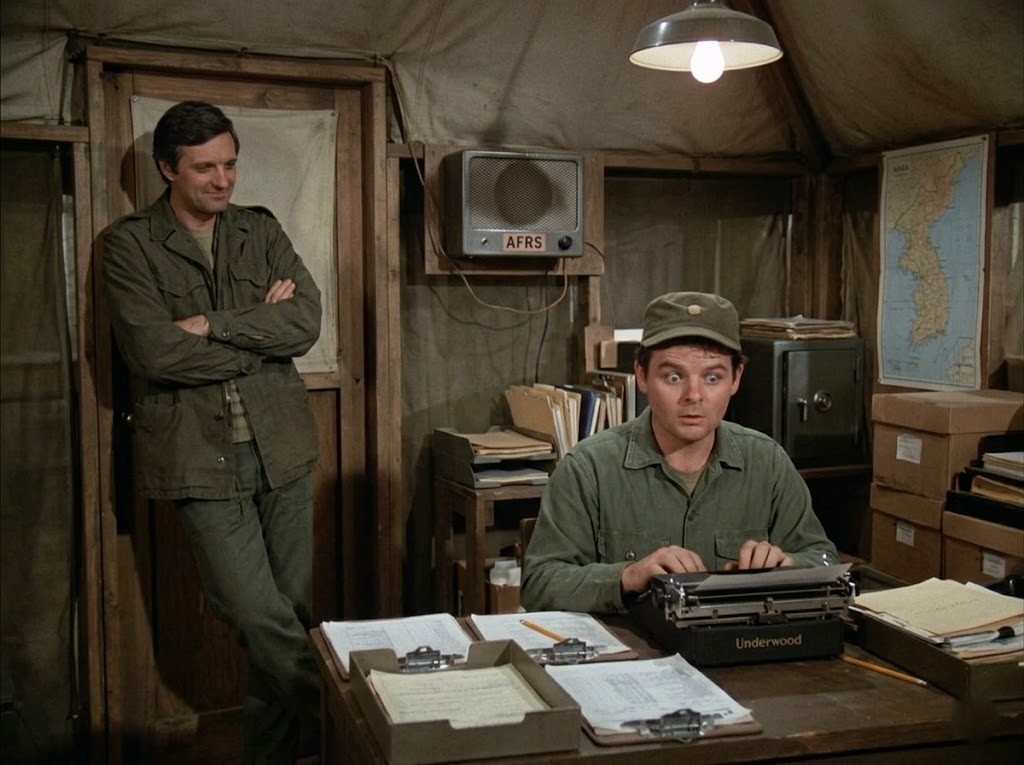
The Swamp was freezing, the O.R. was a meat locker, but the clerk’s office always smelled exactly the same. It was a thick, comforting soup of stale Maxwell House coffee, damp canvas, ink ribbons, and the faint, sweet scent of Radar’s grape Nehi.
To the rest of the 4077th, that tiny office was the true engine room of the camp. If the keys stopped clacking, the world stopped spinning.
Hawkeye Pierce leaned against the wooden doorframe, his long frame draped in a faded olive-drab jacket. His arms were tightly crossed against the autumn chill cutting through the tent seams.
He hadn’t slept in twenty-four hours, his eyes carrying the heavy, shadowed bags of a long night shift. Yet, a quiet, tired smile played on his lips as he watched the young corporal at work.
Radar O’Reilly was hunched over his trusted Underwood typewriter, his fingers flying with a frantic, rhythmic intensity. His cap sat straight on his head, the small brass insignia catching the pale, warm glow of the single bare bulb hanging overhead.
On the desk before him lay a mountain of requisitions, clipboards, and carbon paper. Every form required a signature, every carbon needed a duplicate, and three generals in Seoul were demanding the monthly personnel rosters by sunrise.
The radio on the shelf above—labeled “AFRS” in neat, taped letters—was silent, replaced by the chaotic symphony of Radar’s typing. *Clack-clack-clack-ding!* The carriage return slammed back with mechanical precision.
“You’re going to set those keys on fire, kid,” Hawkeye murmured, his voice laced with affectionate exhaustion. “If you type any faster, MacArthur is going to draft your fingers into the infantry.”
Radar didn’t look up, his round eyes wide with an expression that sat somewhere between absolute panic and total concentration. His jaw was set, his lips slightly parted as he processed the sheer volume of military bureaucracy before him.
“Can’t stop, Captain,” Radar mumbled, his voice cracking slightly under the pressure. “Colonel Potter needs these supply manifests filed before the morning mail jeep leaves, and if we don’t get the order in for the winter blankets, we’re all going to turn into human popsicles by November.”
Hawkeye took a slow step forward, looking at the sheer volume of paperwork piled high in the wooden trays. He knew the burden the kid carried. While the doctors fought the war with scalpels, Radar fought it with ink, keeping the chaos of the army from crushing them all.
Suddenly, the rapid-fire clacking of the Underwood came to a jarring, violent halt.
The carriage bar jammed halfway across the page. A sharp, metallic *snap* echoed through the quiet office, followed by the dull hiss of a tangled ink ribbon.
Radar’s fingers froze instantly in mid-air, hovering over the home row. His face went entirely pale, his eyes widening to the size of saucers as he stared down at the broken machine.
For the first time since Hawkeye had known him, the spark of absolute certainty left the young corporal’s face, replaced by a sudden, terrifying silence.
The silence in the tent was heavy, broken only by the distant, lonely whistle of the Korean wind outside.
Radar didn’t move a muscle. He sat paralyzed, staring at the tangled black ribbon coiled like a mechanical spider inside the belly of the Underwood.
“Captain…” Radar whispered, his voice trembling with a vulnerability that made him look about twelve years old. “It’s stuck. The lowercase ‘e’ is jammed against the ‘r’. And the ribbon… it tore.”
Hawkeye dropped his arms and walked over to the desk, his boots clicking softly on the floorboards. He pulled up a wooden stool and sat down beside the boy, looking at the mechanical casualty.
To anyone else, it was just an old typewriter. To Radar, it was his voice, his shield, and his only way of keeping the 4077th safe from the madness of the Pentagon.
“Hey, easy, Walter,” Hawkeye said gently, using Radar’s real name—a rare occurrence reserved only for moments when the kid truly needed an anchor. “The surgeon is in the house. Let’s take a look at the patient.”
Hawkeye carefully reached out, his long, surgeon’s fingers—usually reserved for repairing delicate human tissue—tendering gripping the jammed metal typebars. With a practiced, gentle touch, he unhooked the tangled letters, easing them back into their slots.
Radar watched him, holding his breath as if Hawkeye were performing open-heart surgery on a general.
“You see that?” Hawkeye said softly, pulling a stray pencil from the desk. He used the eraser tip to guide the torn ink ribbon back onto its spool, winding it tightly until the tension returned. “Just a minor fracture. No need to amputate.”
Radar let out a long, shaky breath, the color returning to his cheeks. He adjusted his glasses and looked up at Hawkeye, a mixture of immense relief and deep gratitude in his eyes.
“Thanks, Hawkeye,” Radar said, his shoulders finally dropping from around his ears. “I don’t know what I would’ve done. If the manifests don’t go out, the Colonel gets the blame, and…”
“And nothing,” Hawkeye interrupted, placing a warm hand on the boy’s shoulder. “The Colonel knows you’re the only thing keeping this madhouse from folding up and blowing away. Now, where were we?”
Radar smiled, a genuine, shy grin that lit up the dimly lit office. He reached into his pocket, pulled out a slightly crushed piece of paper, and slid it into the typewriter roller, twisting the knob until it clicked into place.
“I was just finishing the letter to your father,” Radar said quietly, looking down at his desk. “The one you asked me to type up when you got out of O.R. this morning.”
Hawkeye paused, his hand lingering on Radar’s shoulder. He had forgotten. Amid the blood, the sweat, and the endless parade of choppers, he had asked Radar to help him send a note home to Maine, just to let his dad know he was still breathing.
“You remembered,” Hawkeye said, his voice dropping an octave, the characteristic wit momentarily fading into raw, honest emotion.
“I always remember, Captain,” Radar said softly, looking up through his glasses. “It’s my job.”
Hawkeye smiled, a deep, bittersweet expression that carried the weight of the entire war. He squeezed the boy’s shoulder once, tightly, before standing back up and leaning against the wooden cabinet, his arms crossing once again.
“Alright, Corporal,” Hawkeye said, the familiar sparkle returning to his eyes. “Let’s hear it. Hit those keys. Give me the music of the 4077th.”
Radar nodded eagerly, his fingers returning to the home row. The panic was gone, replaced by the steady, comforting confidence of a boy who knew he was safe among family.
The rhythm started up again. *Clack-clack-clack-clack-ding!*
It was a beautiful, noisy, beautiful sound. It was the sound of survival, the sound of home, and the sound of two friends holding the world together, one page at a time, under a single light bulb in the middle of nowhere.
Amid the noise of a forgotten war, the quiet beat of a typewriter was the closest thing we had to a heartbeat.