The Fabric of the 4077th: A Blanket of Grace
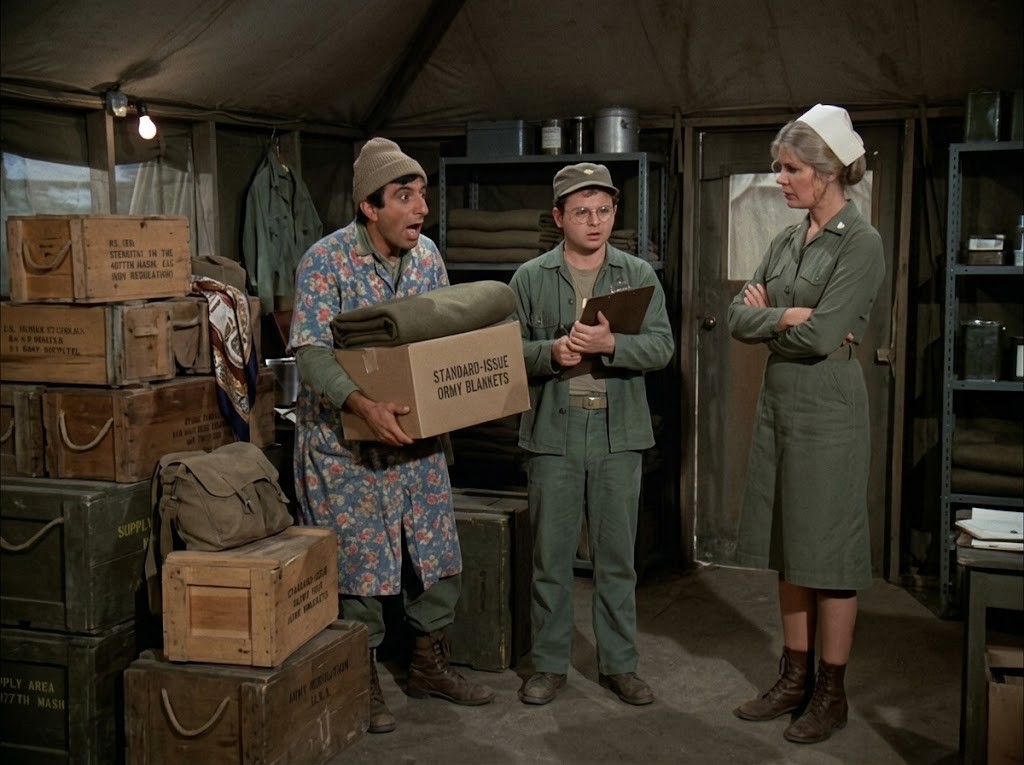
Some days in Korea, the cold didn’t just settle in the air; it crept right into your bones and refused to leave. The wind coming down from the mountains had a mean streak, rattling the canvas of the tents and reminding everyone exactly how far they were from home.
Inside the supply tent, under the dim glow of a single hanging bulb, a quiet battle of logistics and wills was unfolding.
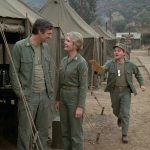
Major Margaret Houlihan stood with her arms tightly crossed, her posture as rigid as an inspection day flagpole. Her eyes were fixed on Corporal Maxwell Klinger, who was currently frozen in mid-protest, his mouth wide open in a mix of theatrical outrage and genuine desperation.
Klinger was clutching a cardboard box stenciled with the words “STANDARD-ISSUE ARMY BLANKETS.” On top of the box sat a neatly folded, heavy wool olive-drab blanket—the only shield the 4077th had against the biting autumn chill.
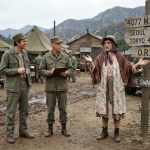
To complete the picture, Klinger was wearing a vibrant, floral-patterned blue dress over his green fatigues, topped with a brown knit beanie. It was a classic Klinger ensemble, designed to turn heads and, hopefully, earn him a one-way ticket back to Toledo, Ohio.
Standing right between them was Corporal Radar O’Reilly, looking like a private caught in a crossfire between two generals. Radar clutched his clipboard to his chest like a shield, his eyes darting nervously between the Major’s stern face and Klinger’s expressive eyes.
“I am counting the inventory, Corporal, and the math simply does not add up,” Margaret said, her voice cutting through the damp chill of the tent. “Three boxes of standard-issue blankets have vanished from the secondary grid, and here you are, caught red-handed with the final reserve.”
“Major, please! You’ve got it all wrong!” Klinger gasped, his Toledo accent thick with urgency. “I’m not hoarding, and I’m certainly not trying to bribe the transport drivers for a ride to Seoul this time. I swear on my mother’s stuffed grape leaves!”
“Then explain the discrepancy, Klinger,” Margaret demanded, stepping closer. “Every tent in this camp is freezing, the post-op ward is running low, and you are standing here looking like a botanical garden while hiding the very blankets our patients need.”
Radar cleared his throat, his voice cracking slightly. “Uh, Major, Ma’am… according to the morning manifest, the supply truck from Seoul was supposed to bring eighty extra wool linens, but they got diverted to the 8055th. Klinger was just… well, he was doing some creative adjusting.”
“Creative adjusting is another word for theft, Radar,” Margaret snapped, though her eyes softened just a fraction as she looked at the nervous company clerk. “We have an influx of casualties expected by nightfall, and the temperature is dropping by the minute. I cannot have supplies wandering off.”
Klinger took a step back, tightening his grip on the heavy cardboard box. His usual theatrical bravado seemed to crack, revealing a raw, exhausted vulnerability that rarely showed beneath the dresses and the jokes.
“They aren’t wandering off, Major,” Klinger whispered, his voice dropping its defensive edge. “They’re already gone. And if you make me put this last box back, there’s a little girl in the orphanage down the road who won’t make it through the frost tonight.”
The tent fell dead silent, the heavy canvas flapping loudly against the wooden frame as a sudden gust of wind howled outside, leaving Margaret staring at Klinger in stunned disbelief.
—
The silence stretched out, heavy and cold, broken only by the steady, rhythmic ticking of the clock on the wall and Radar’s shallow breathing. Margaret’s arms slowly uncrossed, her hands dropping to her sides as she processed Klinger’s words.
“The orphanage?” Margaret asked softly, the sharp edge completely vanishing from her voice. “Klinger, what are you talking about?”
Radar looked down at his clipboard, shifting his weight from one foot to the other. “It’s Kim Soo, Major. The little girl who lost her family near Uijeongbu last month. Father Mulcahy brought her to the local shelter, but the facility doesn’t have a working stove. The draft in there is terrible.”
Klinger nodded, his dark eyes wide and pleading as he looked at the strict head nurse. “I saw her yesterday when I dropped off the kitchen scraps for the local kids. She was shivering so hard she couldn’t even hold a piece of bread, Major. She’s only five years old.”
He adjusted his grip on the box of blankets, pulling it closer to his chest. “I know I’m a pain in the neck. I know I wear these outfits to get out of this army, and Heaven knows I want to go home so bad I can taste it. But I can’t sit in a warm tent knowing that kid is freezing to death.”
Margaret looked from Klinger to the cardboard box, then over to the stacks of olive-drab wooden crates lining the supply tent. She was a military woman through and through, raised on regulations, order, and absolute obedience to the chain of command.
But beneath the starched uniform and the fierce exterior beat the heart of a nurse who had dedicated her life to saving others. She knew the brutal reality of a Korean winter, and she knew what hypothermia did to a child’s small body.
“If Colonel Potter finds out we are short on winter inventory before the casualties arrive, we will all be facing a court-martial,” Margaret said, her voice steady but remarkably gentle.
“I’ve got some old sweaters from my Uncle Albert in Ohio,” Klinger offered quickly, a glimmer of hope returning to his face. “We can chop ’em up, sew ’em together, and use them to pad out the pre-op cots. They’re ugly enough to pass for army issue!”
A small, rare smile tugged at the corner of Margaret’s lips. She looked at Radar, who was watching her with wide, hopeful eyes behind his thick glasses.
“Corporal O’Reilly,” Margaret commanded, her professional tone returning, though it lacked any malice. “Log these three missing boxes as ‘damaged by water exposure during transport.’ Write it down as completely unusable and discarded.”
Radar’s face lit up like a Christmas tree. “Yes, Ma’am! Discarded due to severe moisture. Got it right here on the log!”
Margaret then turned her attention back to Klinger, who was staring at her as if she had just handed him a discharge paper signed by the President. She reached out and patted the top of the folded wool blanket resting on the box.
“And Klinger?” Margaret added, her voice dropping to a warm, maternal whisper. “Make sure you take the jeep. It’s too cold to walk that far in a dress. And tell Father Mulcahy that if he needs extra penicillin for the shelter, he knows where my tent is.”
Klinger’s mouth opened again, but this time, no words came out. For the first time since he had arrived in Korea, the fast-talking corporal from Toledo was completely speechless. A tear welled up in his eye, reflecting the dim light of the supply tent.
“Thank you, Major,” Klinger said quietly, giving her a respectful, dignified nod that transcended any regulation salute.
“Don’t make me regret it, Corporal. Now get out of here before I change my mind,” Margaret said, turning her back to sort through a stack of papers, though her shoulders relaxed significantly.
Klinger turned and quickly bustled out of the tent, the floral pattern of his dress disappearing into the gray, windy twilight of the compound, intent on delivering a piece of warmth to a cold world.
Radar looked up from his clipboard, watching the tent flap settle back into place, a quiet sense of pride filling the small room. In the middle of a forgotten war, surrounded by mud, blood, and endless fatigue, the 4077th always found a way to remain human.
—
Beneath the olive drab and the laughter, the true warmth of the 4077th was always found in the blankets of kindness they wrapped around each other.